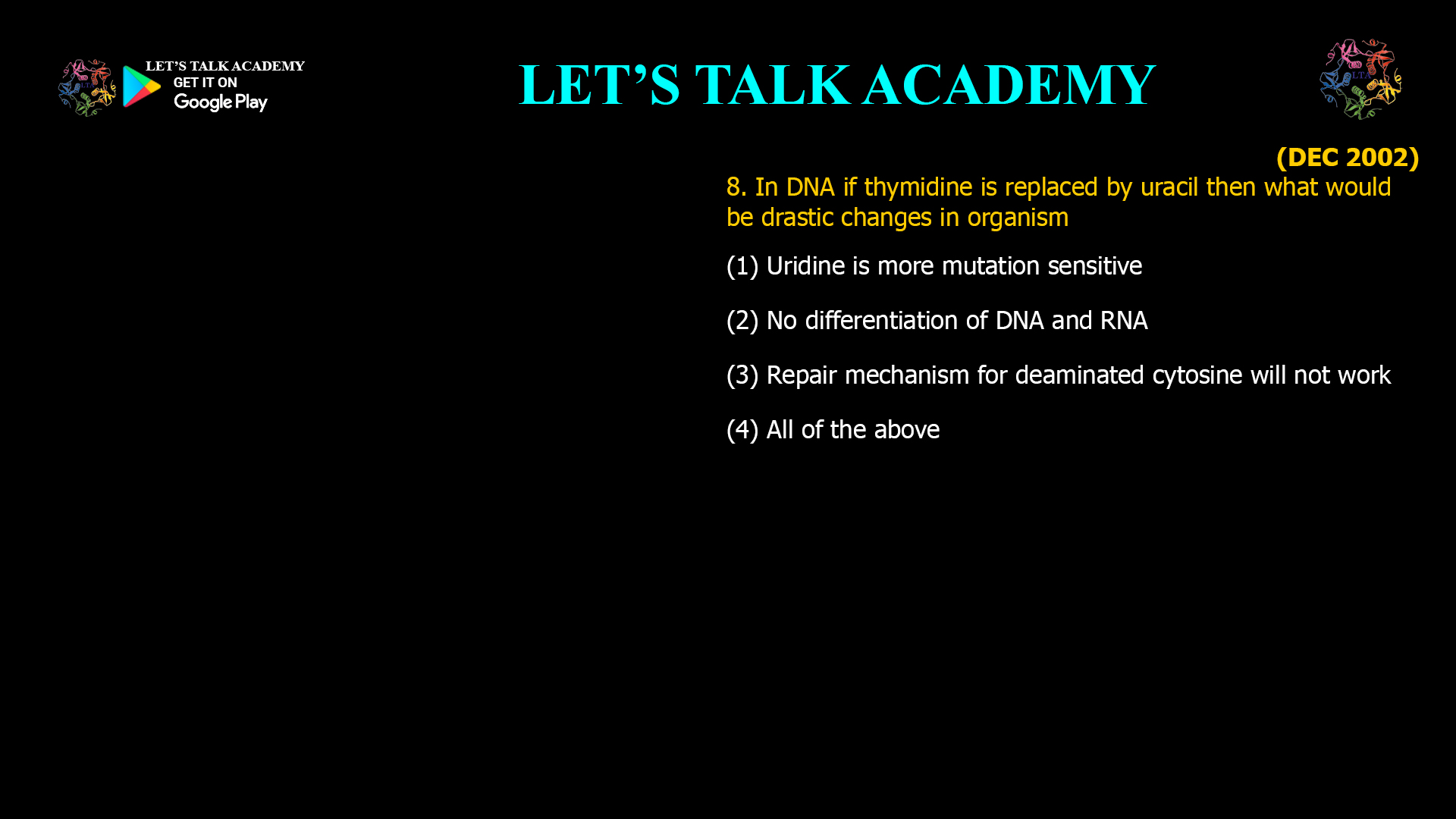
- In DNA if thymidine is replaced by uracil then what would be drastic changes in organism
(1) Uridine is more mutation sensitive
(2) No differentiation of DNA and RNA
(3) Repair mechanism for deaminated cytosine will not work
(4) All of the aboveWhat Happens When Thymidine Is Replaced by Uracil in DNA? Exploring the Drastic Changes in Organisms
DNA and RNA are the fundamental molecules of life, each with distinct roles and chemical compositions. While both contain four major nitrogenous bases, DNA uniquely uses thymine (T) instead of uracil (U), which is found in RNA. But what if thymidine in DNA were replaced by uracil? What would be the drastic consequences for an organism? This article explores the implications, the correct answer, and provides SEO-optimized content with relevant keywords.
The Chemical Difference: Thymine vs. Uracil
-
Thymine (T): A pyrimidine base found exclusively in DNA, thymine is essentially a methylated form of uracil (5-methyluracil).
-
Uracil (U): A pyrimidine base found exclusively in RNA, uracil lacks the methyl group present in thymine.
Despite their similarities—both pair with adenine—the presence of the methyl group in thymine has significant biological implications45.
Why Does DNA Use Thymine Instead of Uracil?
The evolutionary switch from uracil to thymine in DNA is not arbitrary. Several key reasons underpin this choice:
-
Protection Against Mutations:
-
Cytosine Deamination: Cytosine can spontaneously deaminate to form uracil. If DNA contained uracil naturally, this deamination would be indistinguishable from normal uracil, making it impossible for repair systems to detect and correct mutations34.
-
Uracil-DNA Glycosylase (UDG): This enzyme detects and removes uracil from DNA. If uracil were a normal base, UDG would indiscriminately remove it, leading to unnecessary DNA breaks and repair cycles4.
-
-
Genomic Stability:
-
Improved Base Pairing Fidelity:
-
Methyl Group Effect: The methyl group in thymine restricts its conformation, ensuring it only pairs with adenine, reducing mismatches during replication5.
-
Consequences of Replacing Thymidine with Uracil in DNA
If thymidine (the deoxyribonucleoside of thymine) were replaced by uracil in DNA, several drastic changes would occur:
1. Uridine Is More Mutation Sensitive
-
Mutation Rate Increase: Uracil in DNA would make the genome more prone to mutations. Since cytosine deamination produces uracil, the repair system would not be able to distinguish between “normal” uracil (from thymidine replacement) and “aberrant” uracil (from cytosine deamination)34.
-
Premutagenic Lesions: The inability to distinguish these uracils would lead to increased DNA strand breaks, apurinic/apyrimidinic (AP) sites, and genomic instability26.
2. No Differentiation of DNA and RNA
-
Chemical Identity: Both DNA and RNA would contain uracil, blurring the chemical distinction between them.
-
Functional Confusion: This could interfere with processes that rely on the distinction between DNA and RNA, such as transcription, reverse transcription, and viral infection45.
3. Repair Mechanism for Deaminated Cytosine Will Not Work
-
UDG Function: Uracil-DNA glycosylase normally removes uracil resulting from cytosine deamination. If uracil were a natural base in DNA, UDG would remove all uracils, including those replacing thymine, leading to excessive DNA damage and repair cycles34.
-
Futile Repair Cycles: The repair system would be overwhelmed, resulting in DNA fragmentation and cell death, a phenomenon observed in “thymine-less cell death” in experimental settings6.
4. All of the Above
-
Comprehensive Impact: All the above consequences would occur simultaneously, leading to a catastrophic loss of genomic integrity and cellular function.
The Correct Answer
Option (4): All of the above
Replacing thymidine with uracil in DNA would make the genome more mutation-sensitive, eliminate the chemical distinction between DNA and RNA, and render the repair mechanism for deaminated cytosine ineffective. These combined effects would have drastic and detrimental consequences for the organism346.
Related Keywords for SEO Optimization
-
Thymidine vs uracil in DNA
-
Uracil in DNA consequences
-
DNA mutation sensitivity
-
Uracil-DNA glycosylase (UDG)
-
Cytosine deamination
-
DNA repair mechanism
-
Genomic stability
-
Thymine-less cell death
-
DNA and RNA chemical difference
-
Premutagenic lesions
-
DNA strand breaks
-
Uracil misincorporation
-
DNA repair enzymes
-
Evolution of thymine in DNA
-
Mutation rate in DNA
-
DNA fragmentation
-
Cellular genomic integrity
Conclusion
Replacing thymidine with uracil in DNA would have severe consequences for any organism. The genome would become more mutation-sensitive, the distinction between DNA and RNA would be lost, and the repair mechanism for deaminated cytosine would fail, leading to genomic instability and cell death. Therefore, the correct answer is option (4): All of the above.
-


15 Comments
Roopal Sharma
November 7, 2025All of the above 4th option is correct
Kirti Agarwal
November 7, 2025Uracil is more sensitive for mutation
Repair cycle for deaminated cytosine doesn’t work
No difference between DNA and RNA
Deepika Sheoran
November 7, 2025Uridine is more mutation sensitive.
No differentiation of DNA and RNA .
Repair mechanism for deaminated cytosine will not work.
sakshivijay
November 7, 2025all of the above is correct
1 uridine is more mutation sensitive
2 no differentiation of dna and rna
3 repair mechanism for deaminated cytosine will not work
Neelam Sharma
November 7, 2025All of the above
Rishita
November 8, 2025All of the above
Dipti Sharma
November 8, 2025All of the above.
Mohd juber Ali
November 8, 2025All of the above will be drastic changes in an organism
Divya rani
November 8, 2025All changes will happen.
Anisha Beniwal
November 8, 2025All of the above
Heena Mahlawat
November 9, 2025All of the above
Avni
November 10, 2025Option (4): All of the above
Neeraj Sharma
November 12, 2025All of the above
Muskan Yadav
November 12, 2025Option (4): All of the above
Komal Sharma
November 17, 2025Replacing thymidine with uracil in DNA would have severe consequences for any organism. The genome would become more mutation-sensitive, the distinction between DNA and RNA would be lost, and the repair mechanism for deaminated cytosine would fail, leading to genomic instability and cell death. Therefore, the correct answer is 4th