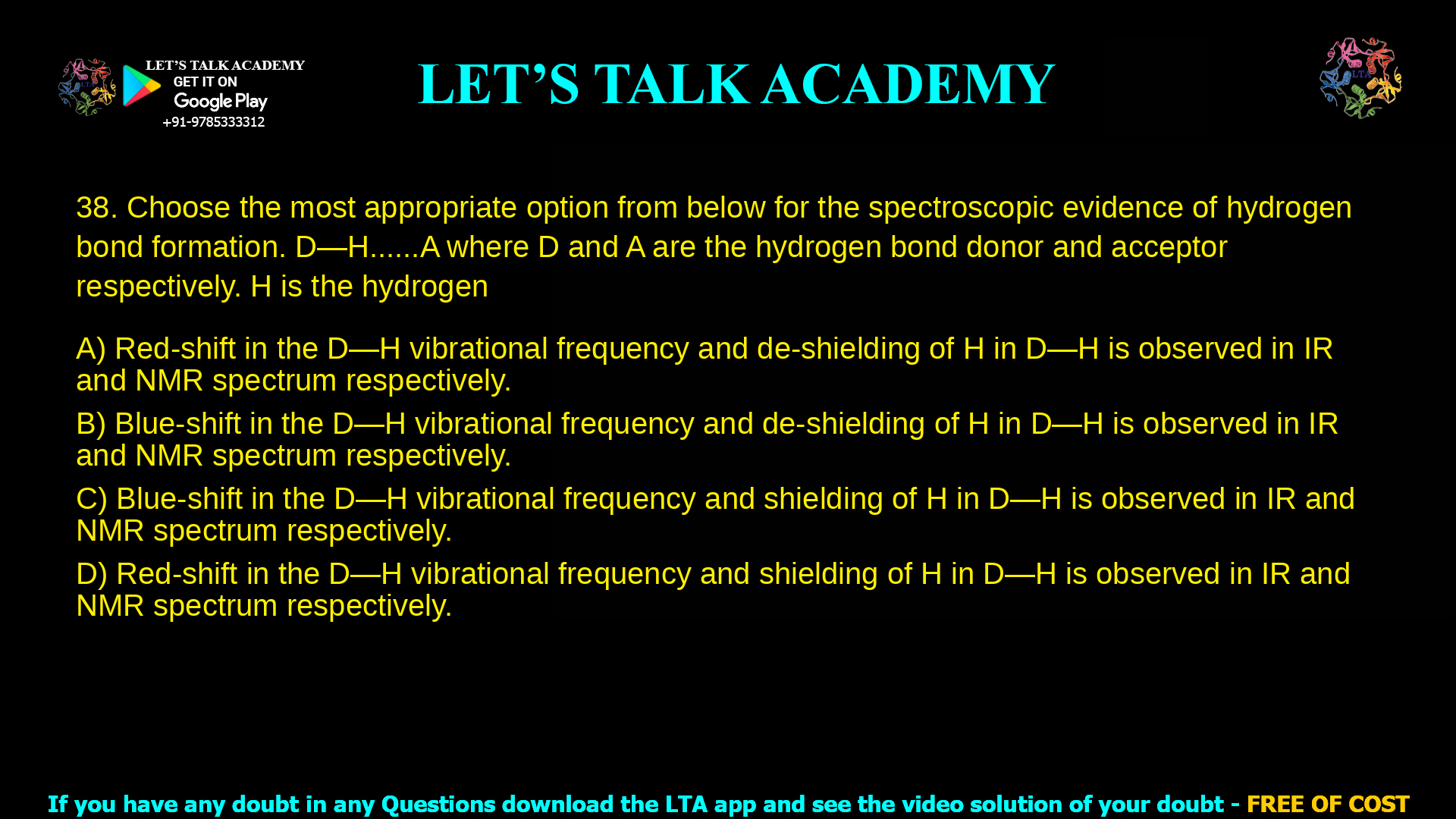
Choose the most appropriate option from below for the spectroscopic evidence
of hydrogen bond formation. D—H……A where D and A are the hydrogen bond
donor and acceptor respectively. H is the hydrogen atom.
Red-shift in the D—H vibrational frequency and de-shielding of H in D—H
is observed in IR and NMR spectrum respectively.
Blue-shift in the D—H vibrational frequency and de-shielding of H in D—H
is observed in IR and NMR spectrum respectively.
Blue-shift in the D—H vibrational frequency and shielding of H in D—H is
observed in IR and NMR spectrum respectively.
Red-shift in the D—H vibrational frequency and shielding of H in D—H is
observed in IR and NMR spectrum respectively.
The most appropriate option is: Red-shift in the D–H vibrational frequency and de-shielding of H in D–H is observed in IR and NMR spectrum respectively. This is the classical spectroscopic signature of hydrogen bond formation for a normal (red-shifting) hydrogen bond.
Introduction
Spectroscopic evidence of hydrogen bond formation in a system of the type D–H…A (D = donor, A = acceptor) is classically recognized by changes in the D–H bond’s IR stretching frequency and the NMR chemical shift of the hydrogen atom. In most conventional hydrogen bonds, formation of D–H…A weakens and lengthens the D–H bond, causing a red-shift in IR and deshielding (downfield shift) of the hydrogen in NMR.
What happens on hydrogen bond formation?
When a hydrogen bond D–H…A forms, electron density from the acceptor A interacts with the antibonding orbital of the D–H bond, weakening and slightly lengthening the D–H covalent bond. A weaker, longer bond vibrates at a lower frequency, so the D–H stretching band shifts to lower wavenumber (red-shift), usually with increased intensity in IR, and the proton experiences a more deshielded environment, shifting downfield in NMR.
Analysis of each option
Option 1: Red-shift + deshielding (correct)
-
Statement: Red-shift in the D–H vibrational frequency and de-shielding of H in D–H is observed in IR and NMR spectrum respectively.
-
IR behavior: In a classical hydrogen bond, the D–H bond is weakened and elongated, so its stretching frequency decreases (red-shift) and the band often becomes broader and more intense.
-
NMR behavior: The hydrogen now engages in a strong interaction with the acceptor A, feels a more electron-poor and anisotropic environment, and shows a downfield shift (deshielding) in the ^1H NMR spectrum.
-
Conclusion: This option correctly describes classical, red-shifting hydrogen bonds and is the most appropriate answer for typical D–H…A hydrogen bonds.
Option 2: Blue-shift + deshielding (particular, not general)
-
Statement: Blue-shift in the D–H vibrational frequency and de-shielding of H in D–H is observed in IR and NMR spectrum respectively.
-
IR behavior: Blue-shifting hydrogen bonds do exist; in such unusual systems, the D–H bond is effectively strengthened and shortened, giving a higher stretching frequency (blue-shift).
-
NMR behavior: In many blue-shifting H-bonds, the proton may not show the same pronounced downfield deshielding as in classical H-bonds, and the pattern can be system-dependent.
-
Conclusion: While blue-shifting hydrogen bonds are real, they are not the standard spectroscopic signature taught for “hydrogen bond formation” in general, so this is not the most appropriate option for the question.
Option 3: Blue-shift + shielding (incorrect for classical H-bonds)
-
Statement: Blue-shift in the D–H vibrational frequency and shielding of H in D–H is observed in IR and NMR spectrum respectively.
-
IR behavior: A blue-shift implies a strengthened D–H bond, which is the hallmark of a special class of hydrogen bonds, not the usual case.
-
NMR behavior: Shielding (upfield shift) of the proton is opposite to the characteristic downfield movement generally used as evidence for regular D–H…A hydrogen bonding.
-
Conclusion: This combination does not describe the classical spectroscopic evidence of hydrogen bond formation and is therefore inappropriate as a general answer.
Option 4: Red-shift + shielding (internally inconsistent for classical H-bonds)
-
Statement: Red-shift in the D–H vibrational frequency and shielding of H in D–H is observed in IR and NMR spectrum respectively.
-
IR behavior: Red-shift is correct for conventional hydrogen bonding, reflecting bond weakening and elongation.
-
NMR behavior: However, shielding (upfield shift) would mean the proton experiences a more electron-rich or magnetically protected environment, which contradicts the typical downfield movement used to identify strong D–H…A hydrogen bonds.
-
Conclusion: Mixing a correct IR trend (red-shift) with an incorrect NMR trend (shielding) makes this option wrong for standard hydrogen bond evidence.
Summary: why Option 1 is best
For a generic hydrogen bond of the type D–H…A, the most widely accepted “textbook” spectroscopic signature is:
-
IR: Red-shift (lower wavenumber) and often increased intensity of the D–H stretching band.
-
NMR: Deshielding (downfield chemical shift) of the hydrogen atom involved in the hydrogen bond.
Therefore, “Red-shift in the D–H vibrational frequency and de-shielding of H in D–H” is the most appropriate choice as the spectroscopic evidence for hydrogen bond formation in a D–H…A system.


