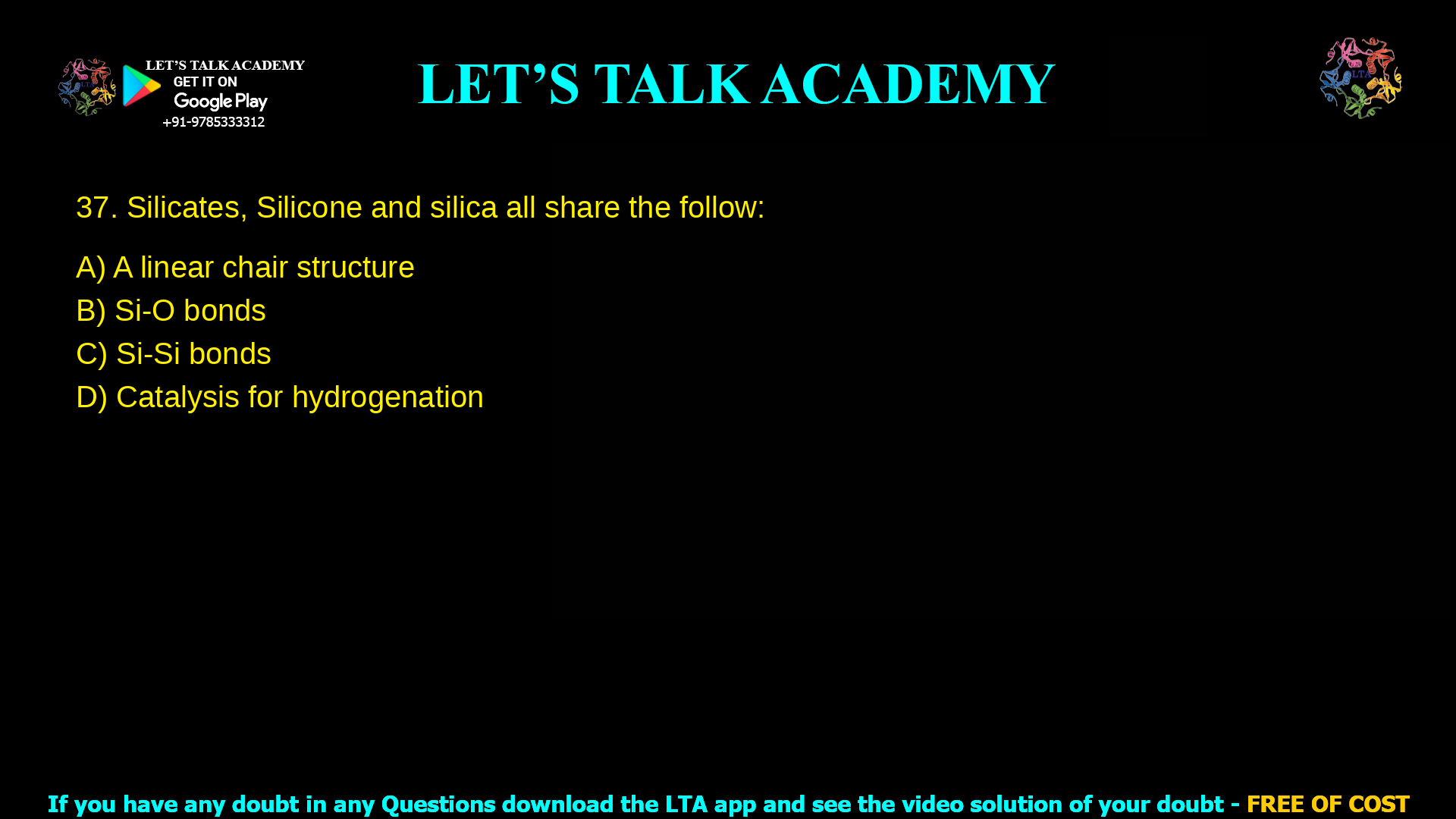
Silicates, Silicone and silica all share the follow:
A linear chair structure
Si-O bonds
Si-Si bonds
Catalysis for hydrogenation
All three – silicates, silicone and silica – contain Si–O (silicon–oxygen) bonds, so the common feature is Si–O bonds.
Introduction
Silicates, silicone and silica are three major classes of silicon‑based materials that appear in mineralogy, materials science and industrial chemistry. Understanding which structural feature they share is a common conceptual question in inorganic chemistry and JEE/NEET type exams.
In the given MCQ, the options are:
-
A linear chain structure
-
Si–O bonds
-
Si–Si bonds
-
Catalysis for hydrogenation
Only one is correct for all three substances.
Option 1: Linear chain structure
Silicates are a broad family of minerals based on SiO44− tetrahedra, which can exist as isolated units, rings, single chains, double chains, sheets or 3‑D frameworks, not always linear chains.
Silica (SiO₂) in its common forms (quartz, cristobalite etc.) is a 3‑D network of SiO4 tetrahedra, not a simple linear chain, and silicones are polymers that can be linear, cyclic or cross‑linked depending on the formulation.
So, “a linear chain structure” is not common to all three, because:
-
Many silicates have sheet or 3‑D framework structures, not linear chains.
-
Silica is a 3‑D network solid.
-
Silicones may be linear, cyclic, or cross‑linked polymers.
Option 2: Si–O bonds (correct)
Silicates are all based on silicon–oxygen tetrahedra; every silicate mineral contains strong Si–O bonds in SiO4 units.
Silica (SiO₂) is likewise a continuous network of Si–O–Si linkages, where each Si is tetrahedrally surrounded by O atoms, giving a classic Si–O bonded structure.
Silicones (polysiloxanes) are polymers whose backbone is an alternating –Si–O–Si–O– chain; this repeating siloxane bond is the defining feature of silicone materials.
Therefore, all three—silicates, silicone and silica—contain Si–O bonds, making this the correct shared property.
Correct answer: Si–O bonds
Option 3: Si–Si bonds
Some organosilicon compounds and certain specialized silicon materials contain direct Si–Si bonds, but these are not a general or defining feature of silicates or silica.
Silicates and silica are dominated by Si–O–Si linkages rather than Si–Si bonds, and typical silicone polymers also have Si atoms separated by oxygen in the backbone, not directly bonded Si–Si along the chain.
So, Si–Si bonds are not a common structural element in all three.
Option 4: Catalysis for hydrogenation
Hydrogenation (or hydrosilylation) typically employs metal catalysts like Pt, Pd, Ni, or supported catalysts; pure silica or silicates are mainly used as supports or fillers rather than as universal hydrogenation catalysts themselves.
Silicones are widely used as lubricants, sealants and elastomers, not as general hydrogenation catalysts, so catalysis for hydrogenation is not a shared intrinsic property of silicates, silicones and silica.
Comparison table
| Feature / Substance | Silicates | Silica (SiO₂) | Silicone (polysiloxane) |
|---|---|---|---|
| Basic building unit | SiO₄ tetrahedra | SiO₄ network | –Si–O–Si– backbone |
| Si–O bonds present? | Yes | Yes | Yes |
| Linear chain structure? | Only some (inosilicates) | No, 3‑D network | Some grades, but also cyclic/cross‑linked |
| Si–Si bonds typical? | No, mainly Si–O–Si | No | Not backbone‑defining |
| Hydrogenation catalyst? | Not generally | Mostly support/filler | Not a standard role |
The only feature shared by all three is the presence of Si–O bonds.


