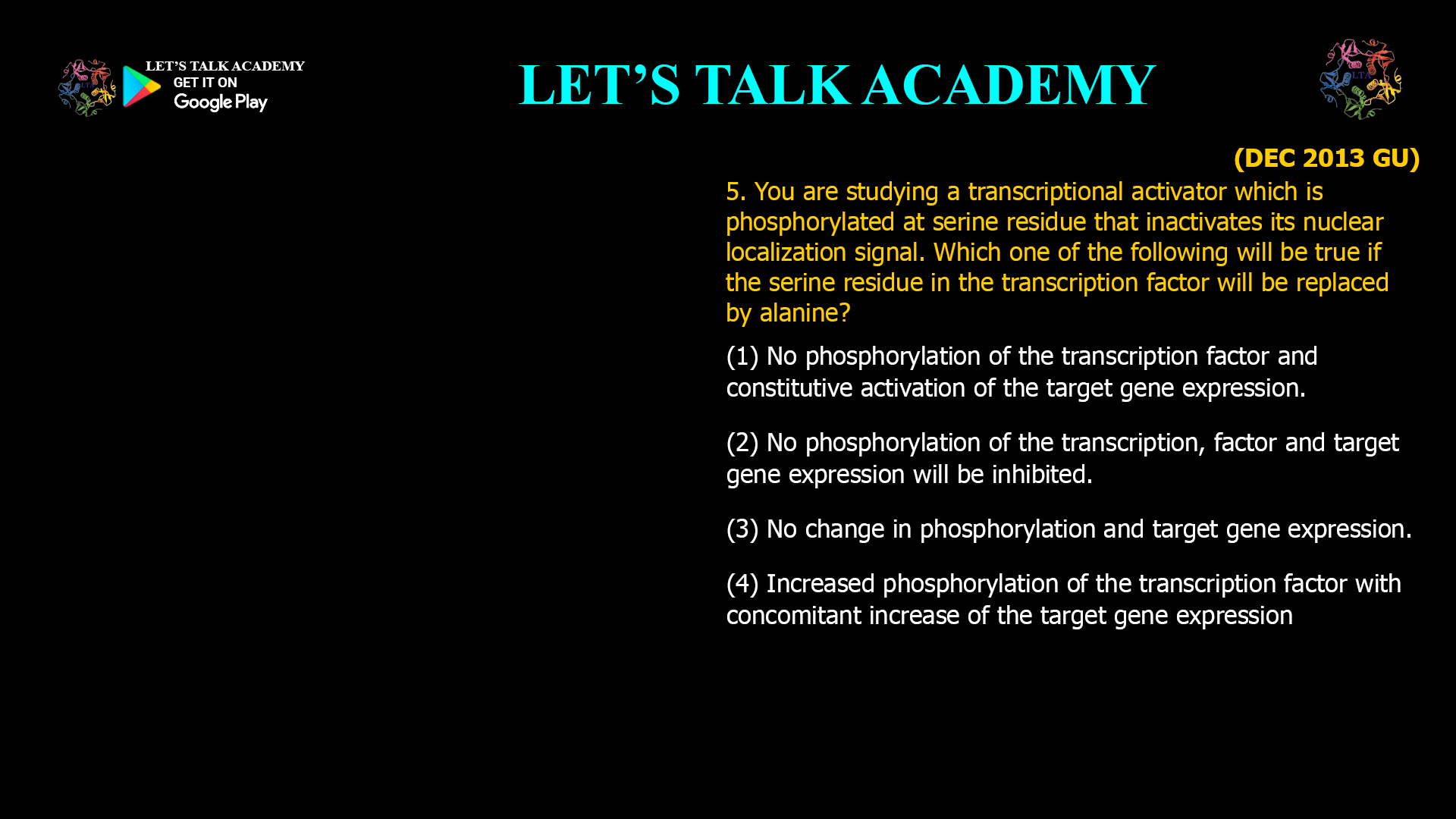
5. You are studying a transcriptional activator which is phosphorylated at serine residue that inactivates its nuclear localization signal. Which one of the following will be true if the serine residue in the transcription factor will be replaced by alanine?
(1) No phosphorylation Of the transcription factor and constitutive activation of the target gene expression.
(2) No phosphorylation of the transcription, factor and target gene expression will be inhibited.
(3) No change in phosphorylation and target gene expression.
(4) Increased phosphorylation of the transcription factor with concomitant increase of the target gene expression
Introduction
Transcriptional regulation is a fundamental process in all living cells, ensuring that genes are expressed at the right time and in the right place. Transcription factors play a crucial role in this regulation by binding to specific DNA sequences and activating or repressing gene expression. The activity of many transcription factors is controlled by post-translational modifications, such as phosphorylation, which can alter their localization, stability, or ability to interact with other proteins. In this article, we will explore how a specific mutation—replacing a serine residue with alanine—can affect the function of a transcription activator, particularly its nuclear localization and transcriptional activity.
The Role of Phosphorylation in Transcription Factor Regulation
Phosphorylation is a common post-translational modification that can regulate the function of many proteins, including transcription factors. By adding a phosphate group to specific amino acids—most often serine, threonine, or tyrosine—cells can rapidly change the activity, localization, or stability of these proteins. In the context of transcription factors, phosphorylation can have several effects, such as:
-
Activating or inhibiting DNA binding
-
Promoting or preventing nuclear localization
-
Enhancing or blocking interactions with other proteins
In the scenario described, phosphorylation of a serine residue inactivates the nuclear localization signal (NLS) of a transcription activator. As a result, the transcription factor cannot enter the nucleus and is unable to activate its target genes.
The Importance of Nuclear Localization
For a transcription factor to regulate gene expression, it must be present in the nucleus, where it can access the DNA. The nuclear localization signal (NLS) is a short amino acid sequence that directs the protein to the nucleus. When the NLS is active, the transcription factor is transported into the nucleus. If the NLS is inactivated—for example, by phosphorylation—the transcription factor remains in the cytoplasm and cannot activate its target genes.
The Effect of a Serine-to-Alanine Mutation
Alanine is a non-polar amino acid that cannot be phosphorylated. By replacing a serine residue with alanine, the transcription factor can no longer be phosphorylated at that site. In the scenario described, this means:
-
The NLS cannot be inactivated by phosphorylation.
-
The transcription factor will always be able to enter the nucleus.
-
The transcription factor will constitutively activate its target genes, regardless of the presence of signals that would normally lead to phosphorylation.
This type of mutation is often used in molecular biology to study the role of specific phosphorylation sites in protein function.
Analyzing the Options
Let’s revisit the options presented in the question and analyze them in light of the above explanation:
1. No phosphorylation of the transcription factor and constitutive activation of the target gene expression.
-
Explanation: The serine-to-alanine mutation prevents phosphorylation, so the NLS remains active. The transcription factor can always enter the nucleus and activate its target genes.
-
Conclusion: Correct.
2. No phosphorylation of the transcription factor and target gene expression will be inhibited.
-
Explanation: If the NLS is not inactivated, the transcription factor can enter the nucleus and activate target genes. Inhibition would not occur.
-
Conclusion: Incorrect.
3. No change in phosphorylation and target gene expression.
-
Explanation: The mutation prevents phosphorylation at the serine residue; there is a change in phosphorylation status.
-
Conclusion: Incorrect.
4. Increased phosphorylation of the transcription factor with concomitant increase of the target gene expression.
-
Explanation: The mutation prevents phosphorylation at that site; phosphorylation cannot increase.
-
Conclusion: Incorrect.
Biological and Practical Implications
Understanding how post-translational modifications regulate transcription factors is essential for both basic research and applied fields such as biotechnology and medicine. By manipulating specific amino acids, researchers can create mutant proteins that are always active or always inactive, allowing them to study the effects of these proteins on gene expression and cellular processes.
For example, a serine-to-alanine mutation in a transcription factor can be used to study the consequences of constitutive nuclear localization and activation. This approach is valuable for identifying the genes regulated by the transcription factor and for understanding the signaling pathways that control its activity.
Examples from the Literature
While the specific scenario described in the question is a classic example of how phosphorylation regulates nuclear localization, similar mechanisms have been observed in many transcription factors and signaling proteins. For instance:
-
STAT proteins: Phosphorylation of specific serine residues can modulate their transcriptional activity and nuclear localization, depending on the cellular context5.
-
Rel/NF-κB transcription factors: Mutations of serine residues to alanine can affect their transforming and transcriptional activities, although the effects may vary depending on the specific residue and the biological context79.
These examples highlight the importance of phosphorylation in regulating transcription factor function and the potential consequences of mutations that prevent phosphorylation.
Conclusion
Replacing a serine residue with alanine in a transcription factor prevents phosphorylation at that site. If phosphorylation normally inactivates the nuclear localization signal, this mutation will result in constitutive nuclear localization and activation of the transcription factor. As a result, the target genes will be expressed continuously, regardless of the signals that would normally inhibit the transcription factor.
Therefore, the correct answer is:
(1) No phosphorylation of the transcription factor and constitutive activation of the target gene expression.


