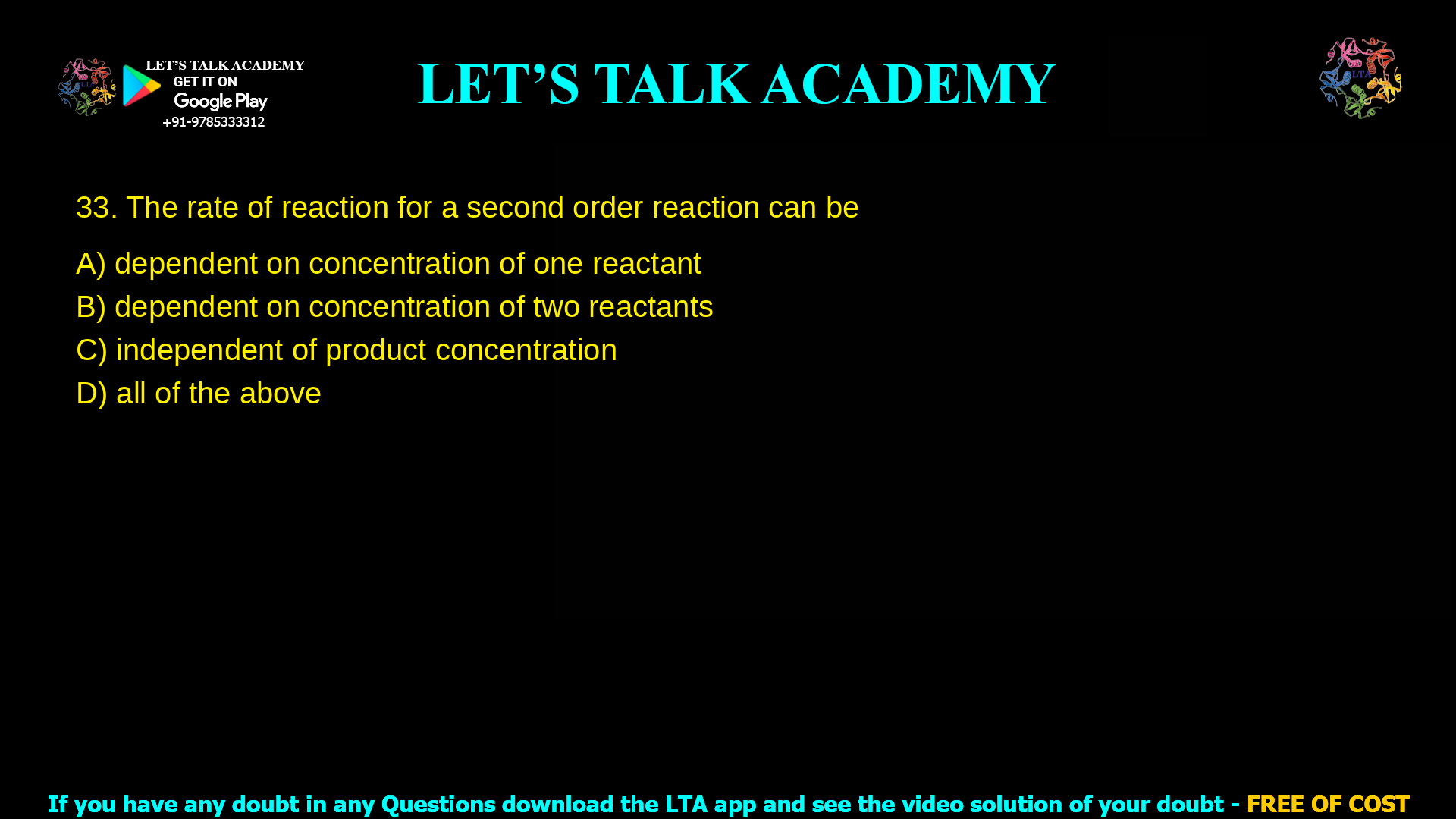
The rate of reaction for a second order reaction can be
dependent on concentration of one reactant
dependent on concentration of two reactants
independent of product concentration
all of the above
The correct answer is: (d) all of the above. For a second‑order reaction, the rate can depend on the concentration of one reactant, on the concentrations of two reactants, and it is independent of product concentration in the elementary rate law.
Introduction
The rate of reaction for a second order reaction is a core concept in chemical kinetics that often appears in competitive exams and university chemistry courses. In such reactions, the rate depends on reactant concentrations in a specific way, which can involve either a single reactant or two different reactants, but not the product concentration in the basic rate law.
What is a second order reaction?
A second order reaction is one in which the overall order of reaction is two, meaning the sum of the powers of concentration terms in the rate law equals 2. This can occur either as rate = k[A]2 (second order in one reactant) or as rate = k[A][B] (first order in each of two reactants).
Typical features include:
- Rate is strongly dependent on reactant concentration(s).
- Units of the rate constant are usually L mol-1s-1.
Option (a): Dependent on concentration of one reactant
In many second order reactions, the rate depends on the square of the concentration of a single reactant. The general form is:
Rate = k[A]2
Here the reaction is second order with respect to A, and the overall order is 2.
Key implications:
- If [A] is doubled, the rate becomes four times (22) the original rate.
- If [A] is halved, the rate becomes one-fourth of the original rate.
Therefore, “dependent on concentration of one reactant” is correct for one common type of second order reaction.
Option (b): Dependent on concentration of two reactants
Another frequent situation is where the rate law is:
Rate = k[A][B]
In this case the reaction is first order in A and first order in B, giving an overall second order (1 + 1 = 2).
Important points:
- The rate depends on both reactant concentrations; any change in either [A] or [B] changes the rate.
- For example, doubling [A] at constant [B] doubles the rate, and doubling both [A] and [B] makes the rate four times.
Thus, “dependent on concentration of two reactants” is also correct for second order reactions.
Option (c): Independent of product concentration
Rate laws in chemical kinetics are written in terms of reactant concentrations only, for elementary or empirically determined rate laws. For a second order reaction, the standard form is either k[A]2 or k[A][B], so the product concentration does not appear in the rate law.
Key ideas:
- The rate of a forward second order reaction is independent of product concentration in its basic rate expression.
- Product concentration may matter in equilibrium expressions, but not in the simple kinetic rate law for the forward reaction.
Therefore, “independent of product concentration” is also a correct statement for the usual rate law of a second order reaction.
Option (d): All of the above (correct answer)
Because:
- A second order reaction can be second order in one reactant: rate = k[A]2.
- A second order reaction can be first order in two different reactants: rate = k[A][B].
- The rate law for such reactions does not contain product concentration, so it is independent of product concentration.
All three statements in options (a), (b), and (c) are simultaneously valid descriptions of second order reaction rate dependence. Hence, the correct choice is (d) all of the above.
Quick comparison table
| Aspect | One-reactant second order (k[A]2) | Two-reactant second order (k[A][B]) |
|---|---|---|
| Reactants in rate law | Only A appears | Both A and B appear |
| Order with respect to each species | Second order in A | First order in A and first in B |
| Overall order | 2 | 2 |
| Dependence on product concentration | No dependence | No dependence |
This analysis matches the exam-style question and supports choosing “all of the above” as the final answer.


