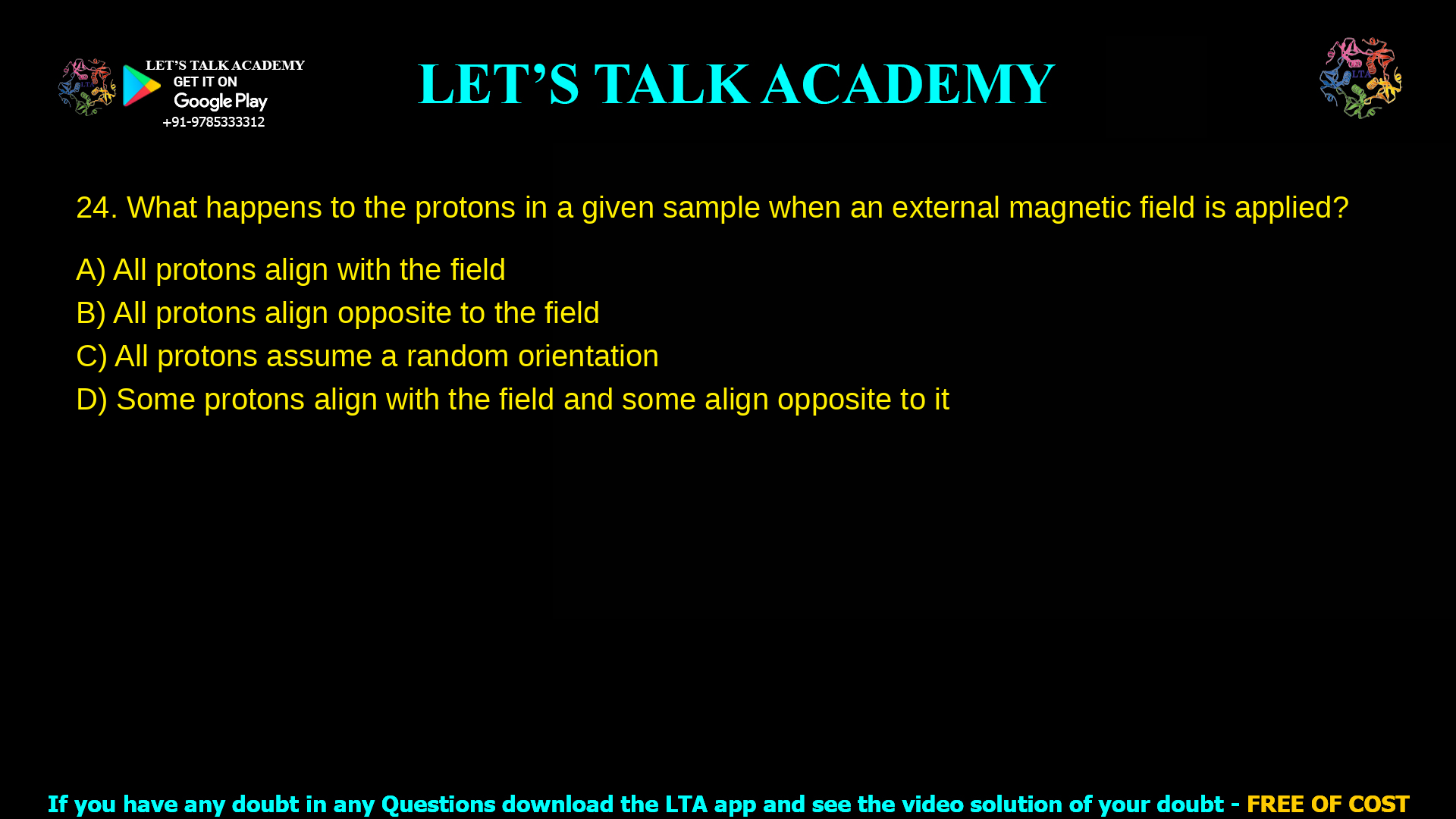
What happens to the protons in a given sample when an external magnetic field
is applied?
All protons align with the field
All protons align opposite to the field
All protons assume a random orientation
Some protons align with the field and some align opposite to it
When an external magnetic field is applied to a sample, some protons align with the field and some align opposite to it, creating two distinct spin states (parallel and antiparallel) with a slight excess in the lower-energy parallel orientation due to Boltzmann distribution.
Correct Answer Explanation
Protons possess intrinsic spin, generating a magnetic moment that behaves like a tiny bar magnet. In the absence of a field, spins are random, but the external field (B0) induces Zeeman splitting, favoring two quantized states: low-energy alignment parallel to B0 (spin-up) and high-energy antiparallel (spin-down). A small net magnetization arises from more protons in the parallel state, essential for NMR and MRI signal detection.
Option Analysis
-
All protons align with the field: Incorrect, as this ignores the quantum two-state nature; full alignment would eliminate detectable signals in NMR by lacking population difference.
-
All protons align opposite to the field: Incorrect, since antiparallel is higher energy; thermal equilibrium prevents total dominance of this unstable state.
-
All protons assume a random orientation: Incorrect post-field application; randomness occurs only without B0, as torque aligns spins into discrete orientations.
-
Some protons align with the field and some align opposite to it: Correct, reflecting spin-1/2 proton behavior with near-equal populations (ratio ~1:1 at room temperature, slight parallel bias).
NMR and MRI Applications
This partial alignment underpins nuclear magnetic resonance (NMR) spectroscopy and magnetic resonance imaging (MRI), where radiofrequency pulses excite the spin imbalance, producing measurable signals after relaxation. Stronger fields increase energy splitting (Larmor frequency), enhancing resolution for molecular structure analysis in biochemistry and medical diagnostics. For CSIR NET Life Sciences aspirants, mastering this concept links to biomolecular studies like protein folding and enzyme kinetics via 1H-NMR.


