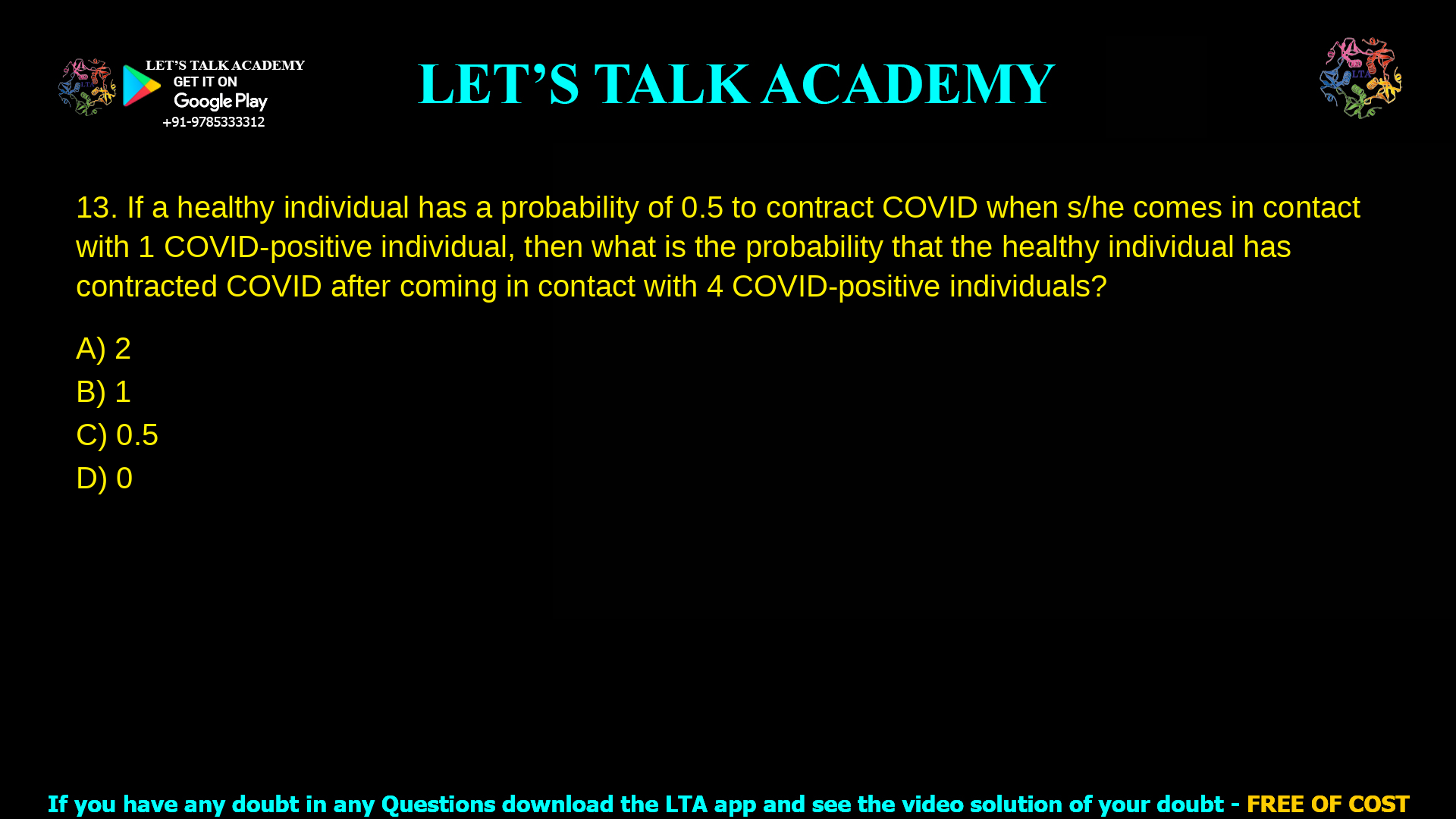
If a healthy individual has a probability of 0.5 to contract COVID when s/he
comes in contact with 1 COVID-positive individual, then what is the probability
that the healthy individual has contracted COVID after coming in contact with 4
COVID-positive individuals?
2
1
0.0625
0.9375
0.54 = 0.0625), so 1 - 0.0625 = 0.9375.
Problem Setup
Each contact represents an independent Bernoulli trial with success probability p = 0.5 (contracting COVID).[web:10] The query seeks P(at least one infection) after n = 4 trials, not the binomial probability of exactly k successes. Independence assumes no immunity buildup or overlapping exposures, common in simplified transmission models.
Calculation Method
Calculate P(not infected) = (1 - p)n = 0.54 = 0.0625.[execute_python] Then P(infected) = 1 - 0.0625 = 0.9375.[execute_python] This avoids summing binomial terms P(X ≥ 1) = 1 - P(X=0), efficient for “at least one” events.
Option Analysis
- 2: Exceeds probability bounds (0-1), impossible.
- 1: Assumes certain infection, ignores 0.0625 chance of avoiding all.
- 0.0625: Probability of zero infections, not at least one.
- 0.9375: Correct, as
1 - (0.5)4.
Options Summary Table
| Option | Represents | Correct? |
|---|---|---|
| 2 | Invalid (>1) | No |
| 1 | Certain infection | No |
| 0.0625 | No infections | No |
| 0.9375 | At least one | Yes |
CSIR NET Context
Such problems test probability complements and independence, key for life sciences exams modeling disease spread or enzyme binding.[web:1] Real transmission varies (e.g., 0.25-0.36 per household contact), but hypothetical uses fixed 0.5.


