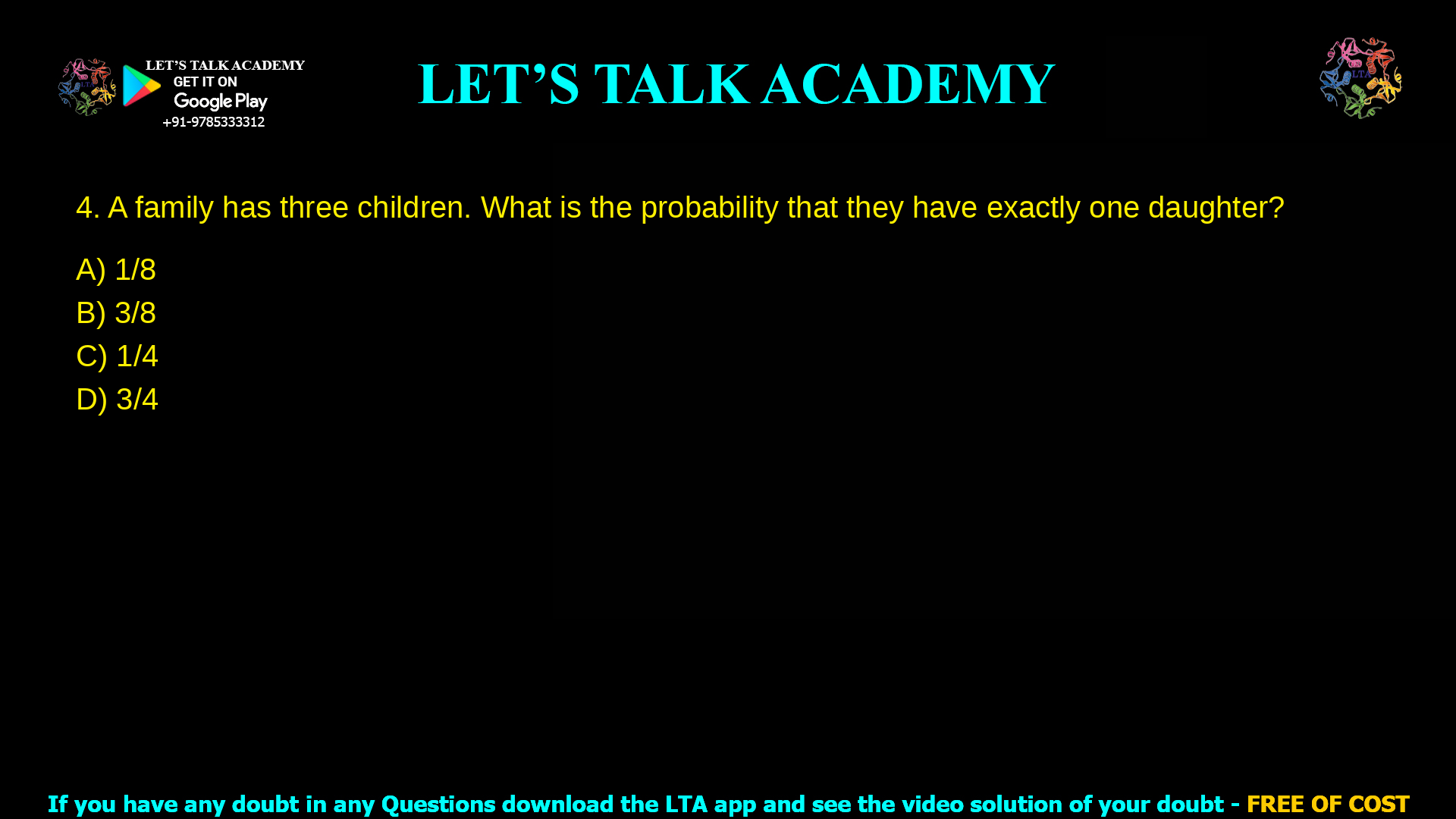
A family has three children. What is the probability that they have exactly one
daughter?
1/8
3/8
1/4
3/4
🎯 Correct Answer: 3/8
The probability that a family with three children has exactly one daughter is 3/8.
This assumes boys (B) and girls (G) are equally likely (probability 1/2 each) and births are independent.
📊 Sample Space Analysis
All possible outcomes for three children form 2³ = 8 equally likely combinations:
BBB, BBG, BGB, GBB, BGG, GBG, GGB, GGG.
Exactly one daughter occurs in: BBG, BGB, GBB—three cases.
Thus, probability = 3/8 = 0.375.
Using binomial formula: P(X=1) = C(3,1) × (1/2)¹ × (1/2)² = 3 × (1/8) = 3/8,
where C(3,1)=3 ways to choose the girl’s position.
✅ Option Breakdown
| Option | Represents | Correct for Exactly One Daughter? | Explanation |
|---|---|---|---|
| 1/8 | All three daughters (GGG) or specific sequence | ❌ No | Probability of all three daughters (GGG) or all sons (BBB), or specific sequence like GBB only. |
| 3/8 | Exactly one daughter (BBG, BGB, GBB) | ✅ YES | Matches exactly one daughter (3 favorable outcomes). CORRECT ANSWER. |
| 1/4 | Grouped outcomes assumption | ❌ No | Assumes four grouped outcomes (0,1,2,3 daughters) equally likely, but 1-girl (3 ways) has probability 3/8, not 1/4. |
| 3/4 | At least one daughter | ❌ No | Probability of at least one daughter (7/8) or exactly two daughters (3/8), but not exactly one. |


