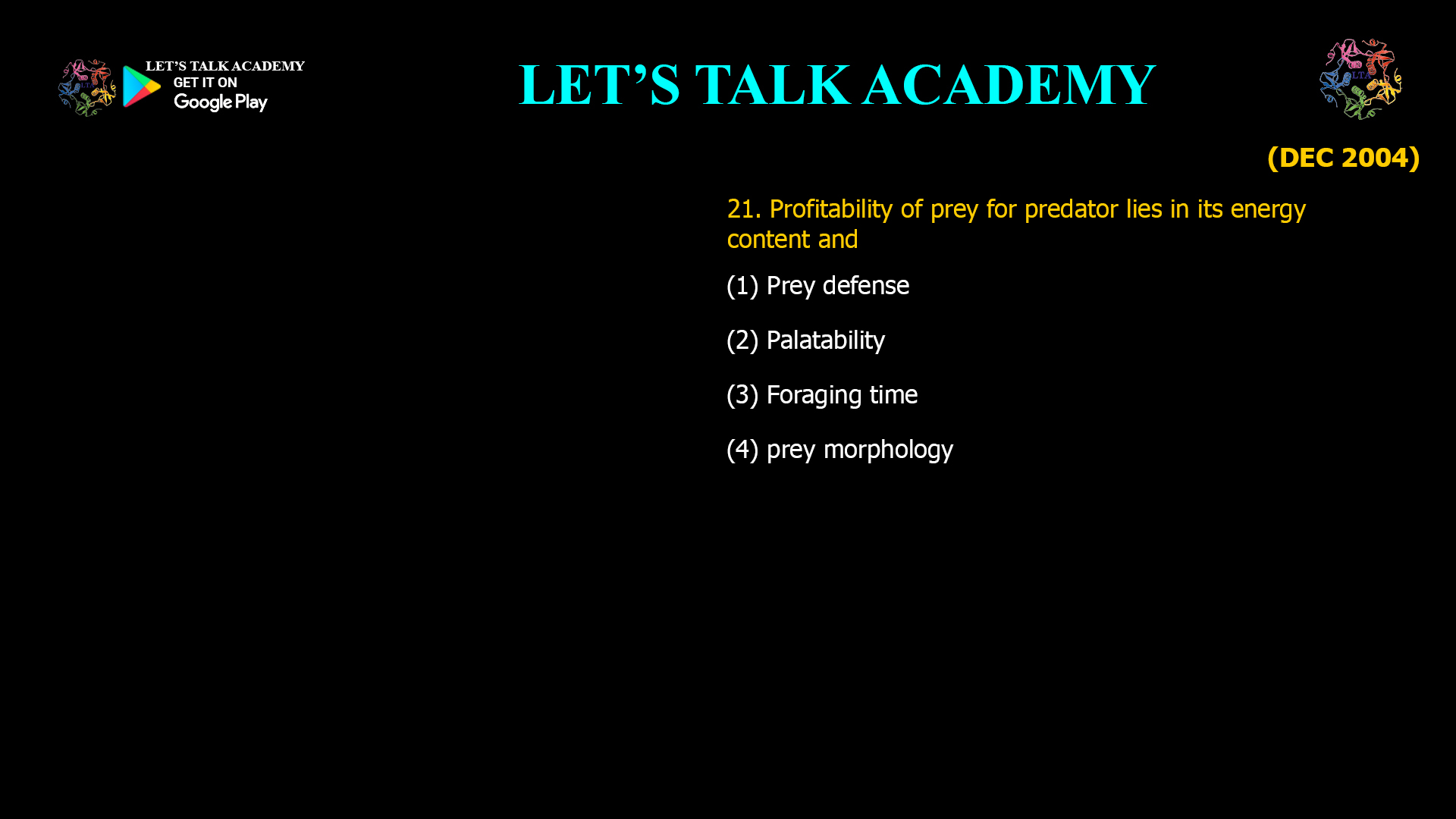
- Profitability of prey for predator lies in its energy content and
(1) Prey defense (2) Palatability
(3) Foraging time (4) prey morphologyUnderstanding Prey Profitability
Prey profitability refers to the net energy gain a predator receives from capturing and consuming a particular prey item. It is not just about how much energy the prey contains, but also how much time and effort the predator must invest to find, capture, and consume it.
The Optimal Foraging Theory
According to the optimal foraging theory, animals forage in ways that maximize their energy intake while minimizing risks and costs. This means predators will prefer prey that offers the highest net energy return for the least amount of effort and time spent hunting or handling1.
Key Factors Affecting Prey Profitability
-
Energy Content: The caloric value of the prey, which provides the predator with energy for survival, growth, and reproduction.
-
Foraging Time: The time and effort required to locate, catch, and consume the prey. This includes search time, pursuit time, and handling time13.
Why Foraging Time Matters
Even if a prey item is rich in energy, it may not be profitable if it takes too long to find or is difficult to catch and handle. A predator must balance the energy gained against the energy and time spent during the hunt. For example, a small, slow-moving prey may be more profitable than a larger, more energetic prey if the former can be caught and eaten quickly, while the latter requires a long chase or complex handling13.
How Predators Make Choices
Predators often adjust their foraging behavior based on prey availability and the costs associated with different prey types. They may switch to more abundant or easier-to-catch prey if their preferred prey becomes scarce or too costly to pursue. This dynamic decision-making ensures that predators maximize their net energy intake over time1.
The Correct Answer
Given the options:
-
Prey defense
-
Palatability
-
Foraging time
-
Prey morphology
The best answer is:
(3) Foraging time
Prey profitability for a predator is determined by both the energy content of the prey and the time required to capture and consume it. Foraging time directly influences the net energy gain and, therefore, the predator’s choice of prey13.
Conclusion
In summary, while the energy content of prey is fundamental, foraging time is the critical factor that, together with energy, determines prey profitability for predators. This principle shapes predator feeding strategies and has far-reaching effects on food web dynamics and ecosystem balance.
-


3 Comments
Manisha choudhary
November 8, 2025Foraging time
Kajal
November 9, 2025Foraging time
Sakshi Kanwar
November 27, 2025Foraging time