
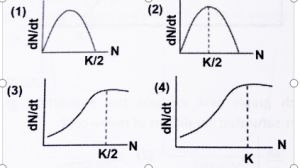
- Which of the following correctly represents the relationship between the rate of population growth and population size?
Understanding Population Growth Rate and Population Size
Population growth is a central concept in ecology, reflecting how the number of individuals in a population changes over time. The rate of population growth measures how quickly this change occurs, while population size is simply the number of individuals present at any given moment.
The Mathematical Relationship
The relationship between the rate of population growth and population size is best described by mathematical models. The two most common models are exponential growth and logistic growth.
Exponential Growth Model
In the exponential growth model, the rate of population growth (dN/dt) is directly proportional to the current population size (N):
dNdt=rN
-
r is the intrinsic growth rate (difference between per capita birth and death rates).
-
As the population increases, the growth rate increases proportionally, resulting in a J-shaped curve.
This model assumes unlimited resources and no environmental constraints, which is rare in natural populations.
Logistic Growth Model
In reality, resources are limited. The logistic growth model introduces the concept of carrying capacity (K), the maximum population size an environment can sustain:
dNdt=rN(1−NK)
-
When N is small, growth is nearly exponential.
-
As N approaches K, growth slows and eventually stops.
-
The curve becomes S-shaped (sigmoid).
Key Insights
-
Direct Proportionality (Exponential Growth):
When resources are unlimited, the rate of population growth increases directly with population size. The more individuals present, the faster the population grows. -
Density Dependence (Logistic Growth):
As population size increases and resources become limited, the growth rate slows down. The relationship is no longer directly proportional but instead peaks at an intermediate population size and declines as the population nears carrying capacity.
Real-World Examples
-
Bacteria in a Nutrient Broth:
Bacteria multiply rapidly (exponential growth) until nutrients run low, then growth slows (logistic growth). -
Wildlife Populations:
Deer populations may grow quickly after a harsh winter reduces numbers but stabilize as food and space become limiting.
Why This Relationship Matters
Understanding how growth rate and population size interact helps biologists predict population booms, crashes, and long-term sustainability. It is also crucial for managing resources, conserving endangered species, and controlling pests.
Conclusion
The correct representation of the relationship between the rate of population growth and population size is as follows:
-
In exponential growth: The growth rate increases directly with population size.
-
In logistic growth: The growth rate increases with population size at low densities, peaks at intermediate densities, and decreases as the population approaches carrying capacity.
This nuanced relationship is fundamental to population ecology and vital for effective environmental management.


3 Comments
Manisha choudhary
October 13, 20252nd is correct answer
Kajal
November 14, 2025Option 2
Sakshi Kanwar
November 29, 2025dN / dT by N is dome shaped graph hence option 2