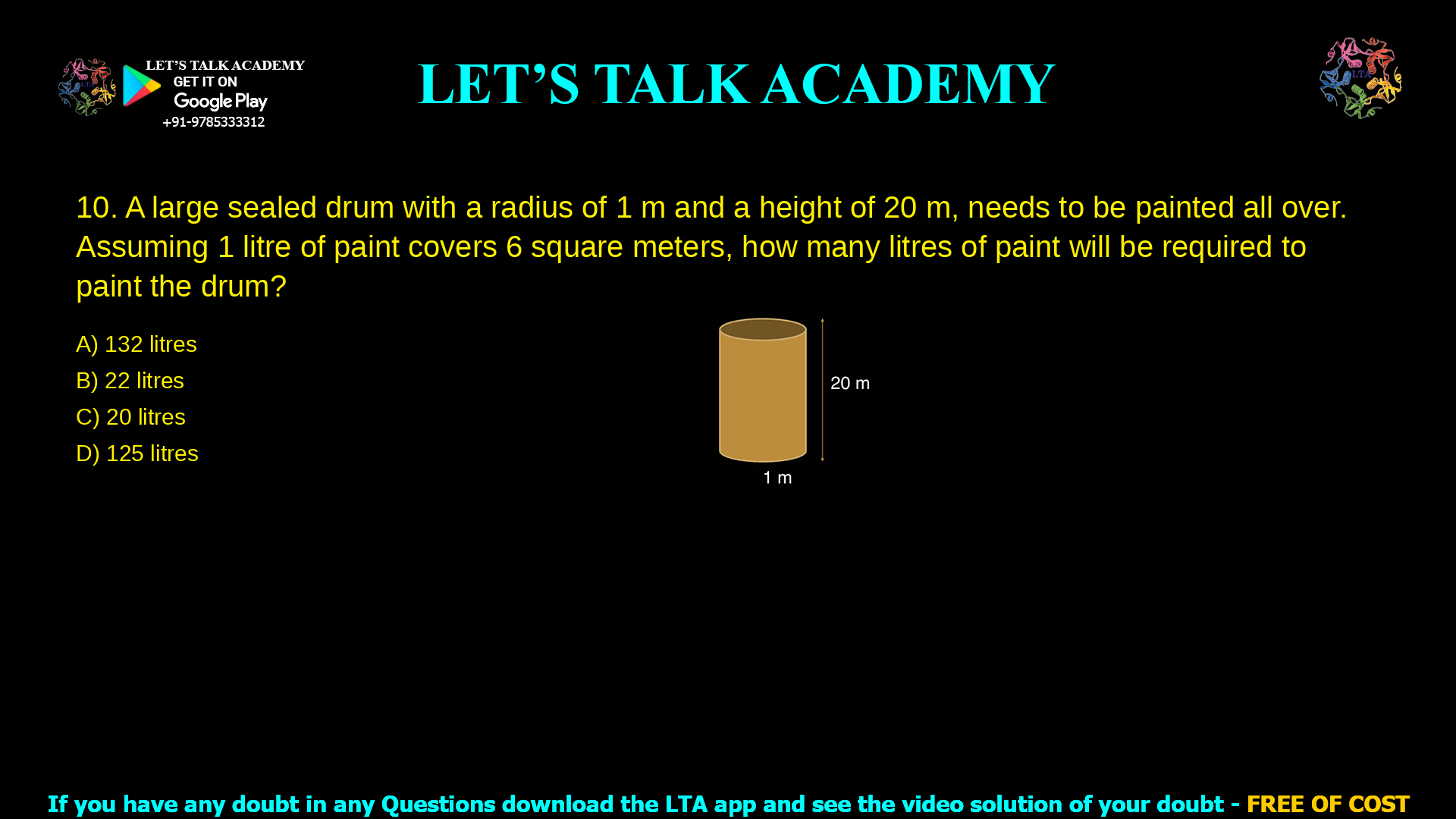
A large sealed drum with a radius of 1 m and a height of 20 m, needs to be
painted all over. Assuming 1 litre of paint covers 6 square meters, how many
litres of paint will be required to paint the drum?
132 litres
22 litres
20 litres
125 litres
Problem Restatement
A large sealed drum is modelled as a closed cylinder with radius r = 1 m and height h = 20 m. The drum must be painted all over, meaning both circular ends and the curved surface are included. One litre of paint covers 6 square metres, and the task is to find how many litres of paint are needed to paint the drum completely.
Step 1: Find Total Surface Area
The total surface area (TSA) of a closed cylinder is given by the formula:
TSA = 2πr(h + r)
Here, the radius is 1 m and the height is 20 m, so:
TSA = 2 × π × 1 × (20 + 1) = 42π m²
Using π ≈ 3.14:
TSA ≈ 42 × 3.14 = 131.88 m² ≈ 132 m²
Therefore, the total paintable area of the drum is approximately 132 square metres.
Step 2: Convert Area to Litres of Paint
Each litre of paint covers 6 m². To find the number of litres required, divide the total surface area by the coverage per litre:
Litres required = Total area ÷ Coverage per litre = 132 ÷ 6 = 22 litres
Hence, the drum requires 22 litres of paint.
Why Each Option Is Right or Wrong
Option A: 132 litres
The value 132 is the total surface area in square metres, not the number of litres. This option treats the area directly as litres and ignores the fact that each litre covers 6 m², so it is incorrect.
Option B: 22 litres
This option uses the correct total surface area (about 132 m²) and correctly divides by 6 m² per litre: 132 ÷ 6 = 22. It matches the required amount of paint to cover the entire curved surface and both ends, so it is the correct answer.
Option C: 20 litres
If 20 litres were used, each litre would effectively cover 132 ÷ 20 = 6.6 m², which contradicts the given coverage rate of 6 m² per litre. This would underestimate the paint required and leave some area unpainted, so this option is incorrect.
Option D: 125 litres
The value 125 does not arise from the surface area formula or from the coverage calculation. It would imply that each litre covers only about 1.06 m², which is far less than the stated 6 m² per litre, so this option greatly overestimates the required paint and is incorrect.


