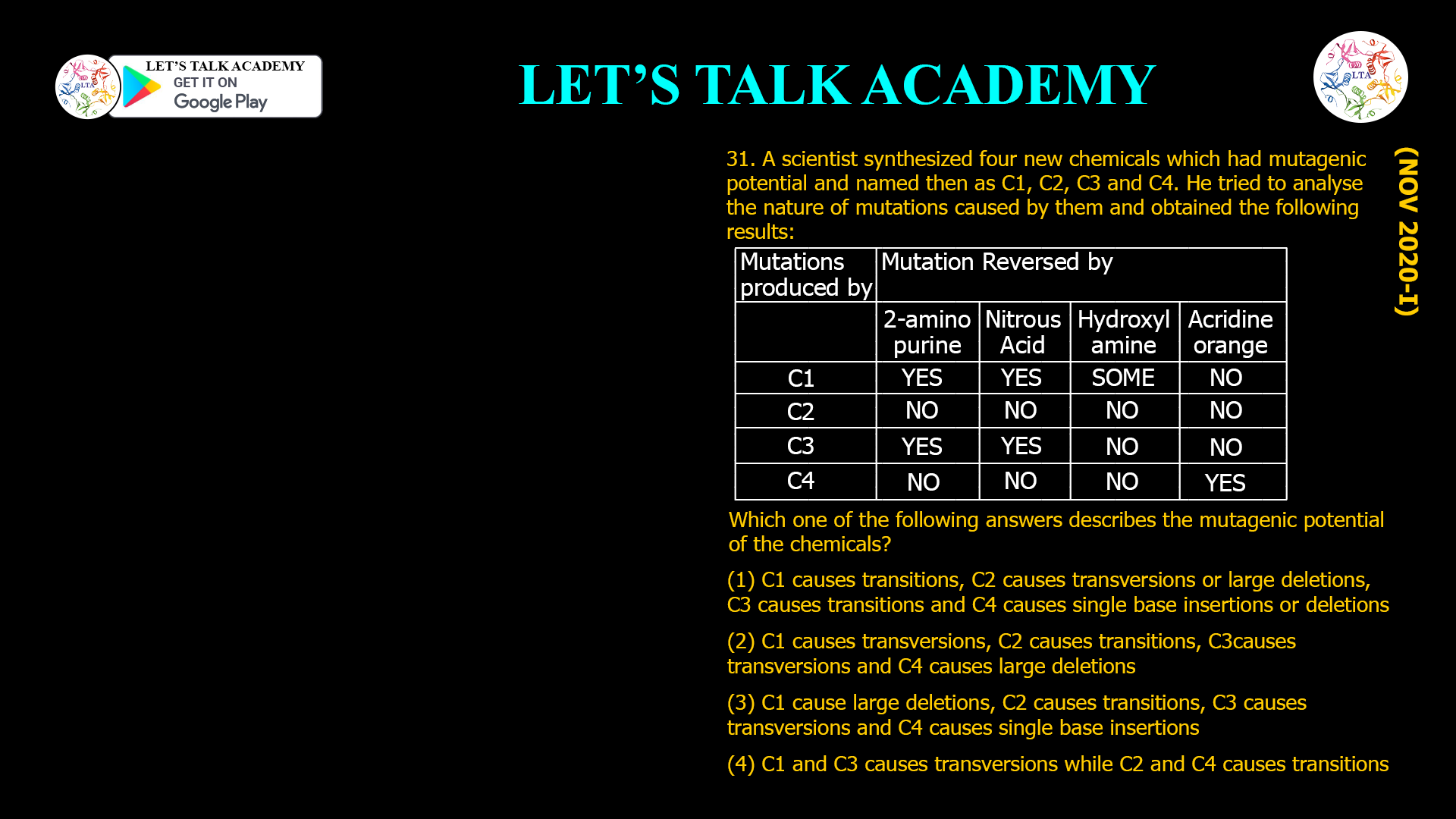
31. A scientist synthesized four new chemicals which had mutagenic potential and named then as Cl, C2, C3 and C4. He tried to analyse the nature of mutations caused by them and obtained the following results:
Which one of the following answers describes the mutagenic potential of the chemicals?
(1) C1 causes transitions, C2 causes transversions or large deletions, C3 causes transitions and C4 causes single base insertions or deletions
(2) C1 causes transversions, C2 causes transitions, C3 causes transversions and C4 causes large deletions
(3) Cl cause large deletions, C2 causes transitions, C3 causes transversions and C4 causes single base insertions
(4) Cl and C3 causes transversions while C2 and C4 causes transitions
C1 causes transition mutations, C2 causes transversions or large deletions, C3 causes transition mutations, and C4 causes single base insertions or deletions; therefore, option (1) is correct for this question on mutagenic potential.
Introduction
This CSIR NET Life Sciences style question tests understanding of how different classical mutagens—2‑aminopurine, nitrous acid, hydroxylamine and acridine orange—reveal the type of DNA mutations produced by unknown chemicals C1, C2, C3 and C4. By analyzing which known mutagen can reverse the mutations, one can deduce whether the chemicals mainly cause transitions, transversions, or frameshift insertions/deletions at the DNA level.
Interpreting the table
From the question table:
-
2‑aminopurine and nitrous acid are base analog/deamination mutagens that mainly induce and can reverse transition mutations.
-
Hydroxylamine specifically modifies cytosine and can reverse some transitions, particularly G·C ↔ A·T transitions.
-
Acridine orange is a classic frameshift mutagen, causing and reversing single base insertions or deletions.
Using this:
-
C1: reversed by 2‑aminopurine, nitrous acid and partly by hydroxylamine, but not by acridine orange → predominantly transition mutations.
-
C2: not reversed by any base‑substitution mutagen and also not by acridine orange → likely causes transversions or large deletions that cannot be fixed by simple base changes or single‑base frameshifts.
-
C3: reversed by 2‑aminopurine and nitrous acid, not by hydroxylamine or acridine orange → again transition mutations (different pattern but still transitions).
-
C4: only reversed by acridine orange → single base insertions or deletions (frameshift).
These deductions match option (1).
Option-wise explanation
Option (1)
“C1 causes transitions, C2 causes transversions or large deletions, C3 causes transitions and C4 causes single base insertions or deletions.”
-
C1 and C3: their mutations are reversed by transition‑inducing mutagens (2‑aminopurine, nitrous acid, partially hydroxylamine), showing they are transition type base substitutions.
-
C2: no reversal by any of the base‑substitution mutagens or acridine orange, so its mutations are likely transversions or larger deletions that cannot be corrected by simple base substitution or single‑base frameshift.
-
C4: reversal only by acridine orange clearly indicates frameshift due to single base insertion or deletion.
So option (1) correctly matches the mutational behaviour of all four chemicals.
Option (2)
“C1 causes transversions, C2 causes transitions, C3 causes transversions and C4 causes large deletions.”
-
C1 and C3 are clearly reversed by transition mutagens, not by acridine orange, so calling them transversion‑inducing is inconsistent with the reversal pattern in the table.
-
C4 is specifically reversed by acridine orange, which is associated with single‑base frameshifts, not with large deletions, so assigning large deletions to C4 contradicts the data.
Therefore option (2) does not agree with the observed reversal profile.
Option (3)
“C1 cause large deletions, C2 causes transitions, C3 causes transversions and C4 causes single base insertions.”
-
If C1 caused large deletions, neither transition mutagens nor hydroxylamine would efficiently reverse them, yet all three show reversal, strongly indicating simple transition substitutions instead.
-
C2 shows no reversal by transition mutagens, so describing it as transition‑inducing is incompatible with the table; likewise, C3 shows a transition‑mutagen reversal pattern, not a transversion pattern.
Hence option (3) does not fit the mutational data.
Option (4)
“C1 and C3 causes transversions while C2 and C4 causes transitions.”
-
Both C1 and C3 are reversed by transition mutagens; transition mutagens cannot generally correct transversion changes, making this assignment incorrect.
-
C4 is reversed only by acridine orange, the hallmark of frameshift insertions/deletions, not by transition mutagens, so grouping C4 under transitions contradicts its acridine‑orange‑specific reversal.
Thus option (4) is also inconsistent with the experimental observations.


