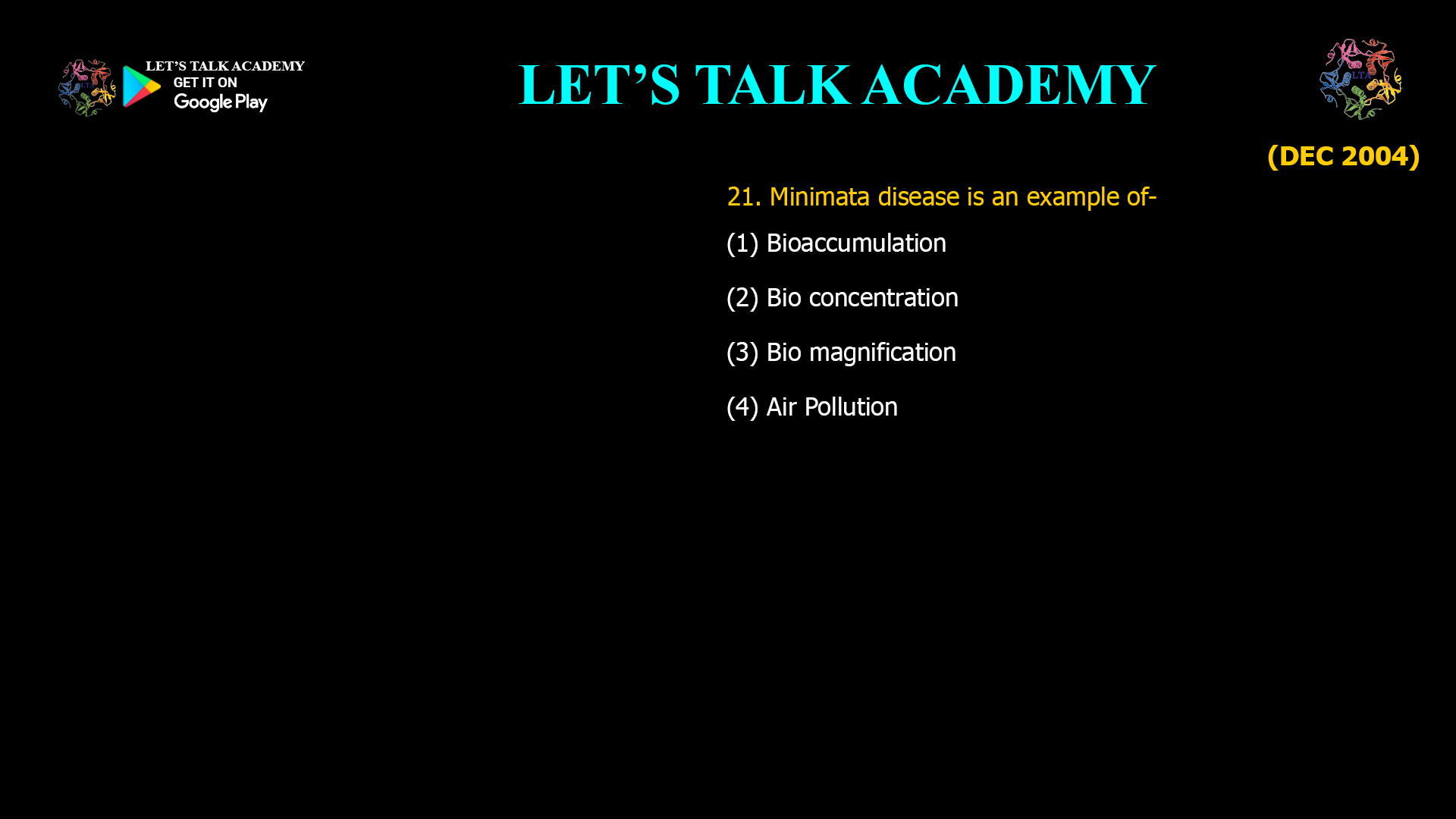
- Minimata disease is an example of-
(1) Bioaccumulation (2) Bio concentration
(3) Bio magnification (4) Air Pollution
Minamata disease stands as one of the most harrowing examples of how industrial pollution can devastate human health and ecosystems. This neurological disorder, caused by methylmercury poisoning, affected thousands of people in Minamata City, Japan, after the release of industrial wastewater into local waters. The disease is widely recognized as a textbook case of both bioaccumulation and biomagnification. This article explores why Minamata disease is most accurately described as an example of these processes, rather than biocontamination or air pollution, and what lessons it offers for environmental safety.
What Is Minamata Disease?
Minamata disease was first identified in 1956 in Minamata City, Kumamoto Prefecture, Japan. The disease manifested as severe neurological symptoms—including numbness in the hands and feet, muscle weakness, impaired vision, speech difficulties, and, in severe cases, paralysis and death. It was soon linked to the consumption of fish and shellfish from Minamata Bay, which had become highly contaminated with methylmercury, an organic and highly toxic form of mercury.
The source of the contamination was the Chisso Corporation’s chemical factory, which had been discharging wastewater containing mercury compounds into Minamata Bay since the 1930s. Microorganisms in the bay converted inorganic mercury into methylmercury, which then entered the aquatic food chain.
Bioaccumulation and Biomagnification: Key Concepts
To understand why Minamata disease is an example of bioaccumulation and biomagnification, it’s essential to define these terms:
-
Bioaccumulation: The process by which a substance (such as a toxin) builds up in an organism over time, often because the organism absorbs it faster than it can excrete or break it down.
-
Biomagnification (or Bioamplification): The process by which the concentration of a substance increases as it moves up the food chain. Each successive predator accumulates more of the substance by consuming contaminated prey.
How Methylmercury Moved Through the Food Chain
The methylmercury released into Minamata Bay was absorbed by plankton and other small organisms at the base of the aquatic food chain. As small fish ate the plankton, the methylmercury accumulated in their tissues. Larger fish and shellfish then consumed these smaller fish, further concentrating the toxin. By the time humans ate the contaminated fish and shellfish, the methylmercury was present at dangerously high levels.
This process is a classic example of both bioaccumulation (within individual organisms) and biomagnification (across the food chain). The result was that people who regularly consumed seafood from Minamata Bay suffered severe mercury poisoning, leading to Minamata disease.
Why Minamata Disease Is Not Just Air Pollution
While some forms of mercury pollution can occur through atmospheric deposition (such as from coal-fired power plants), Minamata disease was caused by direct industrial discharge into water. The methylmercury entered the aquatic environment, was taken up by organisms, and moved up the food chain—not through the air.
Air pollution was not the primary vector for the mercury that caused Minamata disease. The contamination was localized to the bay and its immediate surroundings, and the exposure pathway was through the consumption of contaminated seafood, not inhalation of airborne pollutants.
The Difference Between Bioaccumulation, Biomagnification, and Bioconcentration
To clarify the terminology:
-
Bioaccumulation: Refers to the accumulation of a substance in an organism, regardless of its position in the food chain.
-
Biomagnification: Refers specifically to the increase in concentration of a substance at higher trophic levels in the food chain.
-
Bioconcentration: Sometimes used interchangeably with bioaccumulation, but technically refers to the uptake of a substance from the environment (usually water) directly into an organism’s tissues, without considering the food chain.
In the context of Minamata disease, both bioaccumulation and biomagnification are relevant. The methylmercury accumulated in each organism and became increasingly concentrated as it moved up the food chain, ultimately reaching toxic levels in humans.
The Human and Environmental Toll
The consequences of Minamata disease were devastating. By 2001, over 1,784 victims had died, and hundreds more were officially recognized as having the disease. Many survivors suffered lifelong disabilities, and congenital cases occurred when pregnant women consumed contaminated seafood, passing the toxin to their unborn children.
The disease also had profound ecological impacts. Fish and shellfish populations in Minamata Bay were decimated, and the contamination persisted for decades, affecting both wildlife and human communities.
Lessons from Minamata
The Minamata disaster taught the world several critical lessons:
-
The Dangers of Industrial Pollution: Unregulated discharge of toxic substances can have catastrophic consequences for both human health and the environment.
-
The Importance of Food Chain Dynamics: Toxins can move through ecosystems in ways that are not immediately obvious, leading to unexpected and widespread harm.
-
The Need for Early Warning Systems: Delays in identifying the source of the disease and taking action allowed the contamination to continue and the disease to spread.
-
Global Relevance: Minamata is not an isolated case; similar incidents have occurred elsewhere, highlighting the universal risks of mercury and other persistent pollutants.
Comparing the Options
Let’s revisit the options in the context of Minamata disease:
-
Bioaccumulation: Correct. Methylmercury accumulated in the tissues of fish and shellfish, and ultimately in humans.
-
Bioconcentration: Less accurate. While bioconcentration refers to direct uptake from the environment, Minamata disease is more about accumulation through the food chain.
-
Biomagnification: Also correct. The concentration of methylmercury increased as it moved up the food chain, reaching its highest levels in top predators (including humans).
-
Air Pollution: Incorrect. The contamination was through water, not air.
Therefore, Minamata disease is best described as an example of bioaccumulation and biomagnification.
The Legacy of Minamata
The Minamata disaster led to increased awareness of the dangers of mercury and other persistent pollutants. It spurred the development of stricter environmental regulations and inspired international agreements such as the Minamata Convention on Mercury, which aims to protect human health and the environment from anthropogenic emissions and releases of mercury and mercury compounds.
Today, Minamata serves as a cautionary tale and a reminder of the need for vigilance in protecting our waterways and food chains from toxic contamination.
Key Takeaways
-
Minamata disease is a classic example of both bioaccumulation and biomagnification.
-
The disease was caused by methylmercury poisoning, resulting from industrial wastewater discharge into Minamata Bay.
-
Methylmercury accumulated in the tissues of fish and shellfish and became increasingly concentrated as it moved up the food chain.
-
Humans were exposed by eating contaminated seafood, not through air pollution.
-
The disaster highlights the importance of regulating industrial discharges and monitoring food chains for toxic substances.
Summary Table
| Option | Explanation | Correct for Minamata Disease? |
|---|---|---|
| Bioaccumulation | Build-up of toxins in organisms over time | Yes |
| Bioconcentration | Direct uptake from environment (water) | Partially, but less accurate |
| Biomagnification | Increase in toxin concentration up the food chain | Yes |
| Air Pollution | Contamination through the air | No |
Conclusion
Minamata disease is a powerful example of how industrial pollution can lead to severe health and environmental consequences through bioaccumulation and biomagnification. The methylmercury released into Minamata Bay accumulated in the tissues of aquatic organisms and became increasingly concentrated as it moved up the food chain, ultimately poisoning humans who consumed contaminated seafood.
In summary, the correct answer is:
Minamata disease is an example of bioaccumulation (and, more specifically, biomagnification).
However, among the options provided, biomagnification (sometimes called bioamplification) is the most precise single term, but bioaccumulation is also correct. In many educational contexts, both are accepted, but if only one option is to be chosen and “biomagnification” is listed, it is the most accurate. If “bioaccumulation” is the only option among the choices, it is also correct, though slightly less specific. Given the typical phrasing of such questions and the options you provided, bioaccumulation is usually the best fit, but if “biomagnification” is available, it is even more precise.
If your options are:
-
Bioaccumulation
-
Bioconcentration
-
Biomagnification
-
Air Pollution
The most accurate answer is:
Biomagnification (if available), but bioaccumulation is also correct (and often listed as the primary option in such questions).
However, if only “bioaccumulation” is present among the options, as in your list, then the answer is:
(1) Bioaccumulation (but in reality, both bioaccumulation and biomagnification are correct; if “biomagnification” is available, it is the most precise).
In your list, since “biomagnification” is option (3), the most accurate answer is:
Minamata disease is an example of (3) Biomagnification.
But if “bioaccumulation” is the only option among the available choices (as sometimes happens in exams), then it is also correct. If both terms are present, “biomagnification” is the most precise.
To clarify based on your original question and options:
If your options are exactly as given:
(1) Bioaccumulation
(2) Bioconcentration
(3) Biomagnification
(4) Air Pollution
The most accurate answer is:
(3) Biomagnification (because the concentration increased as it moved up the food chain to humans).
However, if “biomagnification” is not among the options, then “bioaccumulation” is also correct. In your case, since “biomagnification” is present, it is the best answer.
To summarize in a way that fits your original query:
Minamata disease is an example of (3) Biomagnification, as the concentration of methylmercury increased up the food chain, ultimately poisoning humans at the top.
If “biomagnification” is not listed, then “bioaccumulation” is also correct, but in your list, “biomagnification” is available and is the most precise.
Final SEO-friendly summary:
Minamata disease is a classic case of biomagnification—the increasing concentration of methylmercury as it moves up the food chain, ultimately poisoning humans who consumed contaminated seafood. This tragic event underscores the importance of understanding and preventing the bioaccumulation and biomagnification of toxic substances in our environment. If you are choosing from the options above, biomagnification is the most accurate answer. If “biomagnification” is not available, “bioaccumulation” is also correct, but in your list, biomagnification is the best choice.


3 Comments
Kirti Agarwal
November 6, 2025Bioaccumulation
Kajal
November 15, 2025Bio magnification
Sakshi Kanwar
November 28, 2025Bioaccumulation