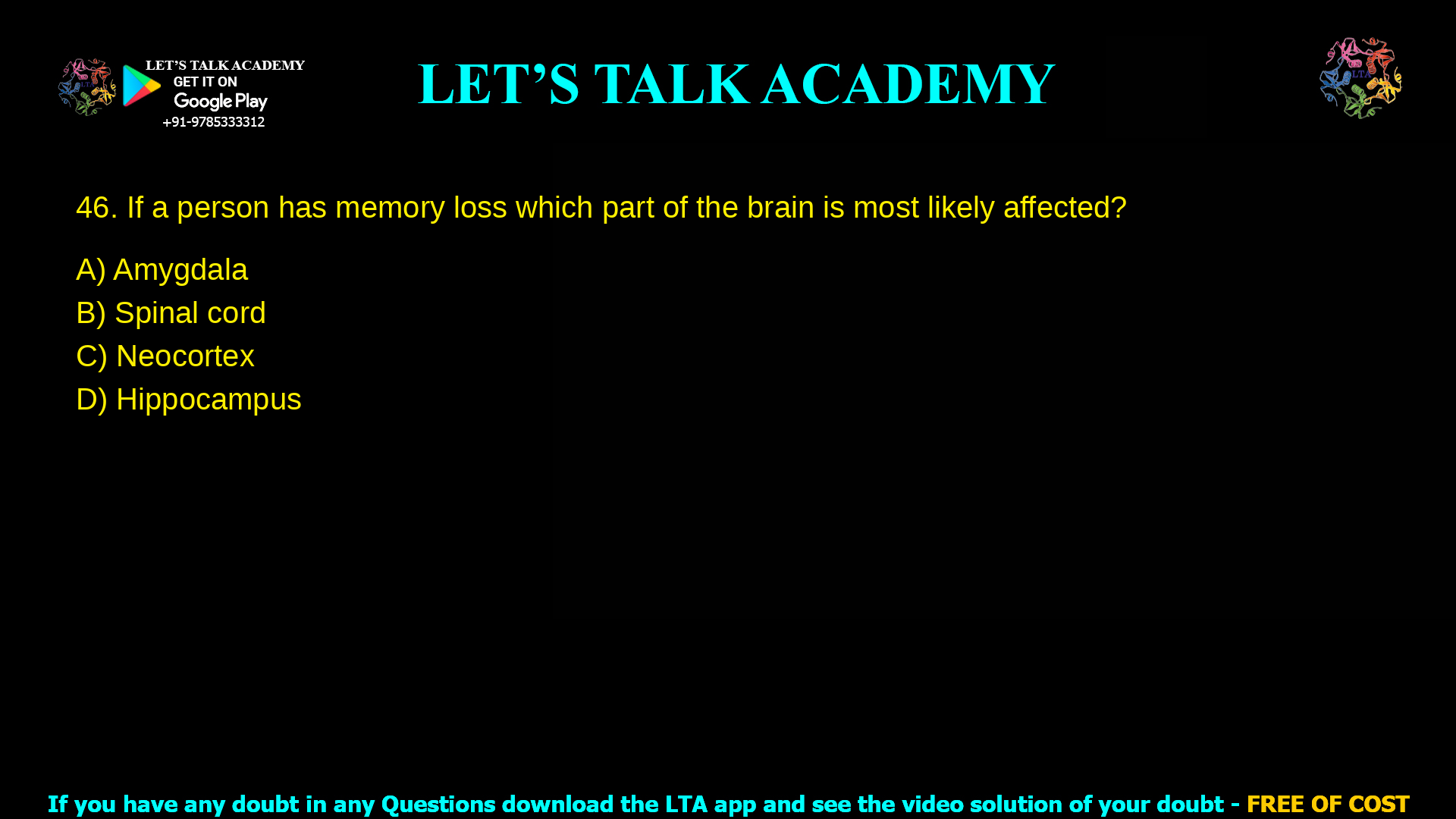
If a person has memory loss which part of the brain is most likely affected?
Amygdala
Spinal cord
Neocortex
Hippocampus
The correct answer is: Hippocampus.
Among the given options, damage to the hippocampus is classically associated with memory loss, especially difficulty forming new memories (anterograde amnesia).
Introduction
When a person develops significant memory loss, especially after head injury or in conditions like dementia, specific parts of the brain are usually involved. For MCQ-style questions such as “If a person has memory loss which part of the brain is most likely affected? Amygdala, Spinal cord, Neocortex, Hippocampus,” it is essential to know the exact brain region that plays a primary role in memory formation and storage. In most standard biology and neuroscience textbooks and exams, the hippocampus is identified as the key structure involved in forming new memories and is therefore the most likely part to be affected when memory is lost.
Correct option: Hippocampus
The hippocampus is a paired, seahorse-shaped structure located in the medial temporal lobe of the brain and is a crucial component of the limbic system. It plays a central role in:
-
Formation of new memories (anterograde memory) – converting short-term experiences into long-term declarative memories (facts and events).
-
Spatial memory and navigation – forming cognitive maps of the environment.
-
Contextual and episodic memory – remembering events in time and place.
Damage to the hippocampus leads to:
-
Anterograde amnesia – inability to form new long-term memories after the injury.
-
Partial retrograde amnesia – loss of some memories formed before the injury.
-
Typical early features of diseases like Alzheimer’s disease, where hippocampal neurons are among the first to degenerate.
Therefore, in the given MCQ, “Hippocampus” is the most accurate answer for memory loss.
Option A: Amygdala
The amygdala is an almond-shaped structure also located in the medial temporal lobe, close to the hippocampus, and is part of the limbic system.
Key functions:
-
Emotional processing, especially fear, aggression, and threat detection.
-
Emotional coloring of memories – it strengthens memories that have a strong emotional component (for example, traumatic or fearful events).
-
Important in conditioning and emotional learning.
What happens when the amygdala is damaged:
-
Reduced fear response and altered emotional behavior.
-
Difficulty recognizing emotional expressions (especially fear) in others.
-
Changes in social behavior and emotional decision-making.
Although the amygdala does influence memory (it enhances emotional memories), it is not the primary site responsible for general memory formation and recall. Hence, it is not the best answer for “a person has memory loss,” especially in exam-style questions.
Option B: Spinal cord
The spinal cord is part of the central nervous system but is mainly involved in:
-
Transmission of nerve impulses between the body and the brain.
-
Reflex actions (like withdrawal reflex, knee-jerk reflex).
-
Conduction of sensory input (touch, pain, temperature) to the brain and motor commands from the brain to muscles.
The spinal cord:
-
Does not directly participate in higher mental functions like memory, thinking, learning, and conscious perception.
-
Damage to the spinal cord leads to paralysis, loss of sensation, and reflex changes, depending on the level and extent of injury.
Therefore, although the spinal cord is crucial for movement and sensation, it is not the part “most likely affected” when a person primarily presents with memory loss, making this option incorrect in the context of the question.
Option C: Neocortex
The neocortex (or cerebral cortex, especially the newer six-layered part) is the highly developed outer layer of the cerebrum. It is involved in:
-
Higher cognitive functions – thinking, reasoning, language, consciousness.
-
Sensory processing – visual (occipital lobe), auditory (temporal lobe), somatosensory (parietal lobe).
-
Voluntary motor control (frontal lobe).
-
Storing aspects of long-term memory, especially semantic memory (facts) and some episodic memory details.
Role in memory:
-
Many long-term memories are thought to be gradually consolidated and stored in cortical networks over time.
-
The prefrontal cortex participates in working memory and organizing retrieval of stored memories.
However, in classical exam questions:
-
The structure most directly and characteristically associated with memory loss and amnesia is the hippocampus, not “neocortex” as a broad term.
-
Neocortical damage can cause cognitive deficits, language problems, and some memory issues, but when a single most likely structure is asked for in relation to memory loss, hippocampus is preferred.
Thus, while the neocortex participates in memory storage and retrieval, it is not the best single answer to this specific MCQ.
Option D: Hippocampus (correct)
Re-emphasizing why hippocampus is the best answer:
-
It is the primary center for forming new declarative memories.
-
Classical neurological cases (e.g., patient H.M.) with bilateral hippocampal removal show severe anterograde amnesia.
-
Early Alzheimer’s disease prominently affects the hippocampus, leading to short-term memory loss and disorientation.
-
In most standard physiology, neurobiology, and psychology MCQs, memory loss → hippocampus is the expected association.
Therefore, when the question is:
“If a person has memory loss which part of the brain is most likely affected? Amygdala / Spinal cord / Neocortex / Hippocampus”
the correct option is unequivocally Hippocampus.
Key points for exam preparation
-
Remember the simple association:
-
Hippocampus → formation of new memories, spatial and episodic memory → damage leads to amnesia.
-
-
Amygdala → emotion and fear, emotional component of memory, not primary memory center.
-
Neocortex → higher functions and long-term storage, but not the classic “memory loss” hotspot asked in basic MCQs.
-
Spinal cord → conduction and reflexes, no direct role in conscious memory formation.
Using these associations helps quickly eliminate options and select Hippocampus in similar brain-and-behavior questions.


