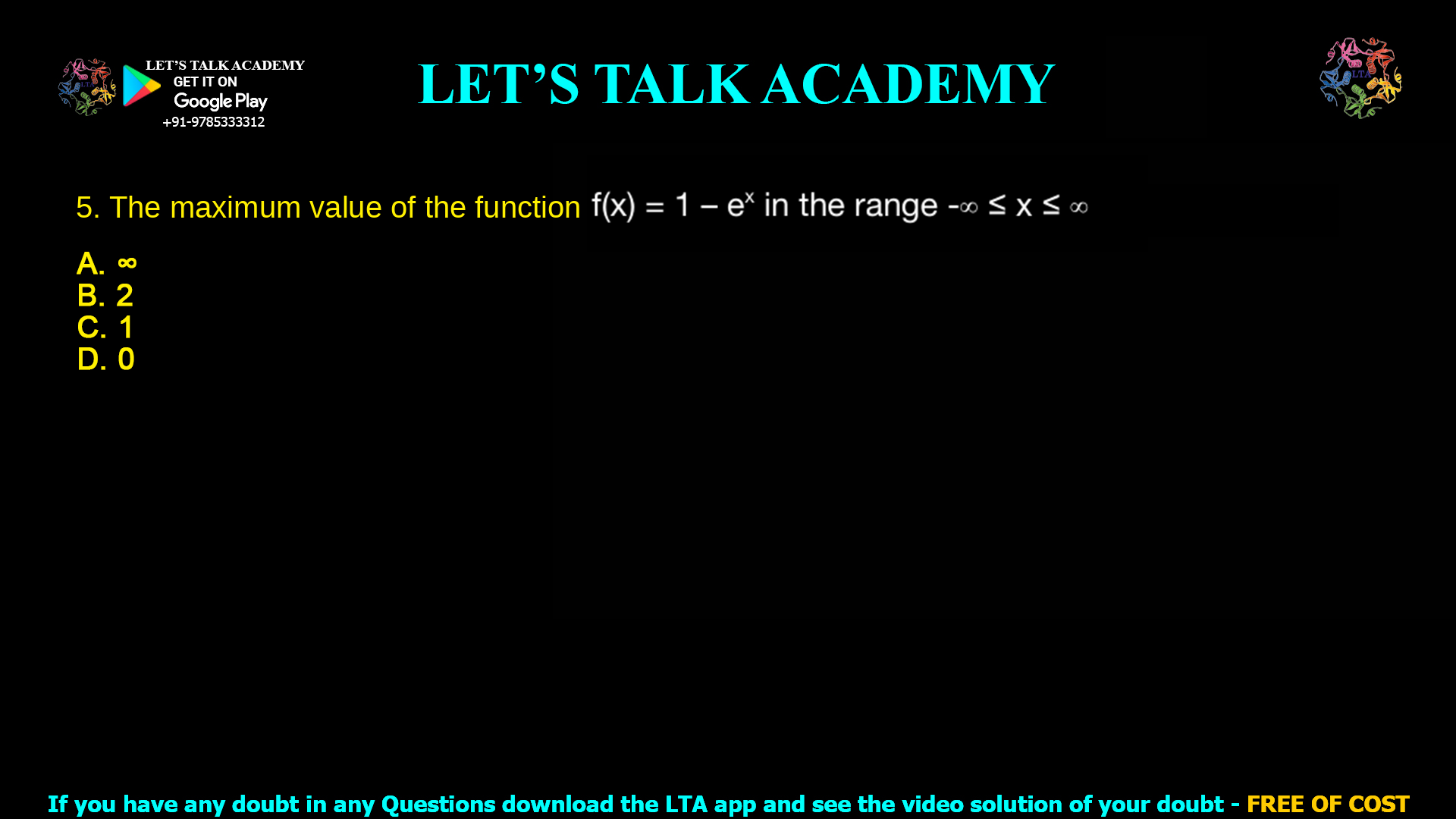
The maximum value of the function f(x) = 1 – ex in the range –
infinite
2
1
0
Maximum Value of the Function f(x) = 1 − ex on the Real Line
Introduction
To find the maximum value of the function f(x) = 1 − ex for all real numbers,
it is essential to understand how the exponential function ex behaves as x moves towards positive
and negative infinity. Using this behavior, we can determine the extreme values of f(x) and then check which
of the given multiple-choice options is correct.
Problem Statement
Find the maximum value of the function:
f(x) = 1 − ex, for −∞ < x < ∞
Options:
- A. ∞
- B. 2
- C. 1
- D. 0
Step-by-Step Solution
- Consider the behavior of the exponential function ex as x → +∞.
In this case, ex → ∞, so:f(x) = 1 − ex → 1 − ∞ = −∞.
This means that as x increases without bound, the function f(x) decreases without bound and
does not have any upper bound coming from the right side. - Now consider x → −∞. In this case, ex → 0+, so:
f(x) = 1 − ex → 1 − 0 = 1.
Therefore, the function approaches the value 1 from below as x becomes very large negative,
but it never exceeds 1. - For any real x, ex is always positive. Hence:
ex > 0 ⇒ 1 − ex < 1.
So f(x) is always strictly less than 1, though it can be made arbitrarily close to 1 by taking
x sufficiently negative. This means 1 is the supremum (least upper bound) of the function.
In many exam settings, when asked for the “maximum value” over (−∞, ∞) for such a function,
the intended answer is this supremum, which is 1.
Analysis of Each Option
Option A: ∞
This option would mean that the function grows without bound above. However,
f(x) = 1 − ex never exceeds 1 and instead decreases to −∞ as x → +∞.
Therefore, ∞ cannot be the maximum value.
Option B: 2
For f(x) to be 2, we would need:
1 − ex = 2 ⇒ ex = −1.
Since ex is always positive for real x, there is no real solution to ex = −1.
Thus the function never reaches or approaches the value 2, making this option incorrect.
Option C: 1
As x → −∞, ex → 0+ and therefore f(x) → 1.
The function values can get arbitrarily close to 1 but never exceed it.
Hence 1 is the supremum (greatest value approached) of f(x) on the entire real line.
Among the given discrete options, 1 is the correct choice for the maximum value.
Option D: 0
The value 0 occurs when:
1 − ex = 0 ⇒ ex = 1 ⇒ x = 0.
So, f(0) = 0. However, there exist values of x (large negative values) for which f(x) is closer to 1,
which is greater than 0. Hence, 0 is not the maximum value of the function.
Final Answer
The maximum value (supremum) of the function f(x) = 1 − ex for −∞ < x < ∞ is:
1
Therefore, the correct option is C. 1.


