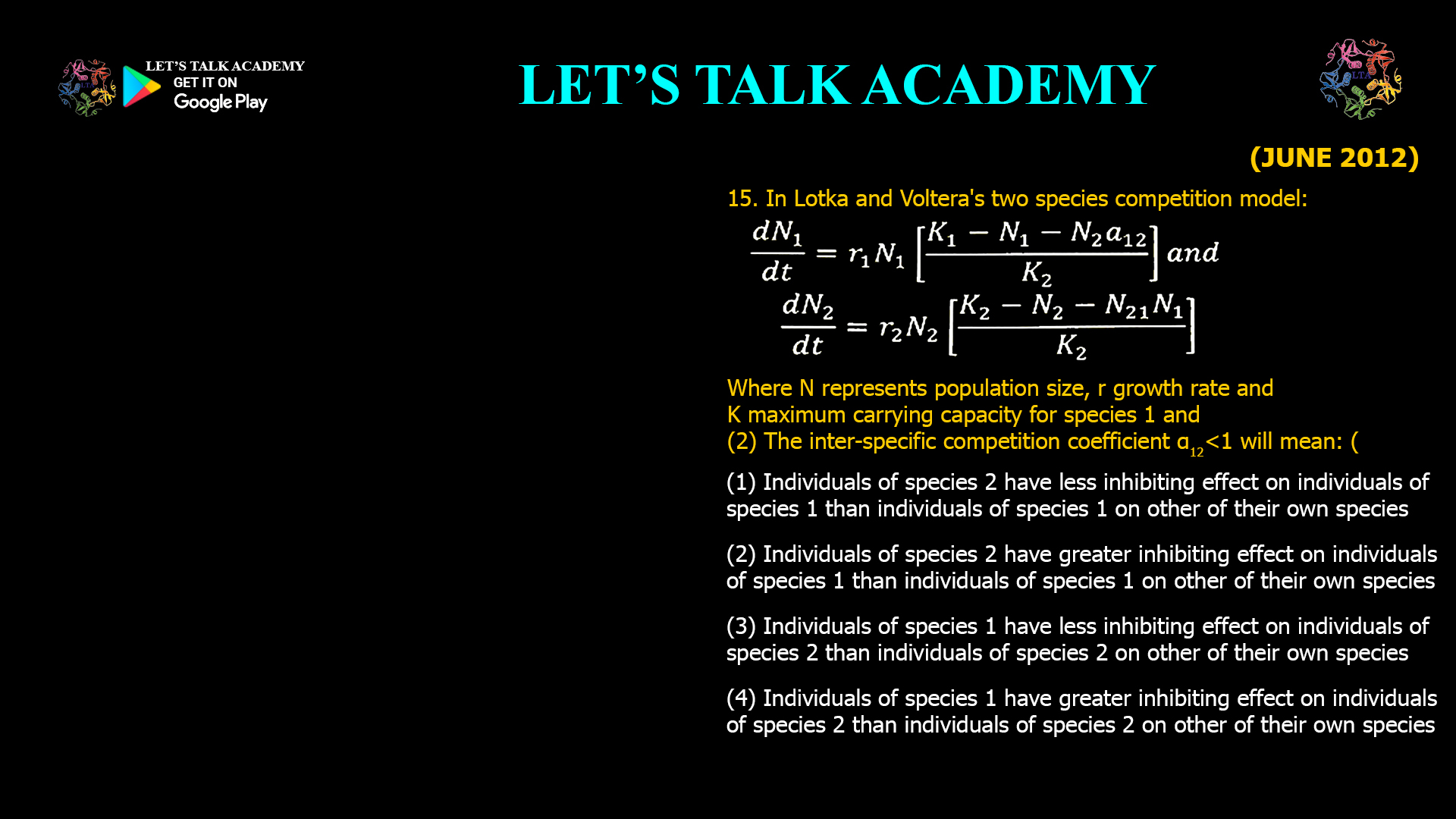
15. In Lotka and Voltera’s two species competition model:
Where N represents population size, r growth rate and K maximum carrying capacity for species 1 and (2) The inter-specific competition coefficient α12<1 will mean: (
(1) Individuals of species 2 have less inhibiting effect on individuals of species 1 than individuals of species 1 on other of their own species
(2) Individuals of species 2 have greater inhibiting effect on individuals of species 1 than individuals of species 1 on other of their own species
(3) Individuals of species 1 have less inhibiting effect on individuals of species 2 than individuals of species 2 on other of their own species
(4) Individuals of species 1 have greater inhibiting effect on individuals of species 2 than individuals of species 2 on other of their own species
What Is α₁₂ in the Lotka-Volterra Model?
In the context of two competing species:
-
N₁, N₂: Population sizes of species 1 and 2
-
r₁, r₂: Intrinsic growth rates
-
K₁, K₂: Carrying capacities
-
α₁₂: The effect of an individual of species 2 on the population growth of species 1, relative to the effect of an individual of species 1 on its own population1358.
The model for species 1 is:
dN1dt=r1N1(K1−N1−α12N2K1)
Here, α₁₂ acts as a conversion factor: it translates the competitive effect of species 2 individuals into “equivalent” individuals of species 11358.
What Does α₁₂ < 1 Mean?
When α₁₂ < 1, it means that each individual of species 2 has less of an inhibiting (competitive) effect on species 1 than an individual of species 1 has on its own population138. In other words, intraspecific competition (within species 1) is stronger than interspecific competition (from species 2).
Ecological Interpretation
-
If you add one individual of species 2 to a habitat, it will reduce the growth of species 1, but by less than if you added one more individual of species 1.
-
This scenario often supports the coexistence of both species, as neither species is more strongly limited by the other than by its own population5.
Why This Matters
Understanding the value of α₁₂ is crucial for predicting outcomes in competitive interactions:
-
α₁₂ < 1: Intraspecific competition dominates; stable coexistence is possible.
-
α₁₂ > 1: Interspecific competition dominates; competitive exclusion is more likely.
Matching the Correct Answer
Given the options:
-
Individuals of species 2 have less inhibiting effect on individuals of species 1 than individuals of species 1 on other of their own species.
-
Individuals of species 2 have greater inhibiting effect on individuals of species 1 than individuals of species 1 on other of their own species.
-
Individuals of species 1 have less inhibiting effect on individuals of species 2 than individuals of species 2 on other of their own species.
-
Individuals of species 1 have greater inhibiting effect on individuals of species 2 than individuals of species 2 on other of their own species.
The correct answer is:
(1) Individuals of species 2 have less inhibiting effect on individuals of species 1 than individuals of species 1 on other of their own species138.
Conclusion
In the Lotka-Volterra competition model, the coefficient α₁₂ < 1 signifies that species 2 is a weaker competitor against species 1 than species 1 is against itself. This insight is fundamental for understanding how species interactions shape community structure and the likelihood of coexistence in nature.


2 Comments
Manisha choudhary
November 8, 20252nd option is correct answer
Alpha<1 species coexist rahegi
Kajal
November 9, 2025Option 1