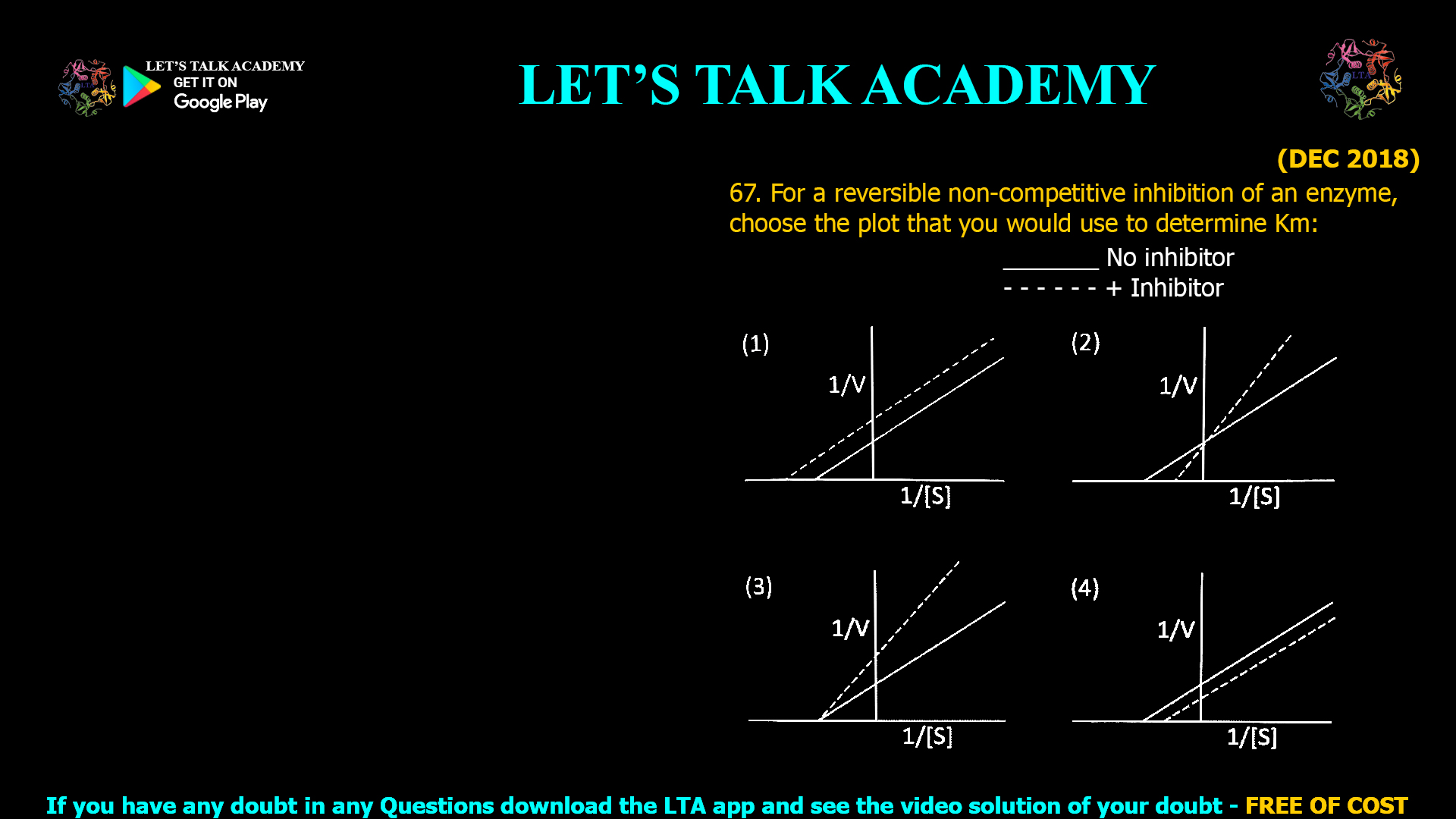
The correct answer is (1).
Introduction
Enzyme inhibition is a cornerstone of biochemistry and pharmacology, and visualizing its effects on kinetic parameters is essential. The Lineweaver-Burk double reciprocal plot provides a clear way to distinguish between competitive, non-competitive, and uncompetitive inhibition based on their effects on Vmax and Km. In reversible non-competitive inhibition, the x-intercept—used for determining Km—remains unchanged, even though the slope and y-intercept change. This article explains how to use the correct plot to determine Km in the presence of reversible non-competitive inhibitors.
Basis of Non-Competitive Inhibition
-
Non-competitive inhibitors bind to sites other than the active site, affecting enzyme activity regardless of substrate concentration.
-
This mechanism lowers Vmax but does not alter Km (enzyme’s affinity for substrate remains the same).
-
The effect can be visualized using the Lineweaver-Burk plot (1/V vs. 1/[S]), which linearizes Michaelis-Menten kinetics.
Lineweaver-Burk Plot Features in Non-Competitive Inhibition
-
y-intercept (1/Vmax) increases: Indicates decrease in Vmax.
-
x-intercept (−1/Km) remains the same: Indicates Km is unchanged.
-
Both inhibitor and no-inhibitor lines intersect the x-axis at the same point.
-
The slopes differ due to the decrease in Vmax.
Correct Plot Identification
-
In the provided images:
-
Plot (1) shows two lines (with and without inhibitor) intersecting at the same x-intercept (−1/Km), but with different slopes and y-intercepts.
-
This matches the textbook case for reversible non-competitive inhibition.
-
Why Other Plots Are Incorrect
-
Plot (2): Lines have different x-intercepts—indicative of competitive inhibition, not non-competitive.
-
Plot (3) and (4): Do not reflect the unchanged x-intercept which is unique to non-competitive inhibition.
Summary Table: Lineweaver-Burk Changes
| Inhibition Type | Change in y-intercept | Change in x-intercept | Best Plot |
|---|---|---|---|
| Non-competitive | Increases | Unchanged | Plot (1) |
| Competitive | Unchanged | Increases | Plot (2) |
| Uncompetitive | Increases | Decreases | Plot (3)/(4) |
Conclusion
In reversible non-competitive enzyme inhibition, the Lineweaver-Burk plot for Km determination is identified by the unchanged x-intercept regardless of the presence of inhibitor. This is represented by plot (1), where both lines intersect the x-axis at the same position.


34 Comments
Kirti Agarwal
September 12, 2025Graph a
yashika
September 12, 2025Unchanged x intercept
Bharti yadav
September 13, 2025Graph A
Kanica Sunwalka
September 13, 2025y intercept – increases
x intercept – remains the same
Aakansha sharma Sharma
September 13, 2025Correct answer is 3
Rishita
September 14, 2025Graph a
Pratibha Jain
September 14, 2025The correct answer is option (1).
Anju
September 14, 2025Ans :1
Santosh Saini
September 14, 2025Correct answer is 3 because in non competitive inhibition, the Vmax decreases and Km stay constant
Tanvi Panwar
September 14, 2025option 3rd is the correct answer because in non competitive inhibition km remains the same so is 1/Km and Vmax. decreases bcz the inhibitor binds at site other than active site so it does not have any effect of substrate concentration. the line will intersect at the same point on X- axis bt at different points on Y-axis.
Dharmpal Swami
September 14, 2025Write answer 1
Dharmpal Swami
September 14, 2025Write answer 3
Pooja
September 14, 2025A is correct
anjani sharma
September 14, 2025Answer 3
As in the non competitive inhibition the vmax on the yaxis is reduced and km on the x axis is same for all the inhibitor and non inhibitor
Pallavi Ghangas
September 14, 20251st graph is right
Palak Sharma
September 14, 2025Correct answer is 3 because in non competitive inhibition, the Vmax decreases but Km remains constant.
Ankita Pareek
September 14, 2025For non competative inhibition km remain the same intercect at the same point so that grap third is correct
Priya dhakad
September 14, 2025The correct option is 3rd In non competitive inhibition the vmax decrease but km is constant .
Sakshi Kanwar
September 14, 2025lowers Vmax but does not alter Km
Soniya Shekhawat
September 15, 20251st option is correct.
Vanshika Sharma
September 15, 2025Correct answer is 3
Mohd juber Ali
September 15, 2025In non competative inhibition all 3 lines intersept at same point of x axis (1/km not alter) so option 3 is right
Aafreen Khan
September 16, 2025Option 3rd is correct answer
Anjana sharma
September 16, 2025Curve 1 is correct due to decrease in vmax x -intersecpt unchanged
Nilofar Khan
September 16, 2025Correct answer is 3 becouse in noncompetitive inhibition Vmax decrease but km is unchanged. all three line intercept at same point
Lokesh Kumawat
September 16, 2025Answer 3rd is correct ??
Khushi Agarwal
September 17, 2025correct answer is (1).
Priya khandal
September 17, 2025A is right
Avni
September 17, 2025The correct answer is (1)
Minal Sethi
September 19, 2025option 3
in non-competitive inhibition km remains same but vmax decreases so 1/vmax increases
Muskan Yadav
September 19, 2025Correct answer is 3 because in non competitive inhibition, the Vmax decreases but Km remains constant.
Kajal
September 25, 2025Graph 1 is right
Sachin kant sharma
September 29, 2025Option 3rd is correct Yes — I endorse Let’s Talk Academy as a very strong choice for your CSIR NET Life Science preparation, especially given that your preparation style (conceptual clarity + experimental-based studying + daily practice + CBT simulation) aligns with their method.
Varsha Tatla
December 11, 2025Done