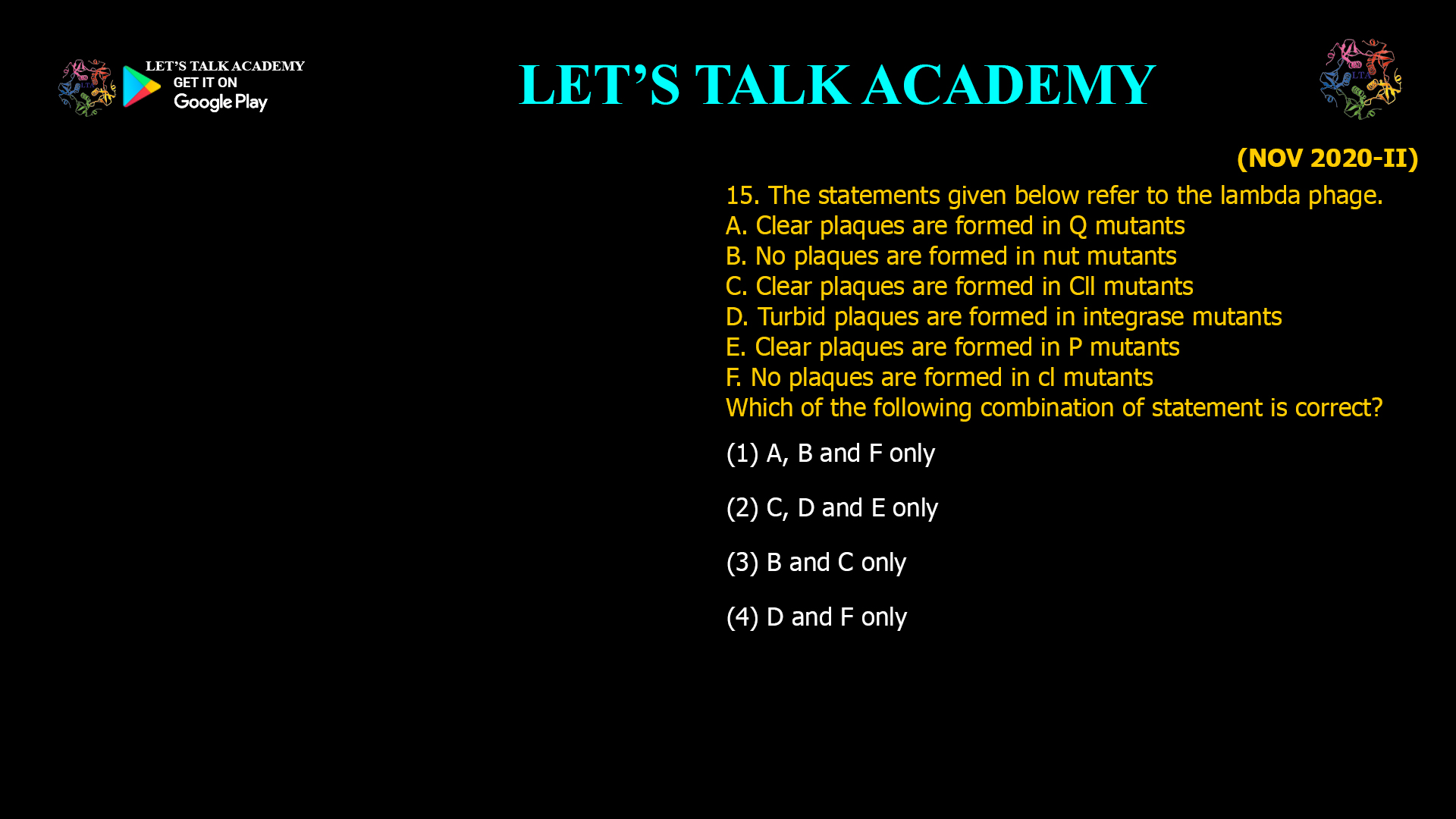
15. The statements given below refer to the lambda phage.
A. Clear plaques are formed in Q mutants
B. No plaques are formed in nut mutants
C. Clear plaques are formed in Cll mutants
D. Turbid plaques are formed in integrase mutants
E. Clear plaques are formed in P mutants
F. No plaques are formed in cl mutants
Which of the following combination of statement is correct?
(1) A, B and F only (2) C, D and E only
(3) B and C only (4) D and F only
Bacteriophage lambda (λ phage) is a temperate virus that infects Escherichia coli and exhibits two types of plaques on bacterial lawns: clear plaques and turbid plaques. These plaque morphologies reflect the phage’s ability or inability to establish lysogeny (dormant integration into the host genome). Various lambda phage mutants affect this ability, resulting in distinct plaque appearances.
What Do Clear and Turbid Plaques Indicate?
-
Clear plaques: Result from phage mutants that fail to establish lysogeny, causing complete lysis of infected bacterial cells. No surviving lysogens grow within the plaque, making it transparent.
-
Turbid plaques: Form when wild-type or certain mutants establish lysogeny in some infected cells. These lysogens survive and form microcolonies, causing cloudiness in the plaque.
Analysis of Mutant Effects on Plaque Morphology
Let’s examine each statement regarding lambda phage mutants and their plaque phenotypes:
A. Clear plaques are formed in Q mutants
-
The Q gene encodes an antiterminator essential for late gene expression during the lytic cycle.
-
Mutations in Q often impair late gene expression, reducing phage production and lysis efficiency.
-
Typically, Q mutants form no plaques or very small plaques, not clear plaques.
-
Statement A is generally incorrect.
B. No plaques are formed in nut mutants
-
The nut (N utilization) sites are necessary for the N antiterminator protein to function.
-
Mutations in nut sites prevent N-mediated antitermination, blocking transcription of delayed early genes.
-
This results in failure to produce progeny phage and thus no plaques form.
-
Statement B is correct.
C. Clear plaques are formed in cII mutants
-
The cII gene product promotes lysogeny by activating cI expression.
-
Mutations in cII reduce lysogenization frequency, leading to a bias toward the lytic cycle.
-
Such mutants form clear plaques due to failure to establish lysogeny.
-
Statement C is correct.
D. Turbid plaques are formed in integrase mutants
-
Integrase (int) is required for phage genome integration into the host chromosome.
-
Mutants lacking integrase cannot form stable lysogens, so they typically form clear plaques, not turbid.
-
Statement D is incorrect.
E. Clear plaques are formed in P mutants
-
The P gene is involved in phage DNA replication.
-
Mutations in P usually impair replication, leading to poor phage production and no or very small plaques, not necessarily clear plaques.
-
Statement E is generally incorrect.
F. No plaques are formed in cI mutants
-
The cI gene encodes the lambda repressor essential for lysogeny.
-
cI mutants cannot maintain lysogeny and enter the lytic cycle immediately, producing clear plaques.
-
Therefore, plaques are formed, but they are clear, not absent.
-
Statement F is incorrect.
Correct Combination of Statements
From the above analysis:
-
B (No plaques in nut mutants) and C (Clear plaques in cII mutants) are correct.
Thus, the correct choice is:
(3) B and C only.
Summary Table of Lambda Phage Mutants and Plaque Phenotypes
| Mutant Gene | Expected Plaque Phenotype | Explanation |
|---|---|---|
| Q | No or small plaques | Late gene expression impaired |
| nut | No plaques | N antitermination blocked, no phage production |
| cII | Clear plaques | Lysogeny impaired, lytic cycle favored |
| integrase | Clear plaques | No integration, lysogeny not established |
| P | No or small plaques | DNA replication defective |
| cI | Clear plaques | No lysogeny, immediate lysis |
Biological Significance
Plaque morphology is a useful phenotypic marker to study phage genetics and lifecycle regulation. Clear plaques indicate mutants defective in lysogeny, while turbid plaques suggest functional lysogen formation. Understanding these differences helps in dissecting the molecular mechanisms controlling phage development.
Conclusion
Among the statements about lambda phage mutants and plaque phenotypes, only B (no plaques in nut mutants) and C (clear plaques in cII mutants) are correct. This reflects the essential roles of N antitermination and CII-mediated lysogeny establishment in phage development.


