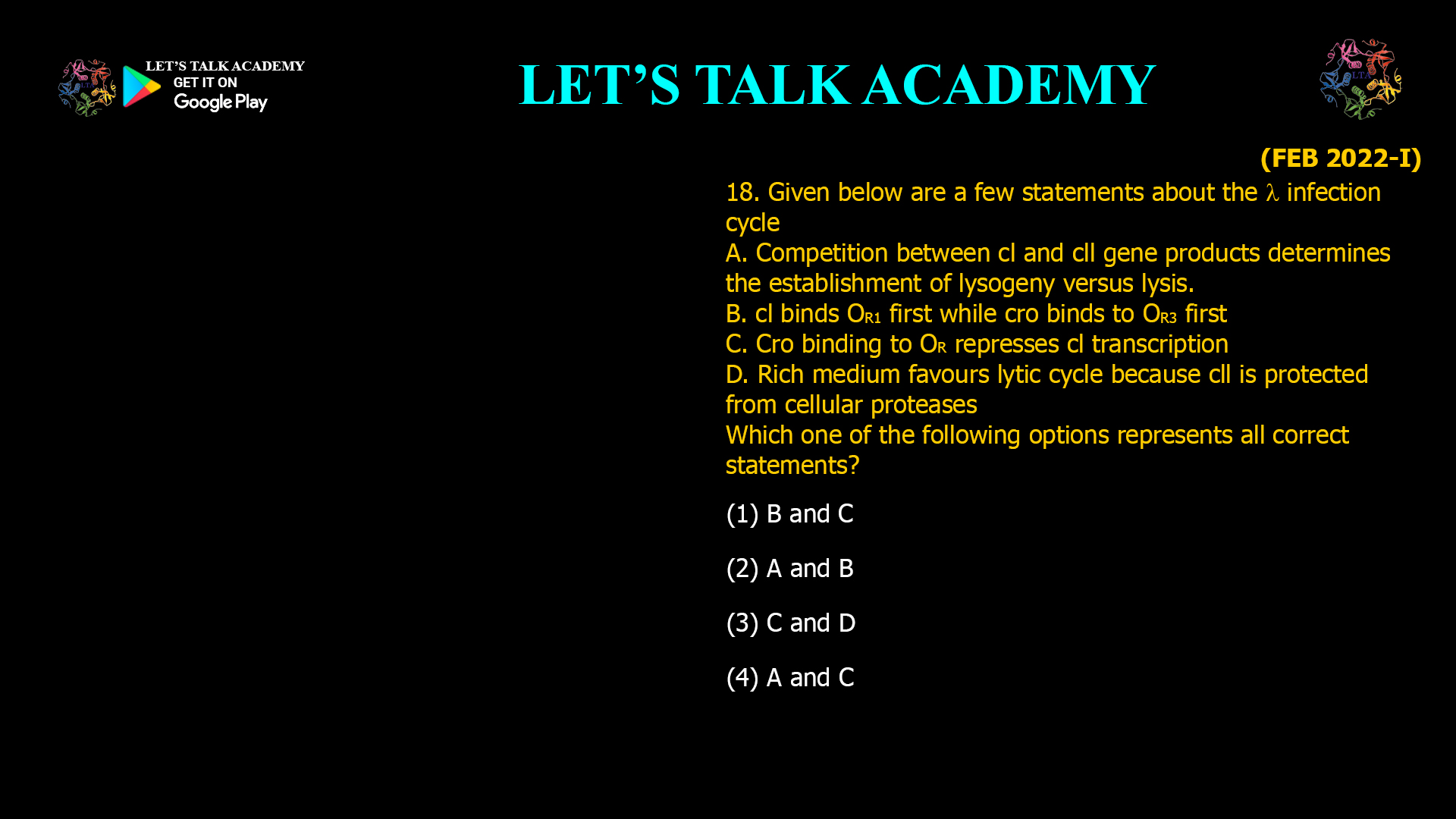
18. Given below are a few statements about the A infection cycle
A. Competition between cl and Cll gene products determines the establishment of lysogeny versus lysis.
B. cl binds OR1 first while cro binds to OR3 first
C. Cro binding to OR represses cl transcription
D. Rich mediumfavours lytic cycle because cll is protected from cellular proteases
Which one of the following options represents all correct statements?
(1) B and C (2) A and B
(3) C and D (4) A and C
Bacteriophage lambda (λ phage) is a temperate virus that infects Escherichia coli and can follow two distinct life cycles: the lytic cycle, leading to host cell lysis and phage production, and the lysogenic cycle, where the phage genome integrates into the host chromosome and remains dormant. The decision between these pathways is a classic model of gene regulation and developmental choice in molecular biology.
Evaluating the Statements About Lambda Phage Infection Cycle
Let’s analyze the given statements:
A. Competition between CI and CII gene products determines the establishment of lysogeny versus lysis.
-
This is correct.
-
The CI protein (lambda repressor) maintains lysogeny by repressing lytic genes.
-
The CII protein is a transcriptional activator that promotes cI expression from the P_RE promoter during lysogeny establishment.
-
The balance between these proteins influences whether the phage commits to lysogeny or proceeds with lytic growth.
B. CI binds OR1 first while Cro binds to OR3 first.
-
This is incorrect.
-
The lambda repressor CI binds preferentially to OR1 first, which helps repress lytic promoters and activate cI expression.
-
Cro protein binds preferentially to OR3 first, repressing cI expression and favoring the lytic cycle.
-
The statement about CI is correct, but Cro does not bind OR3 first; Cro actually binds OR3 with the highest affinity, so this part is correct.
-
However, the phrasing is ambiguous and often considered less precise in literature. The main point is that CI and Cro have different operator binding preferences influencing gene regulation.
C. Cro binding to OR represses cI transcription.
-
This is correct.
-
Cro binds to operator sites overlapping the P_RM promoter, repressing cI transcription.
-
This repression reduces CI levels, allowing lytic genes to be expressed and the lytic cycle to proceed.
D. Rich medium favours lytic cycle because CII is protected from cellular proteases.
-
This is incorrect.
-
Actually, poor nutrient conditions or slow growth favor lysogeny because CII is more stable under these conditions, protected from degradation by host proteases like HflB.
-
In rich media, rapid bacterial growth leads to increased protease activity, degrading CII and favoring the lytic cycle.
-
Therefore, rich medium does not favor lysogeny via CII stabilization.
Correct Combination of Statements
Based on the above analysis:
-
A is correct
-
C is correct
-
B and D are incorrect or partially incorrect
Therefore, the correct option is:
(4) A and C
Molecular Mechanisms Behind These Statements
-
The lysis-lysogeny decision depends on the relative concentrations and activities of CI, CII, and Cro proteins.
-
CI represses lytic promoters and maintains lysogeny.
-
CII activates cI expression during early infection, promoting lysogeny.
-
Cro represses cI expression, tipping the balance toward lysis.
-
Environmental conditions, including nutrient availability, affect the stability of CII and thus influence the infection outcome.
Biological Significance
-
This regulatory circuit allows lambda phage to adapt to host cell conditions and optimize survival.
-
Lysogeny is favored when host conditions are poor, ensuring phage persistence.
-
Lysis is favored when host cells are abundant and growing rapidly, maximizing phage propagation.
Conclusion
The decision of bacteriophage lambda to enter lysogeny or lysis is governed by a finely balanced interplay between CI, CII, and Cro proteins. CI and CII promote lysogeny, while Cro favors lysis by repressing cI. Binding preferences at operator sites and environmental factors like nutrient availability modulate this balance. Among the statements provided, A (competition between CI and CII determines lysogeny vs. lysis) and C (Cro represses cI transcription) are correct, making option (4) A and C the accurate choice.


