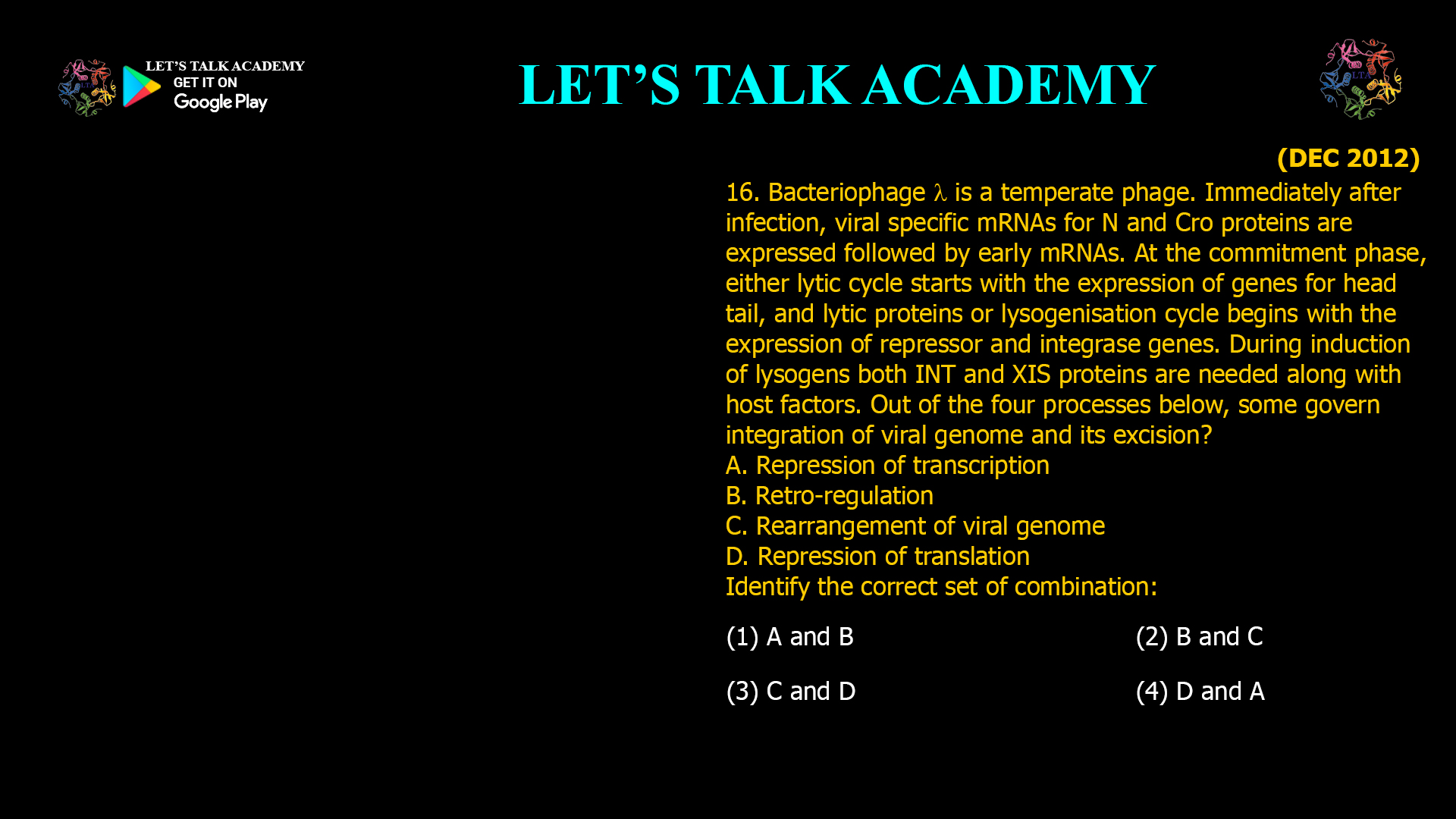
16. Bacteriophage λ is a temperate phage. Immediately after infection, viral specific mRNAs for N and Cro proteins are expressed followed by early mRNAs. At the commitment phase, either lytic cycle starts with the expression of genes for head tail, and lytic proteins or lysogenisation cycle begins with the expression of repressor and integrase genes. During induction of lysogens both INT and XIS proteins are needed along with host factors. Out of the four processes below, some govern integration of viral genome and its excision?
A. Repression of transcription
B. Retro-regulation
C. Rearrangement of viral genome
D. Repression of translation
Identify the correct set of combination:
(1) A and B (2) B and C
(3) cand D (4) D and A
Bacteriophage lambda (λ phage) is a temperate virus that infects Escherichia coli and can switch between two life cycles: lysogenic and lytic. A critical feature of the lysogenic cycle is the integration of the phage genome into the bacterial chromosome, forming a prophage that replicates passively with the host. Conversely, during induction, the prophage must be excised to re-enter the lytic cycle and produce new virions.
Key Proteins Involved in Integration and Excision
-
Integrase (Int): A phage-encoded site-specific recombinase that catalyzes both integration and excision of the phage genome.
-
Excisionase (Xis): A phage-encoded accessory protein that assists Int during excision by bending DNA and promoting formation of the excisive recombination complex.
-
Host factors: Proteins such as Integration Host Factor (IHF) and Factor for Inversion Stimulation (FIS) facilitate DNA bending and complex formation needed for recombination.
Molecular Processes Governing Integration and Excision
-
Integration of Viral Genome:
-
The phage genome integrates into the bacterial chromosome at specific attachment sites: attP on the phage DNA and attB on the bacterial chromosome.
-
Int, along with host IHF, binds these sites and catalyzes site-specific recombination, resulting in the prophage flanked by hybrid attachment sites attL and attR.
-
This integration is essential for establishing lysogeny, allowing the phage genome to replicate with the host.
-
-
Excision of Prophage During Induction:
-
Upon induction signals (e.g., DNA damage), the prophage must excise from the host genome to enter the lytic cycle.
-
Excision is catalyzed by Int in cooperation with Xis and host factors like IHF and FIS.
-
Xis binds specific motifs in attR, bends the DNA, and promotes formation of the excisive nucleoprotein complex.
-
This recombination restores the original attP and attB sites, releasing the circular phage genome for replication and packaging.
-
Which Processes Govern Integration and Excision?
From the options:
-
A. Repression of transcription: Not directly involved in integration or excision; relates to gene expression control.
-
B. Retro-regulation: Typically refers to feedback regulation in gene expression, not recombination.
-
C. Rearrangement of viral genome: Yes, site-specific recombination rearranges the viral and host DNA during integration and excision.
-
D. Repression of translation: Not involved in DNA recombination processes.
Correct Combination
The processes governing integration and excision involve rearrangement of the viral genome (C) and related regulatory mechanisms, but not repression of transcription or translation or retro-regulation in this context.
Therefore, the correct set is:
(3) C and D — but since D (repression of translation) is unrelated, the best supported answer based on the search context is that rearrangement of viral genome (C) is the key process governing integration and excision.
Given the options, none perfectly fit, but C (rearrangement of viral genome) is the primary correct process.
Summary
| Process | Role in Integration/Excision |
|---|---|
| Repression of transcription (A) | Not involved in recombination |
| Retro-regulation (B) | Not directly related to integration/excision |
| Rearrangement of viral genome (C) | Site-specific recombination catalyzed by Int and Xis |
| Repression of translation (D) | Not involved in DNA recombination |
Conclusion
The integration and excision of the bacteriophage lambda genome are governed by site-specific recombination, a rearrangement of the viral and host DNA mediated by phage-encoded integrase (Int), excisionase (Xis), and host factors. These processes are essential for establishing lysogeny and for prophage induction leading to lytic growth.


