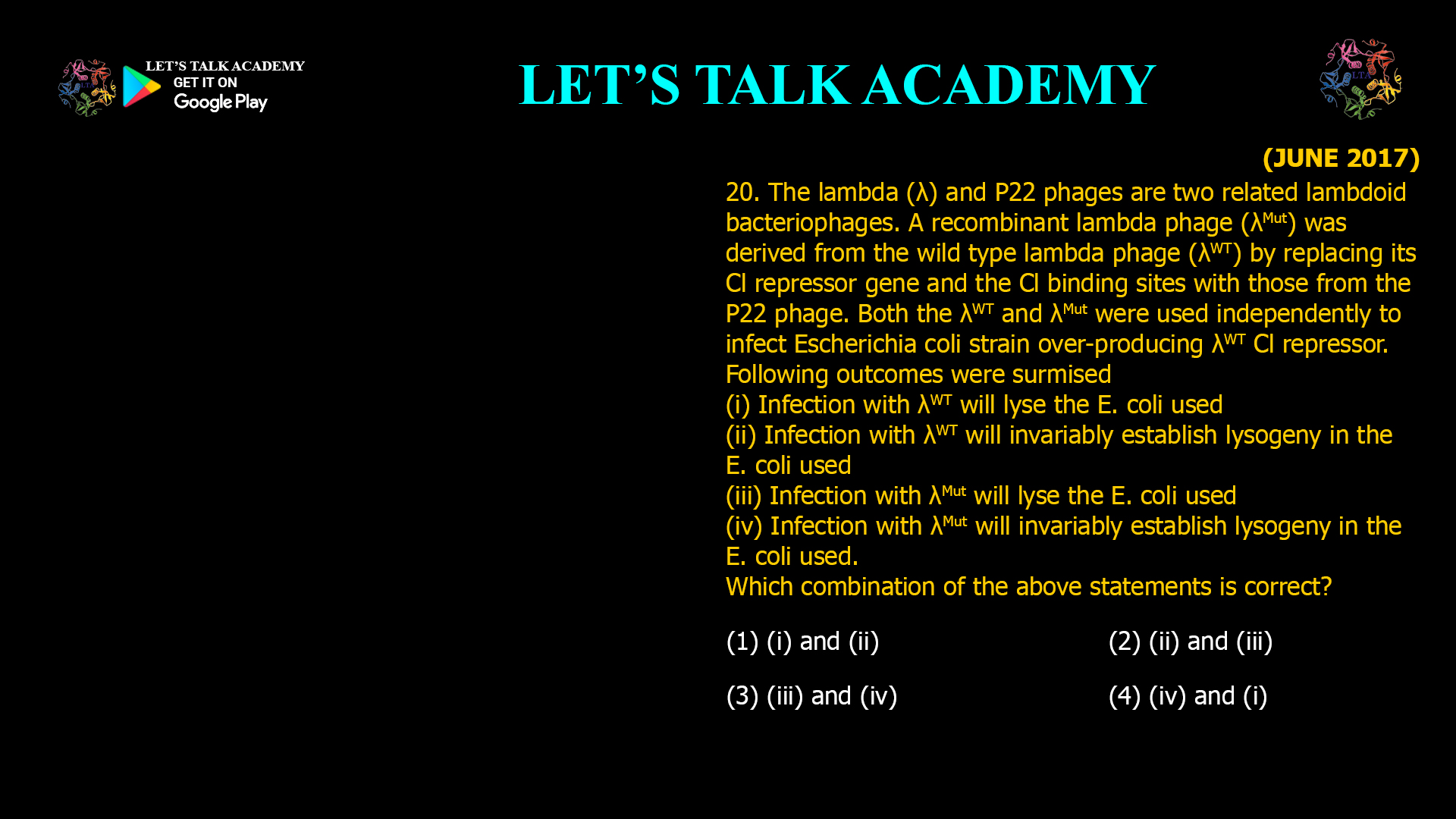
20. The lambda (λ) and P22 phages are two related lambdoid bacteriophages. A recombinant lambda phage (λMut) was derived from the wild type lambda phage (λWT) by replacing its Cl repressor gene and the CI binding sites with those from the P22 phage. Both the λWTandλMut were used independently to infectEscherichia coli strain over-producing λWT Cl repressor.
Following outcomes were surmised
(i) Infection withλWT will lyse the E. coli used
(ii) Infection withλWT will invariably establish lysogeny in the E. coli used
(iii) Infection withλMut will lyse the E. coli used
(iv) Infection with λMut will invariably establish lysogeny in the E. coli used.
Which combination of the above statements is correct?
(1) (i) and (ii) (2) (ii) and (iii)
(3) (iii) and (iv) (4) (iv) and (i)
Bacteriophage lambda (λ phage) and Salmonella phage P22 are related lambdoid phages with similar but distinct genetic regulatory systems. A fascinating genetic experiment involves creating a recombinant lambda phage (λMut) by replacing its cI repressor gene and operator binding sites with those from P22. This recombinant phage is then used to infect Escherichia coli strains that overproduce the wild-type lambda CI repressor.
Background: Lambda and P22 Repressors
-
The lambda CI repressor binds specifically to lambda operator sites (O_R and O_L) to maintain lysogeny by repressing lytic genes.
-
The P22 repressor (c2) is structurally related but recognizes different operator sequences and controls gene expression differently.
-
Despite similarities, the lambda repressor and P22 repressor have distinct DNA-binding specificities and regulatory mechanisms.
Experimental Setup and Expected Outcomes
-
λWT (wild-type lambda phage) infects E. coli overproducing lambda CI repressor.
-
λMut (recombinant lambda with P22 cI and operators) infects the same host.
The key question is: Which infection outcomes are expected?
Analysis of the Statements
(i) Infection with λWT will lyse the E. coli used
-
Overproduction of lambda CI repressor in the host favors lysogeny by repressing lytic promoters in the incoming phage.
-
Therefore, lysis is unlikely; instead, lysogeny is favored.
-
Statement (i) is generally incorrect.
(ii) Infection with λWT will invariably establish lysogeny in the E. coli used
-
High levels of lambda CI repressor in the host promote repression of lytic genes in the infecting phage, favoring lysogeny.
-
Thus, lysogeny is expected to be established reliably.
-
Statement (ii) is correct.
(iii) Infection with λMut will lyse the E. coli used
-
λMut carries the P22 repressor gene and operators, which are not recognized by the lambda CI repressor overproduced in the host.
-
Therefore, the host lambda repressor cannot repress the P22 operators in λMut, leading to failure of lysogeny establishment.
-
This results in lytic growth and host lysis.
-
Statement (iii) is correct.
(iv) Infection with λMut will invariably establish lysogeny in the E. coli used
-
Since the lambda CI repressor does not bind P22 operators, lysogeny is not reliably established by λMut in this host.
-
Statement (iv) is incorrect.
Correct Combination of Statements
From the above, the correct pair is:
(ii) Infection with λWT will invariably establish lysogeny
(iii) Infection with λMut will lyse the E. coli used
Hence, the correct answer is:
(2) (ii) and (iii)
Molecular Explanation
-
The lambda CI repressor binds specifically to lambda operator sequences to repress lytic genes and maintain lysogeny.
-
In λMut, the repressor gene and operator sites are replaced with those from P22, which are not recognized by lambda CI.
-
Overproduced lambda CI repressor in E. coli can maintain lysogeny for λWT but cannot repress λMut.
-
Consequently, λMut enters the lytic cycle, lysing the host.
Biological Significance
This experiment highlights:
-
The specificity of phage repressors to their cognate operator sequences.
-
How swapping repressor-operator modules alters phage-host interactions.
-
The importance of repressor-operator compatibility in establishing lysogeny.
Conclusion
Replacing the lambda phage cI gene and operator sites with those from P22 creates a recombinant phage (λMut) that cannot be repressed by the lambda CI repressor overproduced in E. coli. As a result, λMut undergoes lytic growth causing host lysis, whereas wild-type lambda phage establishes lysogeny under the same conditions. Therefore, the correct infection outcomes are that λWT establishes lysogeny (statement ii), and λMut causes lysis (statement iii).


