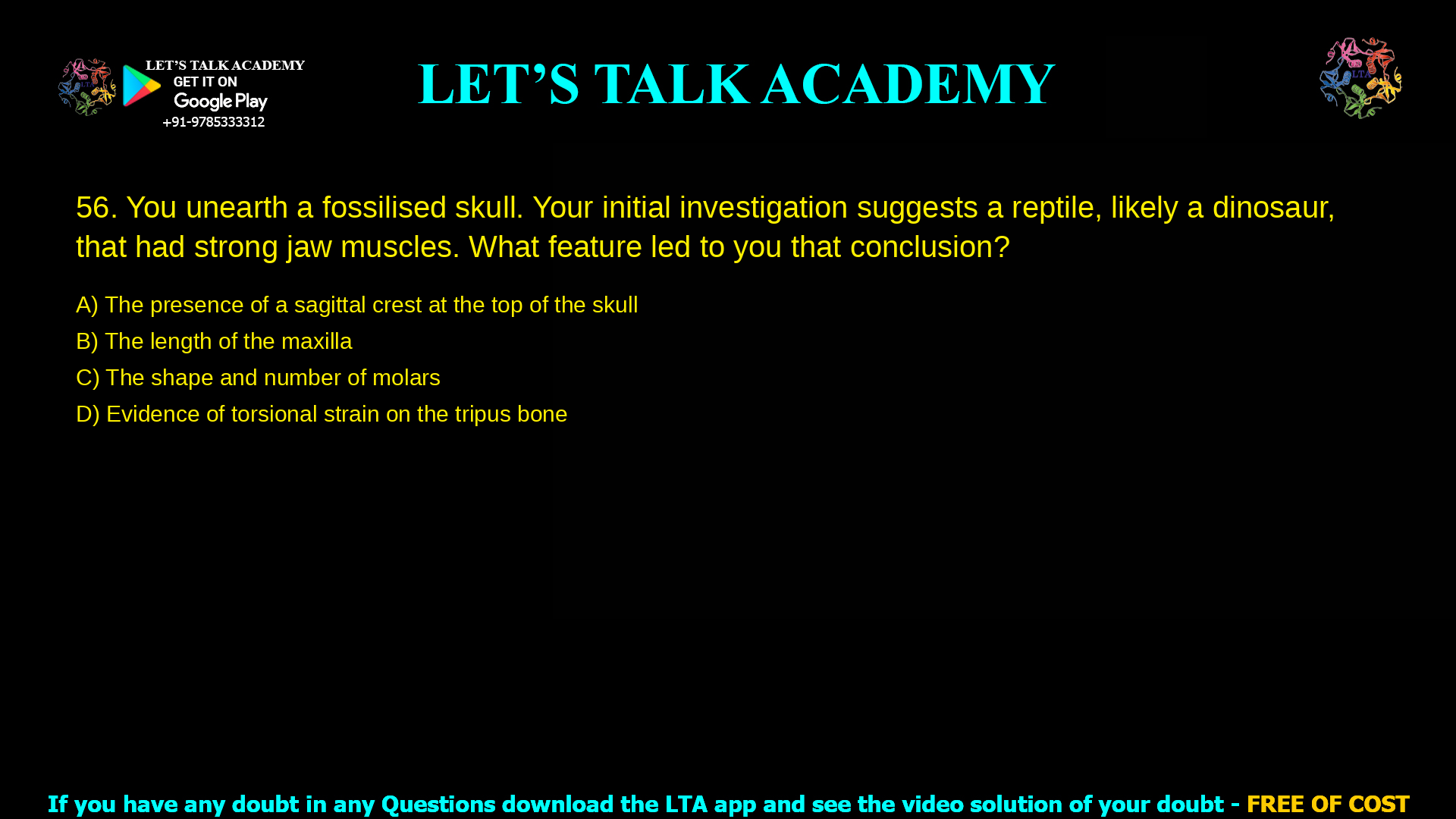
You unearth a fossilised skull. Your initial investigation suggests a reptile,
likely a dinosaur, that had strong jaw muscles. What feature led to you that
conclusion?
The presence of a sagittal crest at the top of the skull
The length of the maxilla
The shape and number of molars
Evidence of torsional strain on the tripus bone
Unearthing a fossilized dinosaur skull is an exciting discovery that offers a glimpse into prehistoric life. When examining such fossils to determine jaw muscle strength, one key feature stands out: the sagittal crest at the top of the skull. This article explains why the sagittal crest is a primary indicator of strong jaw muscles and discusses other skull features that paleontologists consider during fossil identification.
The Presence of a Sagittal Crest
The sagittal crest is a ridge of bone that runs along the midline of the top of a skull. It serves as an attachment site for strong jaw muscles called temporalis muscles. In dinosaurs and other reptiles, a well-developed sagittal crest signals powerful biting and chewing abilities because larger muscles require more surface area for attachment. Thus, finding a sagittal crest is a reliable clue that the creature had strong jaw muscles.
The Length of the Maxilla
The maxilla is the upper jaw bone that holds the upper teeth. While its length can indicate the size and shape of the jaw, it does not directly reveal muscle strength. Longer maxillae may relate to different feeding habits or tooth arrangement but are not reliable indicators of jaw muscle power by themselves.
The Shape and Number of Molars
Molars are teeth specialized for grinding food, mostly in mammals. Dinosaurs had varied tooth types but not true molars like mammals do. Therefore, examining the shape and number of molars is less relevant when assessing jaw muscle strength in dinosaurs. Instead, tooth shape provides insight into diet (e.g., carnivore vs herbivore).
Evidence of Torsional Strain on the Tripus Bone
The tripus bone is not a recognized term in dinosaur anatomy and does not relate to jaw muscle attachment or strength. Torsional strain evidence on bones can help understand movement or stress patterns but is unrelated to identifying powerful jaw muscles in fossilized skulls.
In conclusion, the presence of a sagittal crest is the most direct and trusted feature that indicates strong jaw muscles in reptilian fossils like those of dinosaurs. Understanding these features helps paleontologists reconstruct feeding behavior and ecological roles of ancient animals.
Would you like an article focusing on specific dinosaur species known for their strong jaws?


