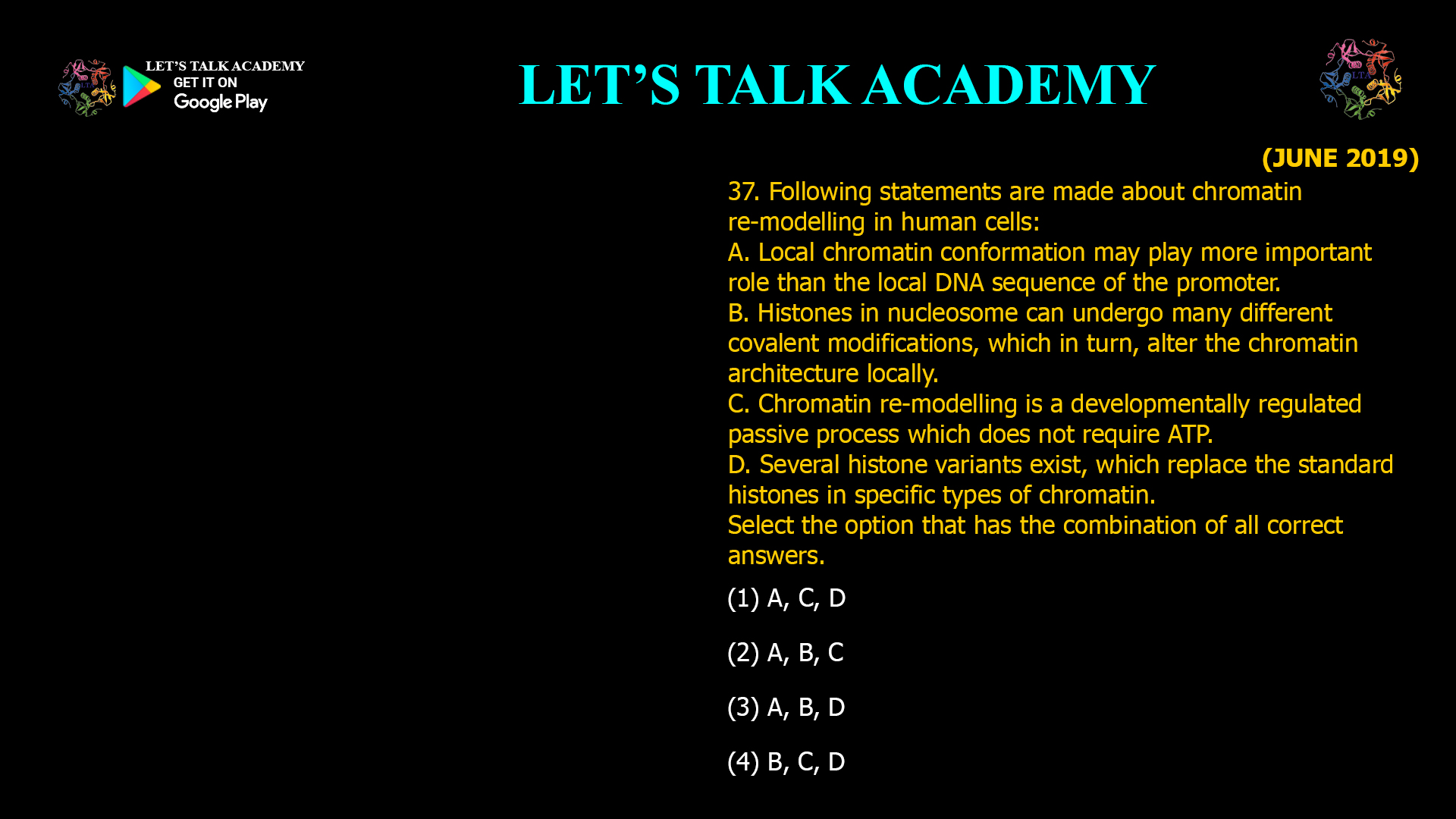
37. Following statements are made about chromatin re-modelling in human cells:
A. Local chromatin conformation may play more important role than the local DNA sequence of the promoter.
B. Histones in nucleosome can undergo many different covalent modifications, which in turn, alter the chromatin architecture locally.
C. Chromatin re-modelling is a developmentally regulated passive process which does not require ATP.
D. Several histone variants exist, which replace the standard histones in specific types of chromatin.
Select the option that has the combination of all correct answers.
(1) A, C, D (2) A, B, C
(3) A, B, D (4) B, C, D
Introduction
Chromatin remodeling is a fundamental process in human cells that regulates gene expression by dynamically altering chromatin structure. This remodeling allows access to DNA by transcriptional machinery and other regulatory proteins. Understanding the mechanisms and characteristics of chromatin remodeling is essential for insights into development, differentiation, and disease. This article examines key statements about chromatin remodeling, clarifying which are accurate based on current scientific knowledge.
Key Characteristics of Chromatin Remodeling
A. Local Chromatin Conformation vs. DNA Sequence
The local conformation of chromatin—how DNA is packaged and folded—often plays a more significant role in regulating gene expression than the local DNA sequence of the promoter alone. Chromatin structure can either facilitate or hinder access of transcription factors and RNA polymerase to DNA, thus influencing transcriptional outcomes.
B. Histone Modifications Alter Chromatin Architecture
Histones within nucleosomes undergo numerous covalent post-translational modifications such as acetylation, methylation, phosphorylation, and ubiquitination. These modifications change the interaction between histones and DNA, thereby altering chromatin compaction and accessibility locally. Such modifications serve as signals for recruiting chromatin remodelers and transcription factors, modulating gene expression dynamically.
C. ATP-Dependence and Active Nature of Chromatin Remodeling
Chromatin remodeling is an active, ATP-dependent process. Specialized chromatin remodeling complexes utilize energy from ATP hydrolysis to slide, evict, or restructure nucleosomes. This active remodeling is tightly regulated during development and in response to cellular signals. Therefore, the idea that chromatin remodeling is a passive process that does not require ATP is incorrect.
D. Histone Variants in Specific Chromatin Types
Multiple histone variants exist beyond the canonical histones and can replace standard histones in specific chromatin contexts. These variants contribute to chromatin diversity and influence DNA accessibility, nucleosome stability, and gene regulation. For example, H3.3 is associated with active chromatin, while macroH2A is linked to repressive chromatin.
Correct Combination of Statements
Based on the above analysis and current scientific evidence:
-
Statements A, B, and D are correct.
-
Statement C is incorrect because chromatin remodeling requires ATP and is an active process.
Conclusion
Chromatin remodeling in human cells is a complex, ATP-dependent process influenced by local chromatin conformation, histone modifications, and the incorporation of histone variants. These factors collectively regulate the accessibility of DNA to transcriptional machinery, thereby controlling gene expression. Recognizing the active nature of chromatin remodeling and the roles of histone modifications and variants is crucial for understanding gene regulation and its implications in health and disease.
Answer:
The correct option is (3) A, B, D.


