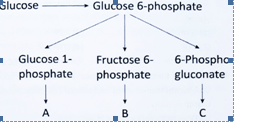
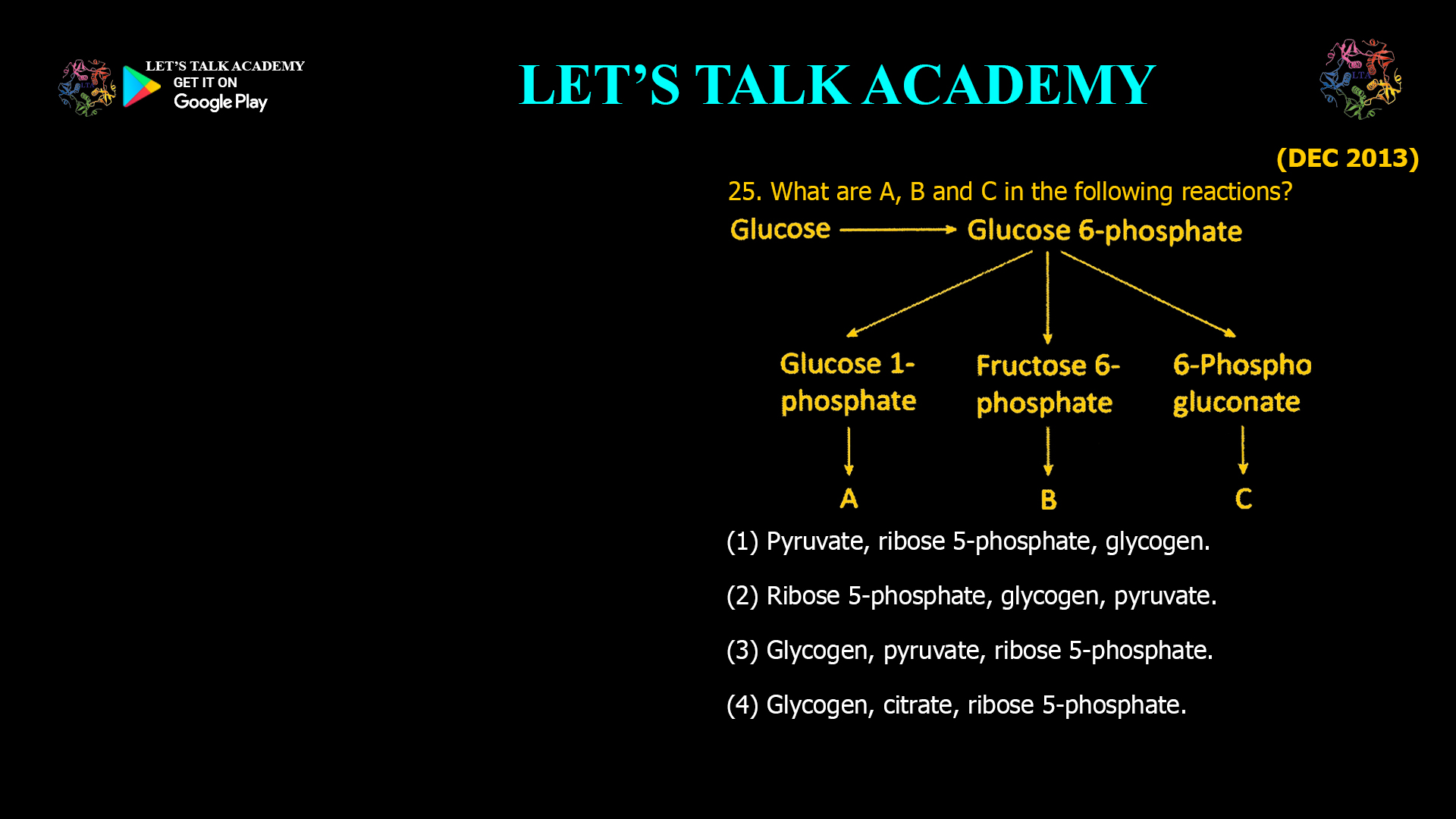
- What are A, B and C in the following reactions?
(1) Pyruvate, ribose 5-phosphate, glycogen.
(2) Ribose 5-phosphate, glycogen, pyruvate.
(3) Glycogen, pyruvate, ribose 5-phosphate.
(4) Glycogen, citrate, ribose 5-phosphate
.
Cellular metabolism involves a complex network of biochemical reactions that convert nutrients into energy and essential biomolecules. Among the crucial metabolites in these pathways are glycogen, pyruvate, and ribose 5-phosphate—each playing distinct yet interconnected roles in energy storage, energy production, and biosynthesis.
This article clarifies the identities of A, B, and C in the context of metabolic reactions, explaining their biochemical significance and how they fit into the broader metabolic framework.
Glycogen: The Storage Form of Glucose (A)
Glycogen is a highly branched polysaccharide composed of glucose units and serves as the primary storage form of glucose in animals, particularly in the liver and muscles.
-
Role in Metabolism:
Glycogen acts as a reservoir of glucose that can be rapidly mobilized when the body requires energy. During glycogenolysis, glycogen is broken down to glucose-1-phosphate, which is converted to glucose-6-phosphate and enters glycolysis or the pentose phosphate pathway. -
Significance:
The liver maintains blood glucose levels by releasing glucose derived from glycogen, while muscle glycogen provides energy locally during muscle contraction.
Pyruvate: The End Product of Glycolysis (B)
Pyruvate is a three-carbon keto acid formed as the final product of glycolysis, the metabolic pathway that breaks down glucose to extract energy.
-
Role in Metabolism:
Pyruvate serves as a critical metabolic hub. Under aerobic conditions, it is transported into mitochondria and converted to acetyl-CoA, entering the citric acid cycle for further oxidation and ATP production. Under anaerobic conditions, pyruvate can be reduced to lactate. -
Significance:
Pyruvate links carbohydrate metabolism to energy production and biosynthetic pathways, making it essential for cellular respiration and metabolic flexibility.
Ribose 5-Phosphate: A Key Intermediate in the Pentose Phosphate Pathway (C)
Ribose 5-phosphate (R5P) is a sugar phosphate produced via the pentose phosphate pathway (PPP), a metabolic route parallel to glycolysis.
-
Role in Metabolism:
R5P is crucial for the synthesis of nucleotides and nucleic acids, serving as the sugar backbone for RNA and DNA. The PPP also generates NADPH, vital for reductive biosynthesis and antioxidant defense. -
Significance:
The production of R5P supports cell growth and division by providing building blocks for genetic material and maintaining redox balance.
Interconnection of Glycogen, Pyruvate, and Ribose 5-Phosphate in Metabolism
The metabolic pathways involving these molecules are interconnected:
-
Glycogen Breakdown to Pyruvate:
Glycogen is degraded to glucose-6-phosphate, which enters glycolysis and is ultimately converted to pyruvate, producing ATP and NADH. -
Glucose-6-Phosphate into the Pentose Phosphate Pathway:
Alternatively, glucose-6-phosphate can enter the PPP, generating ribose 5-phosphate and NADPH. -
Balancing Energy and Biosynthesis:
Cells regulate the flux between glycolysis and PPP depending on energy demands and the need for nucleotide synthesis or antioxidant capacity.
Matching A, B, and C to Their Metabolic Identities
Based on their roles:
-
A = Glycogen (storage polysaccharide)
-
B = Pyruvate (glycolytic end product)
-
C = Ribose 5-phosphate (PPP product for nucleotide synthesis)
This corresponds to option:
(3) Glycogen, pyruvate, ribose 5-phosphate
Summary Table
Letter Metabolite Metabolic Role A Glycogen Glucose storage and mobilization B Pyruvate End product of glycolysis; energy hub C Ribose 5-phosphate Nucleotide synthesis and NADPH generation
Conclusion
Understanding the metabolic functions of glycogen, pyruvate, and ribose 5-phosphate provides insight into how cells balance energy storage, energy production, and biosynthesis. Glycogen serves as a glucose reservoir, pyruvate acts as a central intermediate in energy metabolism, and ribose 5-phosphate supports the synthesis of nucleotides essential for genetic material.
Correct answer: (3) Glycogen, pyruvate, ribose 5-phosphate
-


26 Comments
Kirti Agarwal
September 18, 2025Glycogen, pyruvate, ribose suger
Neha Yadav
September 20, 2025A = Glycogen, B = Pyruvate, C = Ribose -5- phosphate
Bhawna Choudhary
September 21, 2025Glycogen, pyruvate, ribose 5-phosphate
Sonal Nagar
September 21, 2025Glycogen, pyruvate, ribose 5-phosphate…
Manisha choudhary
September 22, 2025Glycogen ,pyruvate ,ribose 5 phosphate is correct answer
Pallavi Ghangas
September 22, 2025glycogen , pyruvate , ribose 5p
Aakansha sharma Sharma
September 22, 2025Correct answer: (3) Glycogen, pyruvate, ribose 5-phosphate
Aafreen Khan
September 23, 2025Glycogen, pyruvate, ribose 5-phosphate
Deepika sheoran
September 23, 2025Glycogen, pyruvate,ribose 5 phosphate
Dharmpal Swami
September 23, 2025Glycogen, pyruvate and ribose 5 phosphate
Anurag Giri
September 23, 2025Correct answer: (3) Glycogen, pyruvate, ribose 5-phosphate
Heena Mahlawat
September 24, 2025Glycogen pyruvate and ribose 5 phosphate
Roopal Sharma
September 24, 20253 option is correct – G 1 phosphate forms glycogen in glycogenolysis, F-6 phosphate forms pyruvate in glycolysis and 6 phospho gluconate forms ribose 5 phosphate in PPP.
Minal Sethi
September 24, 2025Glycogen, pyruvate, ribose 5-phosphate.
option 3
Nilofar Khan
September 24, 2025Correct answer is (3)
A=Glycogen
B=pyruvate
C= ribose 5-phosphate.
Deepika sheoran
September 24, 2025Glycogen pyruvate ribose 5 phosphate
Soniya Shekhawat
September 24, 2025Option 3rd is correct.
Mohd juber Ali
September 25, 2025Option 3
Glycogen , pyruvate, ribose 5 p
Payal Gaur
September 25, 2025Glycogen, pyruvate and ribose 5 phosphate
Avni
September 25, 2025(3) Glycogen, pyruvate, ribose 5-phosphate
Muskan Yadav
September 26, 2025Correct answer: (3) Glycogen, pyruvate, ribose 5-phosphate
Arushi Saini
September 27, 2025A = Glycogen, B = Pyruvate, C = Ribose -5- phosphate
Varsha Tatla
September 27, 2025Correct answer will be 33
Kajal
October 2, 2025Option 3 Glycogen, Pyruvate and ribose 5 phosphate
Santosh Saini
October 5, 2025Glycogen ( storage polysaccharide) , Pyruvate (Glycolytic end product) , Ribose 5 phosphate ( pentose phosphate pathway for nucleotide synthesis)
Sakshi Kanwar
November 26, 2025Glycogen, pyruvate, ribose 5-phosphate