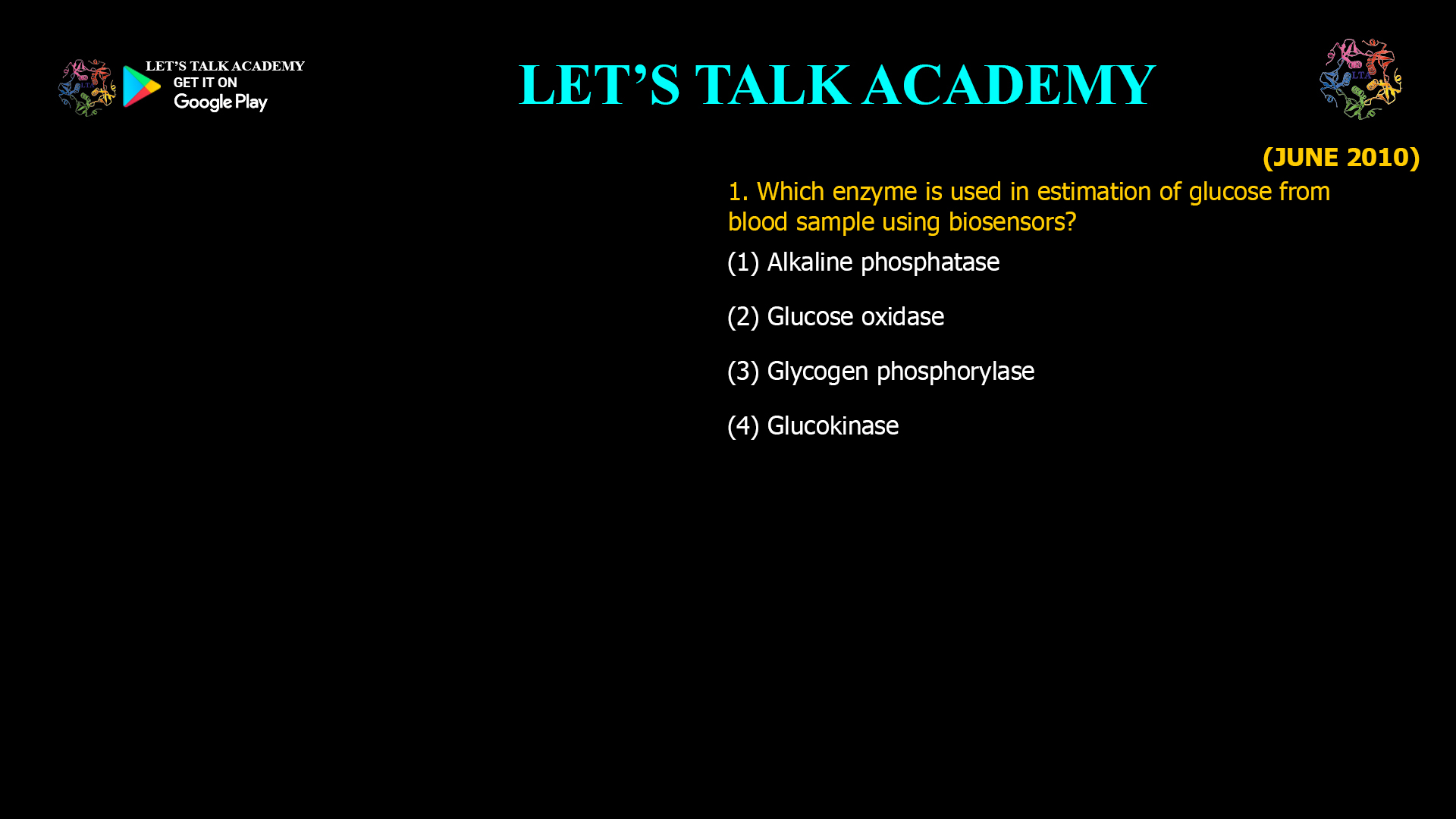
- Which enzyme is used in estimation of glucose from blood sample using biosensors?
(1) Alkaline phosphatase (2) Glucose oxidase
(3) Glycogen phosphorylase (4) GlucokinaseDetailed option-wise explanation:
-
Alkaline phosphatase
-
A hydrolase that removes phosphate groups from many substrates.
-
Used in some diagnostic assays (e.g., ELISA), but not the classic choice for specific glucose detection in blood biosensors.
-
Glucose oxidase – correct
-
Flavoprotein enzyme that specifically oxidizes β-D-glucose to gluconic acid while reducing oxygen to hydrogen peroxide.
-
In most electrochemical blood glucose biosensors (glucometers), glucose oxidase is immobilized on the electrode; the produced hydrogen peroxide or electron transfer from the enzyme is measured as a current proportional to glucose concentration.
-
High specificity and robustness make it the standard recognition element for glucose estimation.
-
Glycogen phosphorylase
-
Enzyme in glycogen breakdown, catalyzing phosphorolysis of glycogen to glucose-1-phosphate in tissues like liver and muscle.
-
Not used in glucose biosensors because it does not directly or specifically measure free blood glucose.
-
Glucokinase
-
A hexokinase isoform that phosphorylates glucose to glucose-6-phosphate in liver and pancreas, functioning in glucose sensing and metabolism.
-
While biologically important, it is not typically immobilized in commercial blood glucose biosensors.
Therefore, for estimation of glucose from a blood sample using biosensors, the enzyme used is glucose oxidase (option 2).
-


1 Comment
Muskan Yadav
December 8, 2025Glucose oxidase – correct