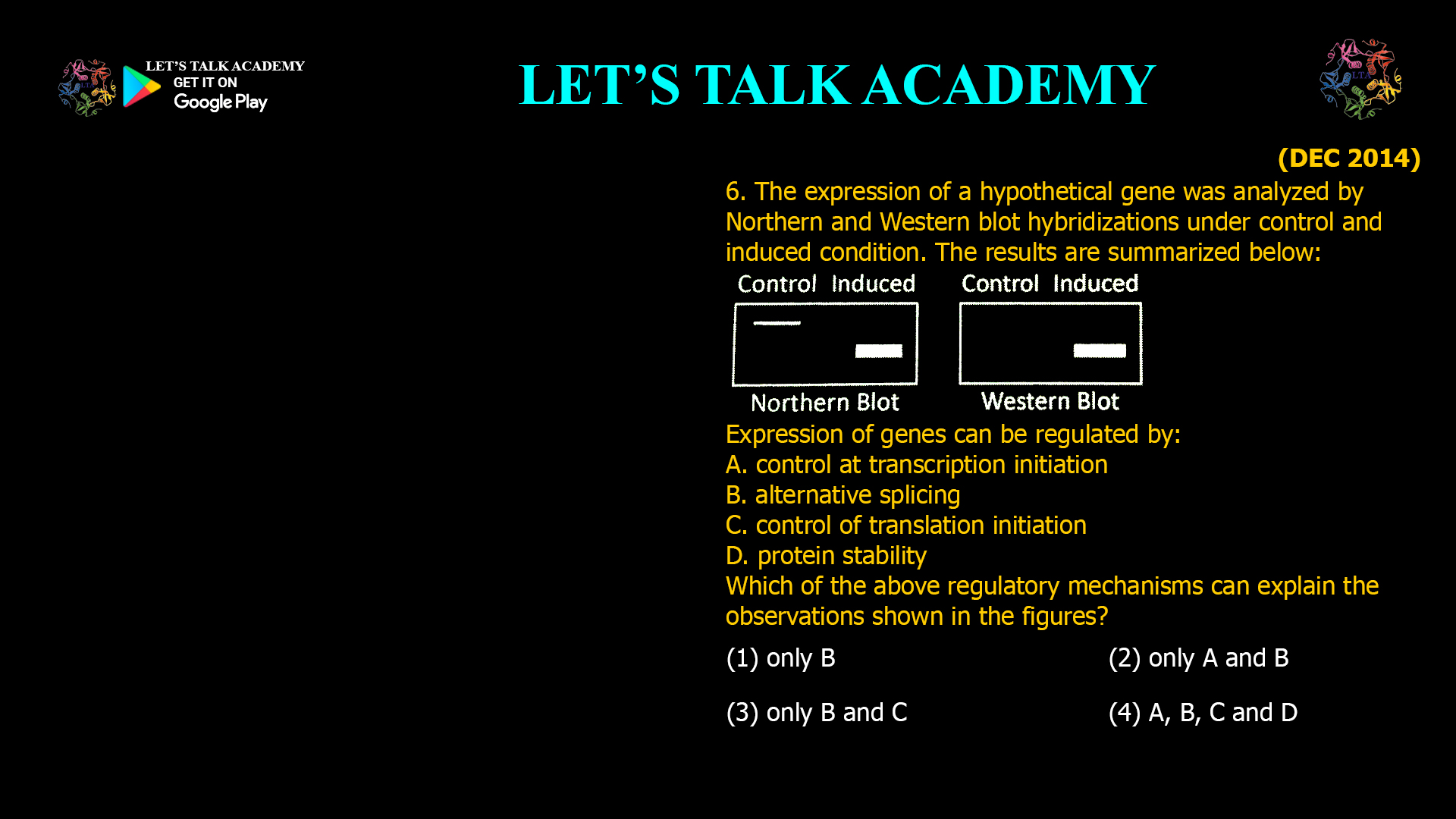
- The expression of a hypothetical gene was analyzed by Northern and Western blot hybridizations under control and induced condition. The results are summarized below:
Expression of genes can be regulated by:
A. control at transcription initiation
B. alternative splicing
C. control of translation initiation
D. protein stability
Which of the above regulatory mechanisms can explain the observations shown in the figures?
(1) only B (2) only A and B
(3) only B and C (4) A, B, C and D
Introduction
Gene expression is a tightly regulated process that ensures the right proteins are produced at the right time and in the right amounts. Researchers use techniques like Northern and Western blotting to analyze mRNA and protein levels, respectively, under different experimental conditions. These analyses can reveal how gene expression is controlled at multiple levels, from transcription initiation to protein degradation. This article explains how each regulatory mechanism can influence the results observed in Northern and Western blot experiments.
Overview of Gene Expression Regulation
Gene expression is regulated at several stages, each providing a unique point of control:
-
Transcription initiation: The process by which RNA polymerase binds to the promoter of a gene and begins synthesizing mRNA. This is a primary point of regulation for the amount of mRNA produced145.
-
Alternative splicing: The process by which different mRNA isoforms are generated from a single gene by selectively including or excluding exons. This can lead to the production of different protein isoforms4.
-
Translation initiation: The process by which ribosomes assemble on mRNA and begin synthesizing proteins. Regulation at this stage controls how much protein is made from existing mRNA7.
-
Protein stability: The process by which proteins are targeted for degradation, determining how long they persist in the cell. This affects the steady-state level of proteins8.
Each of these mechanisms can influence the results observed in Northern and Western blot experiments.
Northern and Western Blot Analyses
Northern Blot
-
Purpose: Measures the abundance and size of specific mRNA molecules.
-
What it reveals: Changes in mRNA levels or the presence of different mRNA isoforms (due to alternative splicing).
-
Limitations: Does not directly measure protein levels or activity.
Western Blot
-
Purpose: Measures the abundance and sometimes the size of specific proteins.
-
What it reveals: Changes in protein levels or the presence of different protein isoforms (due to alternative splicing or post-translational modifications).
-
Limitations: Does not directly measure mRNA levels.
How Each Regulatory Mechanism Can Affect Blot Results
A. Control at Transcription Initiation
-
Effect on Northern blot: Changes in transcription initiation lead to changes in mRNA abundance. If transcription is upregulated, more mRNA will be detected; if downregulated, less mRNA will be detected.
-
Effect on Western blot: Changes in mRNA abundance can lead to changes in protein levels, but this is an indirect effect.
B. Alternative Splicing
-
Effect on Northern blot: Alternative splicing can produce different mRNA isoforms, which may differ in size or sequence. If the probe used in the Northern blot is specific to a particular isoform, differences in band pattern or intensity can be observed.
-
Effect on Western blot: Alternative splicing can also produce different protein isoforms, which may differ in size or sequence. If the antibody used in the Western blot is specific to a particular isoform, differences in band pattern or intensity can be observed.
C. Control of Translation Initiation
-
Effect on Northern blot: Regulation at the level of translation initiation does not directly affect mRNA levels, so no change would be observed in the Northern blot.
-
Effect on Western blot: Changes in translation initiation can lead to changes in protein levels without affecting mRNA levels. This would result in differences in protein abundance detected by Western blot.
D. Protein Stability
-
Effect on Northern blot: Changes in protein stability do not affect mRNA levels, so no change would be observed in the Northern blot.
-
Effect on Western blot: Changes in protein stability can lead to changes in protein levels without affecting mRNA levels. This would result in differences in protein abundance detected by Western blot.
Summary Table
| Mechanism | Northern Blot Effect | Western Blot Effect |
|---|---|---|
| Transcription initiation (A) | mRNA level changes | Protein level changes* |
| Alternative splicing (B) | mRNA isoform changes | Protein isoform changes |
| Translation initiation (C) | No change | Protein level changes |
| Protein stability (D) | No change | Protein level changes |
*Indirect effect via mRNA level changes.
Which Mechanisms Can Explain Observed Differences?
Since both Northern and Western blots are used, all four mechanisms can potentially explain differences in gene expression:
-
A. Control at transcription initiation: Explains changes in mRNA levels (Northern blot) and, indirectly, protein levels (Western blot).
-
B. Alternative splicing: Explains changes in mRNA or protein isoforms (Northern or Western blot).
-
C. Control of translation initiation: Explains changes in protein levels (Western blot) without changes in mRNA levels.
-
D. Protein stability: Explains changes in protein levels (Western blot) without changes in mRNA levels.
Therefore, any of these mechanisms could be responsible for observed differences in gene expression as measured by Northern and Western blot.
Conclusion
Gene expression can be regulated at multiple levels, including transcription initiation, alternative splicing, translation initiation, and protein stability. Northern and Western blot analyses provide complementary information about mRNA and protein levels, respectively. Depending on the experimental results, all four regulatory mechanisms (A, B, C, and D) can explain observed differences in gene expression. Thus, the correct answer is:
(4) A, B, C and D
This understanding is essential for interpreting gene expression data and designing experiments to identify the specific mechanisms controlling gene expression in different biological contexts


