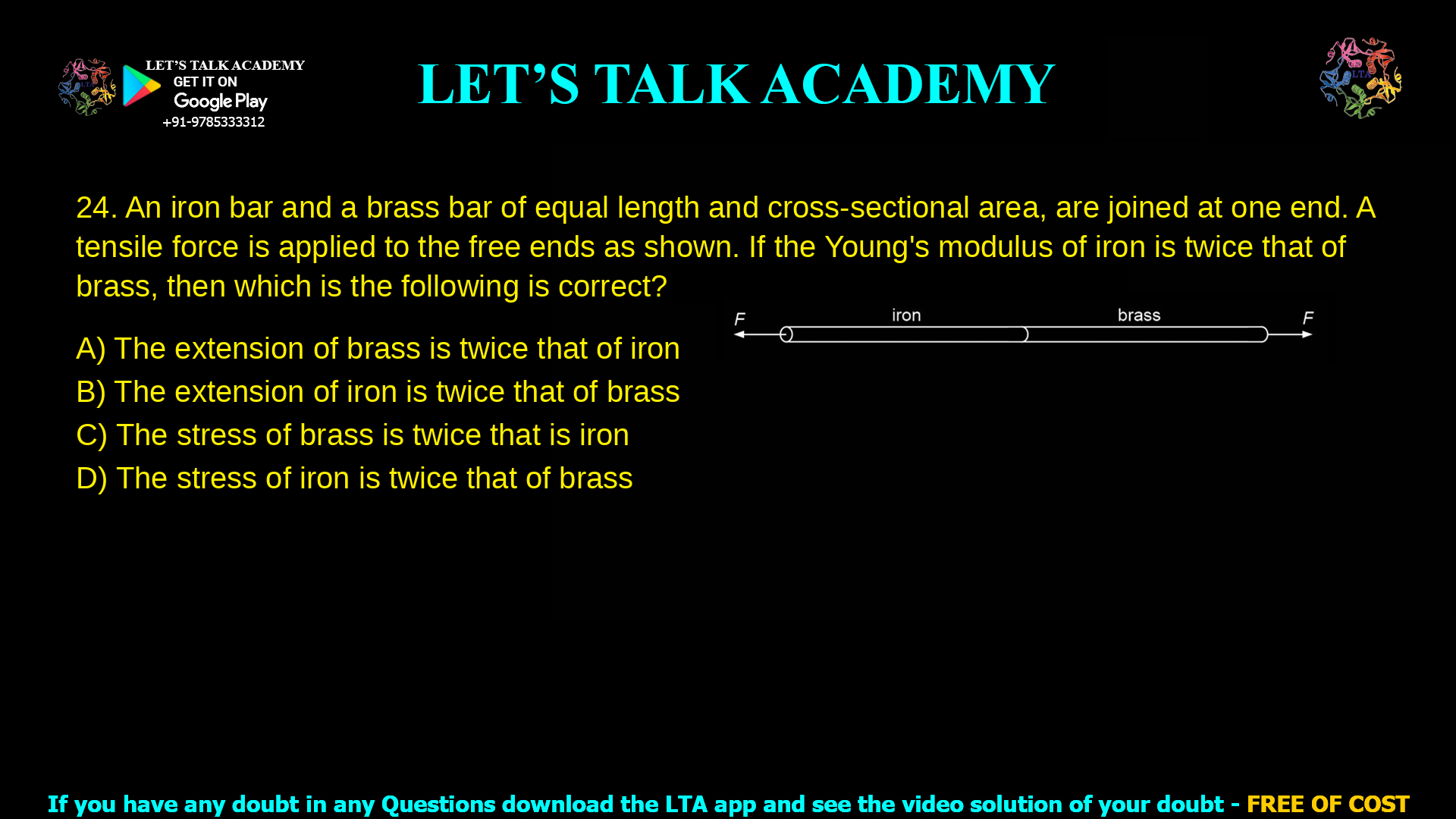
9. An iron bar and a brass bar of equal length and cross-sectional area, are joined at
one end. A tensile force is applied to the free ends as shown.
If the Young’s modulus of iron is twice that of brass, then which is the following is
correct?
a. The extension of brass is twice that of iron
b. The extension of iron is twice that of brass
c. The stress of brass is twice that is iron
d. The stress of iron is twice that of brass
Comparison of Extension and Stress in Iron and Brass Bars
Given Data
Two bars — one made of iron and the other of brass — have:
- Equal length (L)
- Equal cross-sectional area (A)
- Are joined end to end (in series)
- A tensile force (F) applied at the free ends
Young’s modulus relation:
YFe = 2 YBr
Formula for Extension under Axial Load
ΔL = (F × L) / (A × Y)
For Each Bar
Extension in Iron:
ΔLFe = (F × L) / (A × YFe)
Extension in Brass:
ΔLBr = (F × L) / (A × YBr)
Given YFe = 2YBr, therefore:
ΔLBr = (F × L) / [A × (YFe/2)] = 2 × (F × L) / (A × YFe) = 2ΔLFe
Hence, the extension of brass is twice that of iron.
Stress and Strain
Stress for each bar:
σ = F / A
Since both bars carry the same force and have the same area:
σFe = σBr
Strain:
ε = ΔL / L
Because L is the same for both, the strain ratio equals the extension ratio:
εBr = 2 εFe
Evaluation of Options
- Option A: “The extension of brass is twice that of iron” — Correct.
- Option B: “The extension of iron is twice that of brass” — Incorrect.
- Option C: “The stress of brass is twice that of iron” — Incorrect.
- Option D: “The stress of iron is twice that of brass” — Incorrect.
Key Points to Remember
- For bars in series: force is the same.
- If cross-sectional areas are equal, stresses are equal.
- Extension ΔL ∝ 1/Y (when F, L, and A are constant).
- Lower Young’s modulus → greater extension and greater strain under the same stress.
- In this problem, brass (with half the modulus of iron) has double the extension and strain.
“`
Would you like me to make it visually styled like an exam solution (with highlighted boxes for “Given”, “Formula”, “Result”, etc.)?


