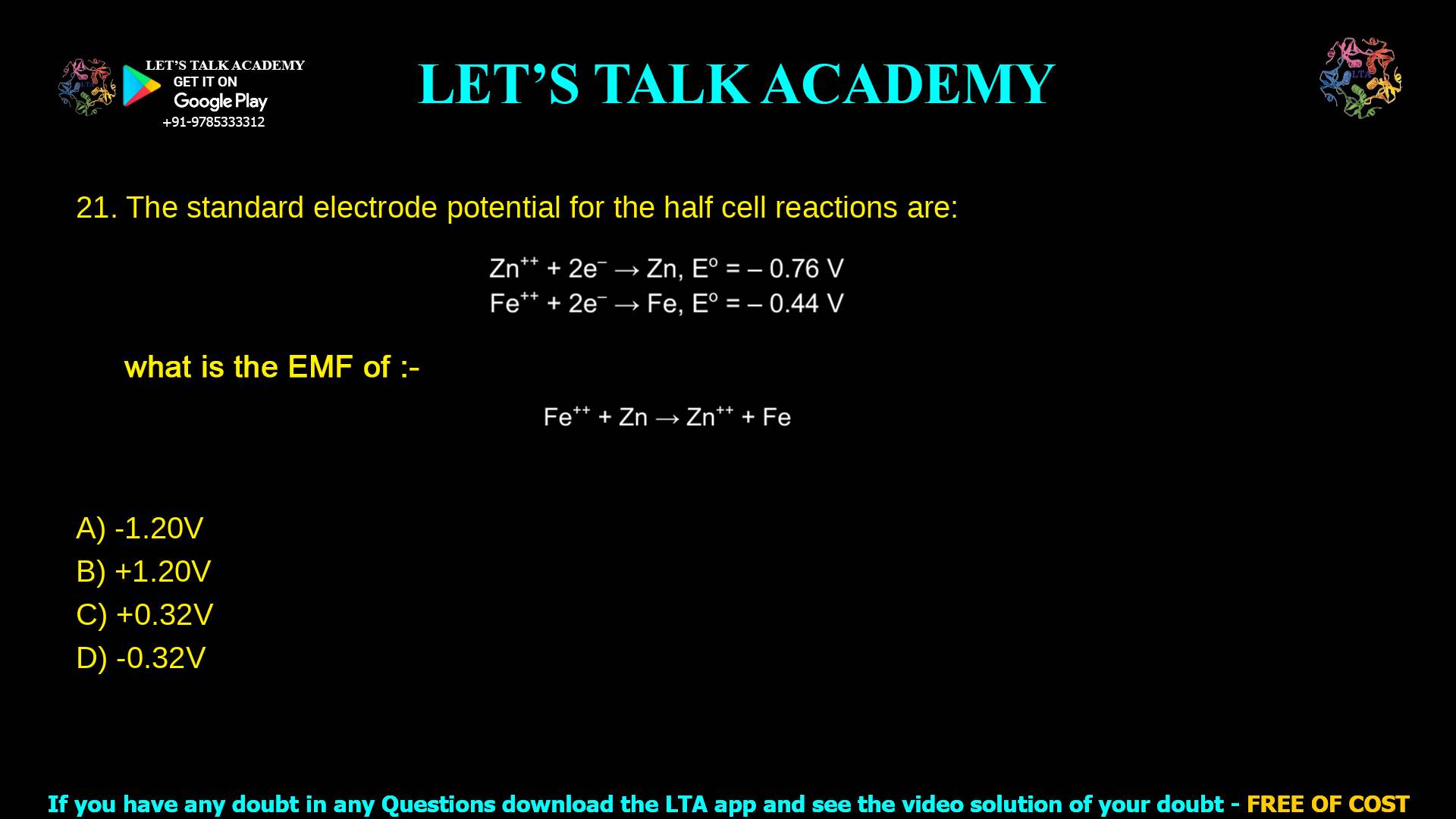
6. The standard electrode potential for the half cell reactions are:
Zn++ + 2e– → Zn, Eo = – 0.76 V
Fe++ + 2e– → Fe, Eo = – 0.44 V
What is the e.m.f. of the cell reaction
Fe++ + Zn → Zn++ + Fe
a. – 1.20 V
b. +1.20 V
c. + 0.32 V
d. – 0.32 V
Given data and concept
Standard reduction potentials are:
- Zn²⁺ + 2e⁻ → Zn, E° = –0.76 V
- Fe²⁺ + 2e⁻ → Fe, E° = –0.44 V
For a galvanic cell, the standard EMF is given by the formula:
E°cell = E°cathode − E°anode
The electrode with the higher (more positive) reduction potential acts as the cathode (reduction), and the one with the lower (more negative) reduction potential acts as the anode (oxidation).
Step-by-step solution
- Compare reduction potentials:
- Zn²⁺/Zn: –0.76 V
- Fe²⁺/Fe: –0.44 V
Since –0.44 V > –0.76 V, Fe²⁺/Fe has the higher reduction potential, so Fe²⁺ is reduced at the cathode and Zn is oxidized at the anode.
- Identify half-reactions in the overall reaction Fe²⁺ + Zn → Zn²⁺ + Fe:
- Oxidation (anode): Zn → Zn²⁺ + 2e⁻
- Reduction (cathode): Fe²⁺ + 2e⁻ → Fe
- Assign standard reduction potentials:
- E°cathode = E°(Fe²⁺/Fe) = –0.44 V
- E°anode = E°(Zn²⁺/Zn) = –0.76 V
Note: When using the formula E°cell = E°cathode − E°anode, always use the standard reduction potentials as given (do not change their signs).
- Calculate EMF of the cell:E°cell = (–0.44 V) − (–0.76 V) = –0.44 V + 0.76 V = +0.32 V
Therefore, the EMF of the cell reaction Fe²⁺ + Zn → Zn²⁺ + Fe is +0.32 V, indicating that the reaction is spontaneous under standard conditions.
Option-wise explanation
Option (a) –1.20 V
This value typically arises from misapplying the formula, for example by subtracting in the wrong order or adding with incorrect signs, such as E°cell = –0.76 V − (+0.44 V) = –1.20 V. This is incorrect because it does not follow the correct cathode–anode convention and also suggests a highly non-spontaneous process, which contradicts the given reaction direction.
Option (b) +1.20 V
This value often comes from simply adding the magnitudes |–0.76| + |–0.44| = 1.20 V, ignoring the actual signs and the formula E°cell = E°cathode − E°anode. It is too large and does not correspond to any proper combination of the given half-cell potentials.
Option (c) +0.32 V (Correct)
This value is obtained by correctly identifying Fe²⁺/Fe as the cathode and Zn²⁺/Zn as the anode, and then applying E°cell = –0.44 V − (–0.76 V) = +0.32 V. It is positive, so it correctly indicates that the reaction Fe²⁺ + Zn → Zn²⁺ + Fe is spontaneous under standard conditions.
Option (d) –0.32 V
This corresponds to the EMF of the reverse reaction Zn²⁺ + Fe → Fe²⁺ + Zn, where the direction of electron flow is reversed. It would be obtained by swapping anode and cathode in the formula, giving E°cell = –0.76 V − (–0.44 V) = –0.32 V, which represents a non-spontaneous reaction in the written direction.
Short SEO-oriented introduction
Understanding how to calculate the EMF of the cell reaction Fe²⁺ + Zn → Zn²⁺ + Fe is essential for mastering electrochemistry in competitive exams such as JEE, NEET, and CSIR NET. By correctly applying standard electrode potentials for Zn²⁺/Zn and Fe²⁺/Fe and using the relation E°cell = E°cathode − E°anode, students can quickly determine the spontaneity of the redox reaction and confidently select the correct answer in multiple-choice questions.


