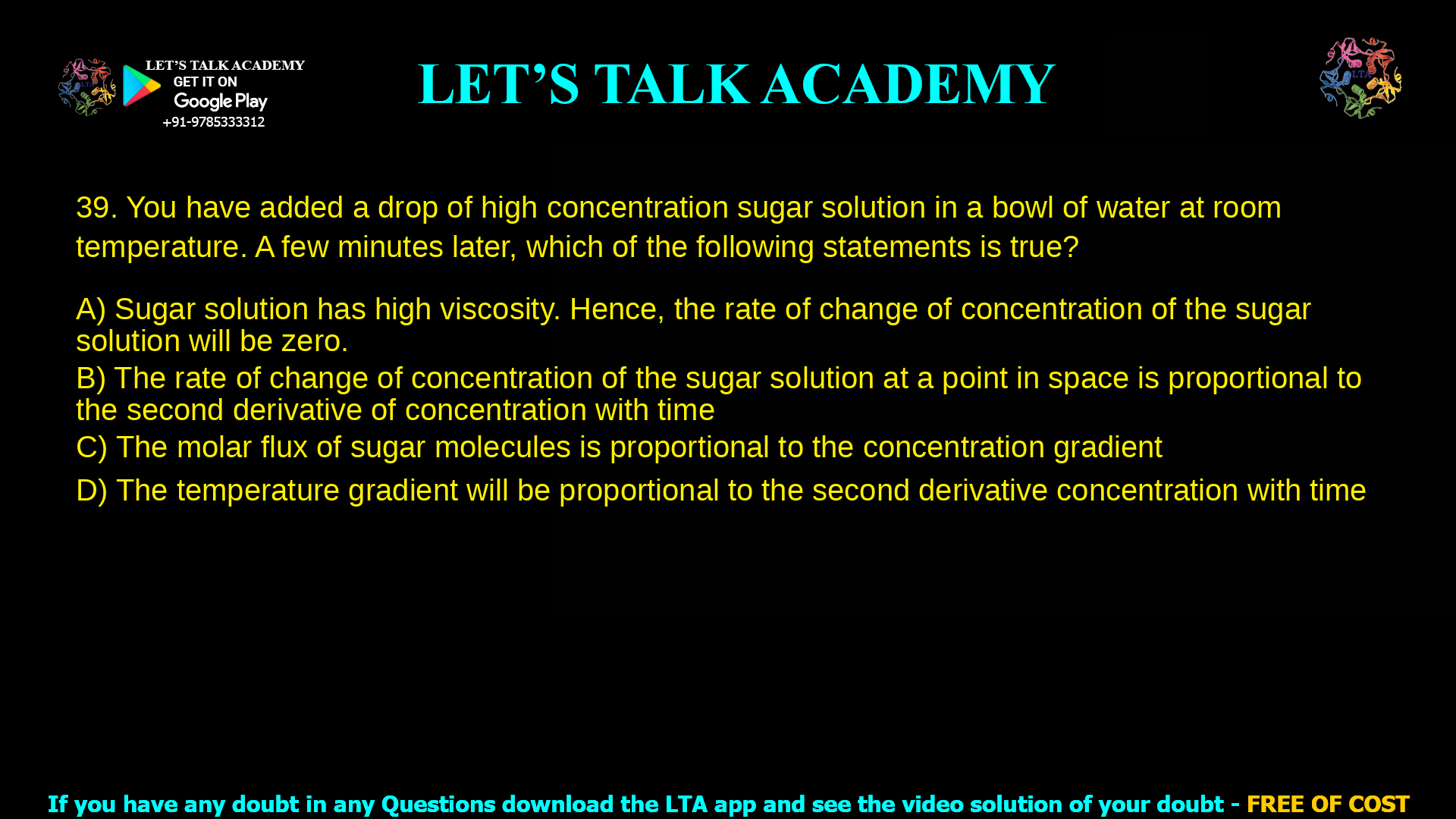
You have added a drop of high concentration sugar solution in a bowl of water
at room temperature. A few minutes later, which of the following statements is
true?
Sugar solution has high viscosity. Hence, the rate of change of
concentration of the sugar solution will be zero.
The rate of change of concentration of the sugar solution at a point in
space is proportional to the second derivative of concentration with time
The molar flux of sugar molecules is proportional to the concentration
gradient
The temperature gradient will be proportional to the second derivative
concentration with time
The correct statement is: “The molar flux of sugar molecules is proportional to the concentration gradient.” This is Fick’s first law of diffusion and describes how sugar diffuses in water after you add a concentrated drop.
Scenario and basic diffusion concept
When a drop of high concentration sugar solution is added to a bowl of water at room temperature, sugar molecules spontaneously diffuse from the high-concentration region into the surrounding lower-concentration water. This spreading continues until the concentration becomes uniform everywhere, driven by random thermal motion of molecules and quantified by Fick’s laws of diffusion.
Option 1: Effect of high viscosity
This option states: “Sugar solution has high viscosity. Hence, the rate of change of concentration of the sugar solution will be zero.”
This mixes two different ideas: viscosity and diffusion.
- Viscosity is a measure of a fluid’s resistance to flow; higher viscosity usually lowers the diffusion coefficient but does not make it zero under normal conditions.
- A lower diffusion coefficient simply slows the rate of change of concentration; diffusion is still occurring, so the concentration at a point continues to change until equilibrium is reached.
Therefore, saying “high viscosity, hence rate of change of concentration is zero” is false; viscosity reduces the rate but does not stop diffusion.
Option 2: Wrong use of second derivative with time
This option states: “The rate of change of concentration of the sugar solution at a point in space is proportional to the second derivative of concentration with time.”
Fick’s second law states that the rate of change of concentration with respect to time is proportional to the second derivative of concentration with respect to space, not time.
In one dimension, it is written as:
∂C/∂t = D ∂²C/∂x²
Here C is concentration, t is time, x is position, and D is the diffusion coefficient.
This option incorrectly uses “second derivative with time” instead of “second derivative with space,” so it is false.
Option 3: Molar flux proportional to concentration gradient
This option states: “The molar flux of sugar molecules is proportional to the concentration gradient.”
This is a direct statement of Fick’s first law of diffusion.
- Fick’s first law: the molar (diffusive) flux
Jis proportional to the negative gradient of concentration,J = -D (∂C/∂x). - The flux is directed from higher to lower concentration; the gradient provides the driving force, and the diffusion coefficient
Dis the proportionality constant.
Therefore, this option is correct and is the only true statement among the four.
Option 4: Confusing temperature gradient with diffusion
This option states: “The temperature gradient will be proportional to the second derivative concentration with time.”
This statement confuses heat conduction with mass diffusion.
- Fick’s second law links
∂C/∂tto the spatial second derivative of concentration, not to temperature gradient. - Temperature gradients are described by separate heat transport equations and are not, in general, “proportional to the second derivative of concentration with time.”
So this option is also false in the context of sugar diffusion in water.
Summary table of statements
| Option | Statement (short) | True/False | Reason (concept) |
|---|---|---|---|
| 1 | High viscosity ⇒ rate of change of concentration is zero | False | High viscosity reduces the diffusion coefficient but does not make diffusion or concentration change zero. |
| 2 | Rate of change of concentration ∝ second derivative of concentration with time | False | Fick’s second law uses the second derivative with respect to space, not time. |
| 3 | Molar flux ∝ concentration gradient | True | Direct statement of Fick’s first law of diffusion. |
| 4 | Temperature gradient ∝ second derivative of concentration with time | False | Mixes thermal transport with mass diffusion; not the diffusion law for sugar in water. |
Final answer
The correct statement for the given situation is: “The molar flux of sugar molecules is proportional to the concentration gradient.”


