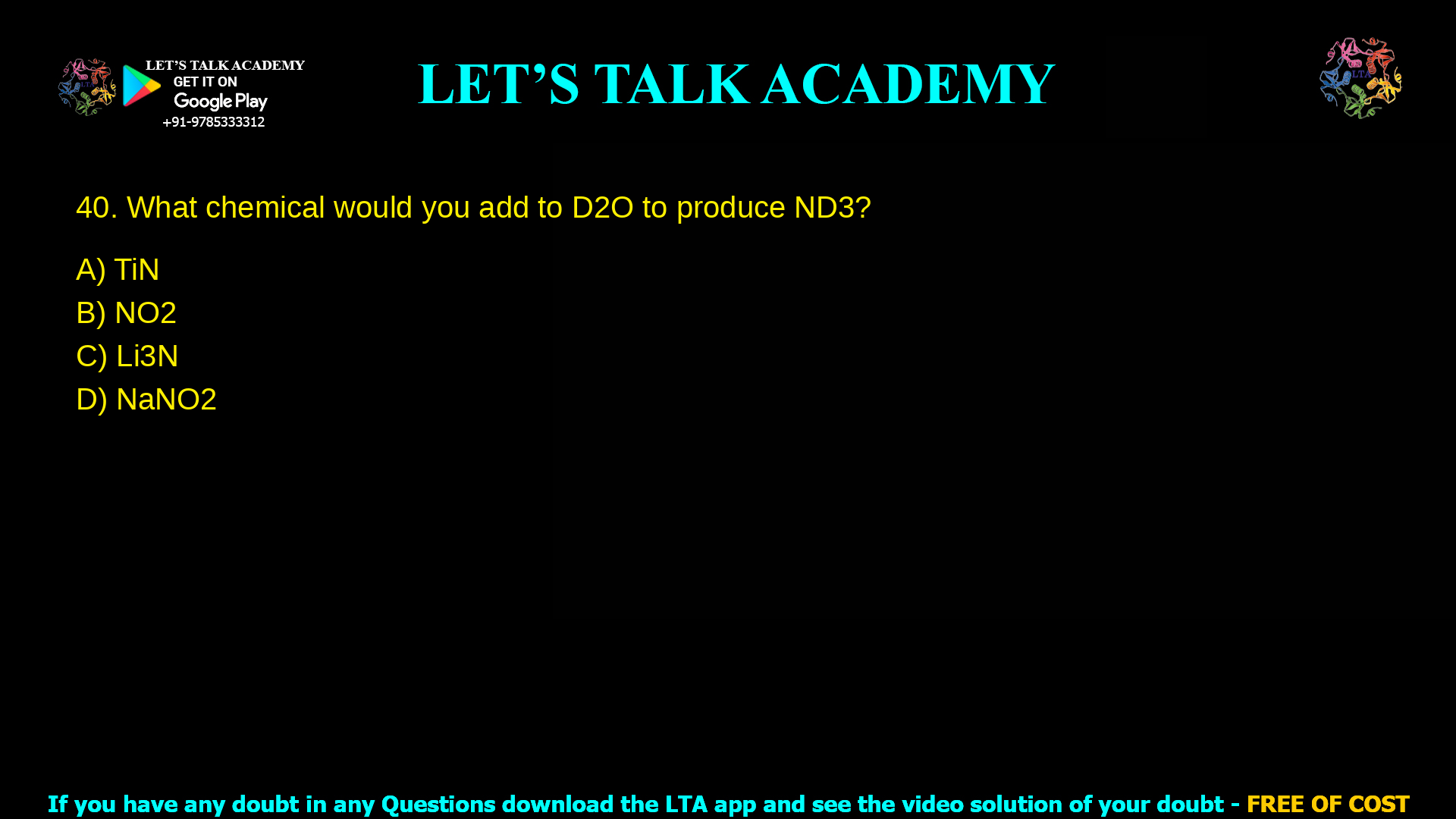
What chemical would you add to D2O to produce ND3
TiN
NO2
Li3N
NaNO2
Lithium nitride (Li₃N) reacts with deuterium oxide (D₂O, heavy water) to produce deuterated ammonia (ND₃) via the equation: Li₃N + 3D₂O → ND₃ + 3LiOD. This hydrolysis exchanges deuterium for nitrogen-bound hydrogen, forming ND₃ gas, a key method in isotopic chemistry.
Option Analysis
TiN (Titanium Nitride): TiN, a refractory ceramic, shows no documented hydrolysis with D₂O to yield ND₃. Studies focus on its use in catalysis or hydrogen adsorption, but oxygen defects in TiN lead to HER activity, not ammonia release.
NO₂ (Nitrogen Dioxide): NO₂ reacts with H₂O to form HNO₃ and HNO₂ (3NO₂ + H₂O → 2HNO₃ + NO), but no pathway produces ND₃ with D₂O; it yields deuterated acids instead.
Li₃N (Lithium Nitride): Correct choice. The reaction Li₃N(s) + 3D₂O(l) → ND₃(g) + 3LiOD(aq) directly generates ND₃, used for isotopic labeling in NMR or mass spectrometry.
NaNO₂ (Sodium Nitrite): NaNO₂ decomposes in acid to HNO₂ and NO, or forms salts, but lacks a mechanism for ND₃ production with D₂O; no nitride hydrolysis occurs.
Reaction Mechanism
Metal nitrides like Li₃N or Mg₃N₂ hydrolyze stepwise: nitride ion (N³⁻) accepts D⁺ from D₂O, forming ND₃ and metal deuteroxide. Magnesium nitride follows Mg₃N₂ + 6D₂O → 3Mg(OD)₂ + 2ND₃. This suits CSIR NET-level questions on heavy water chemistry.


