62. Human polydactyly traits having extra fingers or toes are caused by a dominant allele. In a screening it was found that out of 42 individuals having an allele for polydactyly, only 38 of them were polydactylus. Which of the following is the correct interpretation of the observation? (1) The penetrance of polydactyly is estimated to be 90% (2) The expressivity of polydactyly is 90% (3) This is an example of variable expressivity (4) The polydactyly trait is showing complete penetrance.

Understanding Polydactyly Penetrance

61. Pentadactylity is a dominant trait, yet many individuals having single dominant alleles does not show any sign of polydactylity due to (1) Incomplete penetrance (2) Variable expressivity (3) Co dominance (4) Incomplete dominance

Understanding Pentadactylity and Its Incomplete Penetrance

60. In some sheep, horns are produced by an autosomal allele, 'H' that is dominant in males and recessive in females. H+H+ individuals are hornless. A horned female is crossed With a hornless male. one of the resulting F1 females is crossed with a hornless male. What proportion of the male and female progeny of F1 will have horns? (1) 50% of male and 50% of female progeny will be horned (2) 50% of male progeny but none of the female progeny will be horned (3) 25% of male and 25% of female progeny will be horned (4) 100% of male progeny and 50% of female progeny will be horned

 Understanding Sex-Influenced Inheritance of Horns in Sheep

59. In an organism, allele for red eye colour is dominant over the allele for white eye colour. A cross is made between a white eyed male and a red eyed female. In the progeny all males are red eyed while the females are white eyed. The reciprocal cross leads to all red eyed progeny, Based on the above information which one of the following conclusions is correct? (1) This is a sex-limited trait, and the male is the homomorphic sex (2) This is a sex-linked trait, with male being the homomorphic sex (3) This is a sex-linked trait, with female being the homomorphic sex (4) This is a case of autosomal inheritance, with incomplete penetrance

Sex-Linked Inheritance of Eye Color

58. A Drosophila male carrying an X-linked temperature sensitive recessive mutation that is lethal at 290C but viable at 180C is mated to: A. a normal female B. a female containing attached X-chromosome If the eggs laid in both the cases are reared at 290C, what will be male-female ratio in the given progeny? (1) A-1:2, B-1:1 (2) A-1:1, B-only females (3) A-0:1, B-1:1 (4) A-1:0, B-1:2

Understanding Male-Female Ratios in Drosophila with X-Linked Temperature-Sensitive Lethal Mutation

57. The allele l in Drosophila is recessive, sex- linked and lethal' when homozygous or hemizygous. If a female of the genotype Ll is crossed with a male, what is the ratio of females : males in the progeny? (1) 3 female: 1 male (2) 2 female: 1 male (3) 1 female: 1 male (4) 1 female: 2 male

Understanding the Progeny Sex Ratio in Drosophila with a Recessive Sex-Linked Lethal Allele

56. Consider the following crosses involving grey(wild-type) and yellow body colour true breeding Drosophila: Cross F1 Progeny F2 Progeny Cross 1 Grey female X yellow male All male : grey All female: grey Grey female : 98 yellow males : 45 Grey males : 49 Cross 2 Yellow female X grey males All males : yellow All female : grey ? Assuming 200 F2 offspring are produced in cross 2, which one of the following outcome is expected? (1) 97 grey males, 54 yellow females, 49 grey males (2) 102 yellow males, 46 yellow females. 52 grey females (3) 52 grey males, 49 yellow males, 48 yellow females, 51 grey females (4) 98 grey males, 94 yellow females, 2 yellow males, 6 grey females

Drosophila Grey and Yellow Body Colour Cross

55. Drosophila melanogaster males with normal wing size and grey body colour is crossed with females having vestigial wings and yellow body colour. Vestigial wing and yellow body colour are recessive characters. The F1 progeny is sib-mated. In the F2 progeny the following phenotypes are observed in the ratios given below: S. No. Phenotype Sex Ratio Wing Shape Body Color 1. Normal Grey Male 3 2. Normal Yellow Male 3 3. Normal Grey Female 3 4. Normal Yellow Female 3 5. Vestigeal Grey Male 1 6. Vestigeal Yellow Male 1 7. Vestigeal Grey Female 1 8. Vestigeal Yellow Female 1 The above observation suggests: (1) Yellow body colour X-Iinxed, while vestigial wing an autosomal character. (2) Yellow body colour IS autosomal, while vestigial wing is an X-linked character (3) Both yellow body and vestigeal wing are X-linked character. (4) Both yellow body and vestigial vang are autosomal and un-linked.

Drosophila Cross: Normal Wing Grey Body × Vestigial Wing Yellow Body – Sex Linkage and Autosomal Inheritance Explained

54. On basis of statement given below the mode of inheritance is • Mostly males are sufferer of disease • All male child of affected mother are diseased • Female develop disease only when her father is diseased and mother is carrier (1) X-linked recessive (2) X-linked dominant (3) Autosomal dominant (4) Autosomal recessive

Understanding X-linked Recessive Inheritance

53. A cross between a red eyed male fly and white eyed female fly produces red eyed female and white eyed male progenies. While reciprocal cross produces all offsprings with red eyes. The trait for eye color is (1) Sex linked traits (2) Sex influenced trait (3) Sex linked homogametic male (4) Sex linked heterogametic male

Understanding Sex Linked Traits in Drosophila

52. Among the following which statement is NOT correct for X-linked recessive disorder ? (1) Female with such disorders ate rare (2) Males the diseased allele are always diseased (3) Females are diseased only when their mother is carrier and father is diseased (4) Males always passes trait to all of his sons

Understanding X-linked Recessive Disorders

51. Among the following, which is sex linked disorder (1) Night blindness (2) color blindness (3) Cretinism (4) Myxedema

Understanding Sex-Linked Disorders

50. Paternal grandfather is hemophilic, what is probability of his grandson to be hemophilic (1) 1/2 (2) 1/4 (3) 1/8 (4) 0

Probability of Hemophilia in Grandson When Paternal Grandfather is Hemophilic

49. The probability of a son to be color blind for parent with colorblind father and normal homozygous mother would be (1) 0% (2) 25% (3) 50% (4) 100%

Probability of Son Being Color Blind with Color Blind Father and Normal Homozygous Mother

48. Among the following which is probable cause of unequal results during the reciprocal crosses? (1) X-linked inheritance (2) polygenic inheritance (3) Mendelian Inheritance (4) Epitasis

Why Reciprocal Crosses Show Unequal Results

47. A well-known genetic disorder is carried by a woman. She marries a normal man and her all female child are alive but she tost all male child. Such a disorder must be- (1) X-linked dominant (2) X-linked recessive (3) Y-linked dominant (4) Autosomal recessive

Sex-linked genetic disorder where carrier mother loses all sons but all daughters survive

46. Baldness of male is due to- (1) X- linked (2) Y-linked (3) Autosomal (4) Multifactorial

Genetic Causes of Male Baldness

45. A Drosophila mutant (line A) with vestigial wings is isolated in a laboratory. The vestigial wing phenotype was observed to be recessive and mapped to gene 'X'. Three other laboratories also isolated vestigial mutants, called line B, C and D. In order to test if the mutation in lines B-D also mapped to gene the following crosses were made and phenotype of F1 progeny observed. Cross F1 progeny (wing morphology A X B vestigial A X B Vestigial A X D Normoal B X C Vestigial B X D Normal C X D Normal Based on the above identify the line(s) which is most likely NOT to have a mutation in gene (1) Both lines B and C (2) Line C only (3) Line D only (4) Both lines B and D

Complementation Test in Drosophila

44. A researcher exposed Drosophila larvae to 370C during their growth. One of the adult flies that emerged had a crossveinless phenotype. Crossveinless is a known mutant in Drosophila. When this crossveinless fly was crossed to a known crossveinless mutant fly all the progeny had normal phenotype. The observed phenotype can be best explained as an example of (1) Conditional mutant (2) Phenocopy (3) Penetrance (4) Pleiotropy

Understanding Conditional Mutants in Drosophila Crossveinless Phenotype Exposed to Heat

43. The individuals considered in this question are having two haploid sets of autosomes and no Y. chromosome. The X:A ratio of the individuals, the type of organisms chosen, their primary sex and number of Barr bodies expected in their cells are shown in the table below: X:A ratio Organism Primary Sex Number of Barr bodies i. 0.5 ii. 2 A.Human B.Drosophila I. Male II. Female III.Metafemale a. Zero b. One c. Two d.Three Select the option below with all correct matches: (1) i-A-II-a; ii-A-II-d; i-B-I-a; ii-B-III-a (2) i-A-I-a; ii-A-II-c; i-B-II-a; ii-B-I-a (3) i-A-II-c; ii-A-I-d; i-B-I-c; ii-B-II-b (4) i-A-II-a; ii-A-II-d; i-B-III-a; ii-B-I-a

X:A ratio, sex determination and Barr bodies in humans and Drosophila

42. A male mouse cell line has a large translocation from X chromosome into chromosome 1. When a GFP containing transgene is inserted in this chromosome 1 with translocation, it is often silenced. However when inserted in the other homologue of chromosome 1 that does not contain the translocation, it is almost always expressed. Which of the following phenomenon best describes this effect? (1) Genome imprinting (2) Gene balance (3) Sex-specific expression (4) Dosage compensation

Understanding Dosage Compensation in Mouse Chromosome Translocations Affecting Gene Expression

41. In context of DNA methylation, which one of the following statements is FALSE? (1) Generally, methylation occurs at the 3rd carbon position of cytosine and converts it to 3-methyl cytosine (2) Maintenance methyl transferase acts constitutively on hemi-methylated sites and converts them to fully methylated sites (3) During mammalian gametogenesis, the genomic methylation patterns are erased in primordial germ cells (4) Replication converts a fully methylated site to hemi- methylated site

DNA Methylation

40. Criss-cross inheritance is shown by- (1) Sex linked traits (2) Sex influenced traits (3) Sex limited traits (4) Autosomes

Understanding Criss-Cross Inheritance

39. Gene 'A' in mouse is needed for its normal growth [normal size). Mouse strains with deletion in gene 'A' (Adel) have been developed. When the following cross is made …..AdelA X AA…… All progeny (both males and females) are of normal size When the F1, progeny with the following genotypes are crossed: …..AdelA X AA…… 50% of the progeny obtained are small in size. The above observation can be explained by: (1) Maternal inheritance (2) Maternal imprinting (3) Paternal imprinting (4) Maternal effect

Understanding Maternal Effect in Mouse Gene ‘A’ Deletion Impact on Growth

38. Which one of the following statements is correct? (1) Epigenetic memory depends on DNA acetylation by trithorax group of proteins (2) An epigenetic change could be inherited from a cell to a daughter cell (3) Parental origin does not influence the expression level of imprinted loci (4) Epigenetic changes do not alter the chromatin landscape

Understanding Epigenetic Memory and Inheritance

37. A mouse carrying two alleles of insulin-like growth factor II (igf2) is normal in size; whereas a mouse that carries two mutant alleles lacking the growth factor is dwarf. The size of a heterozygous mouse carrying one normal and one mutant allele depends on the parental origin of the wild type allele. Such pattern of inheritance is known as (1) Sex-linked inheritance (2) Genomic imprinting (3) Gene-envr interaction (4) Cytoplasm inheritance

Understanding Genomic Imprinting in Insulin-like Growth Factor II (Igf2) Inheritance

36. Following statements were made about imprinting in the human genome. A. Imprinting control centre (lC) harbors part of the SNRPN gene. B. Imprinting of genes in an individual cannot be tissue specific. C. Sperms and eggs exhibit identical pattern of genome methylation, except in the sex chromosomes. D. At imprinted loci, expression depends on the parental origin. Select the option with all the correct statements. (1) A and D (2) B and D (3) A and C (4) B and C

Understanding Imprinting in the Human Genome

35. A gene inherited from mother is not expressed the offspring, but the same gene when inherited from father is expressed in both male and female offspring. This phenomenon is the hallmark of gene (1) recombination (2) deletion (3) silencing (4) imprinting

Understanding Genetic Imprinting

34. In knockout mice experiment was performed for germline transmission of gene A, null allele from a male chimera shows retarded growth of all mutant heterozygotes. On inbreeding animals produced the expected ratio of heterozygote pups but only 50 percent of heterozygote are with retarded growth of phenotype. These results are consistent with the following (1) Genomic Imprinting (2) Sex linked inheritance (3) Cytoplasmic inheritance (4) Co-dominance

Understanding Retarded Growth in Knockout Mice

33. The pattern of genomic imprinting is maintained from one generation to another by (1) Phosphorylation of DNA (2) Methylation of DNA (3) Acetylation of DNA (4) Glycosylation of DNA

How Genomic Imprinting Is Maintained Across Generations

32. Dosage compensation in mammal females is achieved by (1) Methylation of one X chromosome (2) Hyper activation of one X chromosome (3) Elimination of one X chromosome (4) Hypoactivation of Both X chromosome

Dosage Compensation in Mammal Females

31. Dosage compensation in drosophila is achieved by- (1) Selective elimination of maternal X chromosome (2) Heterochromatization of paternal X chromosome (3) Hyperactivation of maternal X chromosome (4) Hyperactivation of paternal X chromosome

 Dosage Compensation in Drosophila

30. Dosage compensation occurs in- (1) Insects and mammals (2) Reptiles and mammals (3) Reptiles and Aves (4) Insects and reptiles

Dosage Compensation in Insects and Mammals

29. Dosage compensation in drosophila is mediated by (1) Inactivation of one X chromosome in female (2) Hyper activation of one X chromosome in male (3) Hypo activation of both X chromosome in female (4) Methylation of both X chromosomes and autosomes

 Dosage Compensation in Drosophila

28. In mammals effective dosage of genes of two sexes is made equal by- (1) Elimination of X chromosome in females (2) Hyper activation of one X chromosome in males in males (3) Hypoactivation of both X chromosomes female (4) Inactivation of one of the X chromosome in females

How Dosage Compensation Balances Gene Expression in Mammals

27. In human females there is inactivation of one X chromosomes for dosage compensation due to- (1) Methylation (2) Acetylation (3) Phosphorylation (4) Formylation

DNA Methylation as the Mechanism of X Chromosome Inactivation in Human Females

26. In a plant r+ and a+ genes encode for a regulatory and a structural protein, respectively. These genes are responsible for blue color of flower. Mutation in either of the genes leads to white flowers, which is a recessive character. The two genes assort independently. When two homozygous white flowered plants are crossed. The F1 plants have blue colored flowers. If the F1 plant is backcrossed, the progeny will have plants with blue and white flowers in the ratio of: (1) 9:7 (2) 1:1 (3) 3:1 (4) 1:0

Complementary Gene Interaction in Plants

25. A plant that produces disc-shaped fruit is crossed with another plant that produces long fruit. All the F1 plants gave disc-shaped fruits. When the F1 were intercrossed, F2 progeny were produced in the following ration: 9/16 plants with disc-shaped fruits; 6/16 plants with spherical fruits and 1/16 plants having long fruits. Which one of the following options gives correct genotype of spherical fruits obtained in F2? (1) A_bb only (2) aaB_ only (3) A_bb and aaB_ (4) A_B_ and aabb

Genetic Inheritance of Fruit Shape in Plants

24. In a mammal, coat colour is governed by gene B, The coat colour is either black or brown, depending on whether the genotype is BB or Bb. It is not known which of these genotypes lead to the black and brown colours. The genotype bb results in albino coat colour. Further, the genotype cc suppresses the expression of coat colour resulting in albino coat colour. An albino male was crossed with a brown female and the resulting progeny had individuals with either black or brown coats. From this observation it can be inferred that the genotype of the male and female that were crossed are: (1) BB cc and Bb CC, respectively (2) Bb cc and Bb CC, respectively (3) bb CC and BB CC, respectively (4) bb Cc and BB CC. respectively

Epistasis in Mammalian Coat Colour

23. Two Yellow mice with straight hair were crossed and the following progeny was obtained: 1/2 Yellow, straight hair 1/6 Yellow, fuzzy hair 1/4 gray, straight hair 1/12 gray, fuzzy hair In order to provide genetic explanation for the and assign genotypes to the parents and progeny of this cross the following statements were given: (A) The 6:2:3:1 ratio obtajned here indicate', recessive epistasis. (B) This cross concerns two independent body colour and type of hair. (C) The deviation of dihybrid ratio from 9:3:3:1 to 6:2:3:1 may be due to one of the genes being a recessive lethal (D) The lethal allele is associated With straight hair The most appropriate combination of statements to provide genetic explanation for the result is: (1) B and C (2) A only (3) B, C and D (4) A, C and D

Genetic Explanation of 6:2:3:1 Phenotypic Ratio in Mice Crosses with Recessive Lethal Alleles

22. In a flower species, light pink locus is hypostatic to pigment development locus. R is for pigment development and W for light pink. The recessive allele (w) in light pink locus gives red colour and recessive allele in pigment locus (r) gives white colour. What will be the phenotype of W/-, r/r and w/w, r/r? (1) Red, Pink (2) Pink, White (3) Red, Red (4) White, White

Interpreting epistasis and gene interactions in flower color loci

21. The following is a hypothetical pathway for the development of wild type (red) eye colour in an insect: Enzymes A and B are encoded by the genes a+ and b+, respectively. The following statements are made regarding inheritance of the genes involved in the development of eye colour: A) When two heterozygous individuals of the genotype a+ab+b are mated, progenies with red, orange, brown and white eye colour will be observed irrespective of whether the genes are independently assorting or showing incomplete linkage. B) When two heterozygous individuals of the genotype are mated, progenies with red, orange, brown and white eye colour will be observed in a ratio of 9:3:3:1, when the genes are independently assorting. C) When an heterozygous individual of the genotype a+b/ a b+ is test crossed, progenies with red and white eye colour will be more in number if genes are linked. D) When an heterozygous individual of the genotype a+b/ ab+ is test crossed, progenies with orange and brown eye colour will be more in number if genes are linked. Which of the above statements is TRUE? (1) A and C (2) B and C (3) A,B, and C (4) A, B and D

Epistasis in Insect Eye Colour

20. The following is a schematic representation of a hypothetical pathway involved in formation of eye color in an insect species. Genes A and B are linked and have a map distance of 10cM. Females With genotypes a+ab+b are test crossed. Further. in these females. the two genes are linked in cis. a+ and b+ represent wild type alleles, while a and b are null alleles. The progeny of the test cross have individuals with four different eye colours. What is the expected ratio of individuals with eye color Red: Vermillion: Brown: White in the progeny? (1) 9:3:3:1 (2) 1:1:1:1 (3) 9:1:1:9 (4) 1:9:9:1

Linked genes eye colour problem

19. A hypothetical biochemical pathway for the formation of eye color in insect is given below. Two autosomal recessive mutants 'a' and 'b' are identified which block the pathway as shown above. Considering that the mutants are not linked, what will be the phenotype of the F2 progeny if crosses were made between parents of the genotype aaBB x AAbb, and the F1 progeny are intercrossed? (1) 9 orange-brown: 3 orange; 3: brown: 1 colorless (2) 9 orange-brown: 7 colorless (3) 1 orange: 2 colorless (4) 15 orange-brown: 1 colorless

Hypothetical biochemical pathway

18. Consider the following hypothetical pathway: H allele converts X substance to H substance h allele cannot convert X to H substance and leads to phenotype 'O' A allele converts H substance leading to A phenotype a allele cannot convert H substance B allele converts H substance leading to B phenotype b allele cannot convert H substance An individual with 'A' phenotype when crossed with that of 'B' phenotype has a progeny with 'O' phenotype. Which one of the following crosses can lead to the above observation? (1) Aahh X BbHH (2) AaHh X BBHh (3) AaHh X BBHH (4) AAHH X BbHh

Chi-Square Pathway Question

17. Following is a hypothetical biochemical pathway responsible for pigmentation of leaves. The pathway is controlled by two independently assorting genes 'A' and 'B' encoding enzymes as shown below. Mutant alleles 'a' and 'b' code for non-functional proteins. What is the expected progeny after selfing a plant with the genotype AaBb? (1) Green (9): White (4): Yellow (3) (2) Green (9): Yellow (4): White (3) (3) Green (9): Yellow (6): White (1) (4) Green (9): White (7)

Genetic pathway problem

16. A black Labrador homozygous for the dominant alleles (BBEE) is crossed with a yellow Labrador homozygous for the recessive alleles (bbee). On intercrossing the F1, the F2 progeny was obtained in the following ratio: 9 black: 3 brown: 4 yellow. This is an example of (1) recessive epistasis where allele e is epistatic to B and b. (2) dominant epistasis where allele E is epistatic to B and b. (3) recessive epistasis where allele e is epistatic to E. (4) complementary epistasis where allele b is epistatic

Labrador Coat Colour Genetics: Why a 9 Black : 3 Brown : 4 Yellow Ratio Shows Recessive Epistasis

15. Two plants with white flowers are crossed. White flowers arise due to recessive mutation. All F1 progeny have red flowers. When the F1 plants are selfed, both red and white flowered progeny are observed. In what ratio will red-flowered plants and white-flowered plants occur? (1) 1:1 (2) 3:1 (3) 9:7 (4) 15:1

Predicting Red and White Flower Ratios in Pea Plants

14. A plant heterozygous for a dominant trait was selfed. The progeny had 140 plants showing the dominant trait and 20 plants showing the recessive trait. A researcher hypothesised that there are two genes with identical functions that control the dominant trait. The researcher also proposed that the two genes are not linked. The researcher carried out a chi-square test to test the hypothesis. Which one of the following options is the correct chi-square value (rounded to second decimal) obtained by the researcher? (1) 22.86 (2) 13.33 (3) 10.67 (4) 5.71

Chi-square test for a 15:1 ratio when two duplicate genes control a dominant trait

13. A plant with red fruit is crossed to a plant with white fruit. The F1 progeny had red fruits. On selfing the F1 two kinds of progeny were observed, plants with red fruits and those with white fruits. To test whether it was a case of recessive epistatic interactions a chi-square test was performed. A value of 1.062 was obtained (chi- square value of Poos=3.841 for Degree of freedom=1). The following statements were made: A. The null hypothesis was that plant with red and white fruits will occur in a 9:7 ratio B. The null hypothesis was that plant with red and white fruits will occur in a ratio C. Based on the chi square value, it is a case of recessive epistatic interactions D. Based on the chi square value, it is not a case of recessive epistatic interactions Which of the combination of above statements is correct? (1) A and C (2) A and D (3) Band C (4) B and D

 Understanding Recessive Epistasis and Chi-Square Test in Fruit Color Genetics

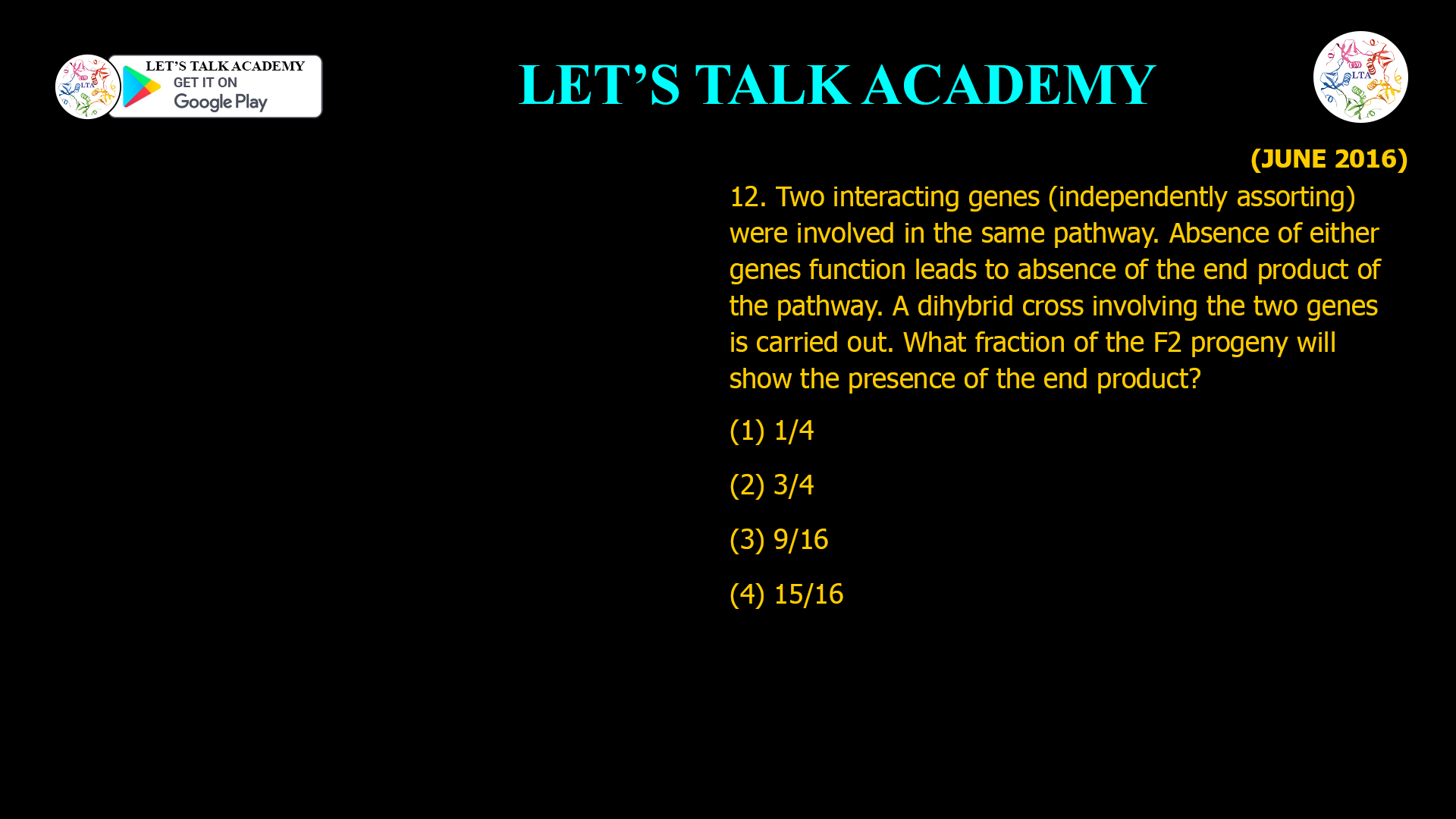
12. Two interacting genes (independently assorting) were involved in the same pathway. Absence of either genes function leads to absence of the end product of the pathway. A dihybrid cross involving the two genes is carried out. What fraction of the F2 progeny will show the presence of the end product? (1) 1/4 (2) 3/4 (3) 9/16 (4) 15/16

Understanding F2 Progeny Ratios in Two Interacting Genes Affecting Pathway End Product

11. The following is the biochemical pathway for purple pigment production in flowers of sweet pea: Recessive mutation of either gene A or B leads to the formation of white flowers. A cross is made between two parents With the genotype: AaBb x aabb. Considering that the two genes are not linked, the phenotypes of the expected progenies are (1) 9 purple: 7 white. (2) 3 white: 1 purple. (3) 1 purple: 1 white. (4) 9 purple: 6 light purple: 1 white

Biochemical Pathway Genetics in Sweet Pea

10. When two independent pure lines of pea with white flowers are crossed, the F1 progeny has purple flowers. The progeny obtained on selfing shows both pruple and white flower in a ratio of 9:7. The following conclusions were made A. Two different genes are involved, mutation in which lead to formation of white flower. B. These two genes show independent assortment C. This is an example of complementary gene action D. The is an example of duplicate genes Which of the following conclusions are correct? (1) A and C only (2) A and D only (3) A, B and D (4) A, B and C

How to Interpret the 9:7 Flower Color Ratio in Pea Plants

9. Two mutant plants, both bearing white flowers, were crossed. All F1 plants had red coloured flowers. When an F1 plant was selfed it produced progeny with either red or white coloured flowers in 9:7 ratio. Based on this information, which one of the following conclusions is correct? (1) The mutations in the parents do not complement each other (2) The mutations in the parents are allelic (3) The mutations in the parents are non-allelic (4) The mutations in the parents are linked

9:7 ratio and complementation between two white-flower mutants

8. A cross is made between two plants with white flowers. All the F1 progeny had red coloured flower. This is because of (1) complementation (2) recombination (3) translocation (4) reversion

Why Crosses Between Two White-Flowered Plants Produce Red-Flowered F1 Progeny?

7. There are two mutant plants. One shows taller phenotype than wild type, whereas the other has the same height as the wild type. When these two mutations were brought in together by genetic crosses, the double mutant displayed even taller phenotype than the tall mutant plants. This genetic interaction is called (1) additive interaction. (2) antagonistic interaction. (3) synergistic interaction. (4) suppressive interaction.

Understanding Genetic Interaction: Identifying Synergistic Interaction in Plant Height Mutants

6. A cross between hens with different comb shape was carried as shown in figure. The conclusion which can be drawn is (1) Single gene is involved for comb shape (2) Two independent segregating genes are involved (3) Two genes are showing collaboration for phenotype (4) Four independent segregating alleles are involved

9:3:3:1 comb pattern in hens shows gene interaction for comb shape

5.In a certain genetic cross, 1/16 proportion of progeny shows mutant phenotype. It means (1) Two independent assorting genes are involved for trait (2) Two independently assorting duplicate genes are involved (3) Two linked genes are involved for trait (4) Two independent segregating alleles responsible for trait

What Does a 1/16 Mutant Phenotype Proportion Indicate in Genetic Crosses?

4. In a hybridization experiment a plant shows phenotypic ratio of 15:1. How many genes control the trait for observed phenotypic ratio? (1) One (2) Two (3) Three (4) Polygene

How Many Genes Control the Trait in a 15:1 Phenotypic Ratio in Plants?

3. In a genetic test 9: 7 ratio in F2 generation represents (1) Epitasis (2) Co-dominance (3) Incomplete dominance (4) Complete dominance

What does a 9:7 F₂ phenotypic ratio represent in genetics?

2. F2 phenotype ration for comb shape in chicken was observed to be walnut, rose, peanut and single as 8:3:4:1. What is probable genotype of parents? (1) PPrr X PPrr (2) PpRr X PpRr (3) PpRR X PpRr (4) ppRr X pprr

Understanding the F2 Phenotypic Ratio of Chicken Comb Shapes: Walnut, Rose, Pea, and Single Explained

1. The dihybrid F2 ratio 9:7 represents (1) Dominance (2) Independent assortment (3) Epistasis (4) Co-dominance

Understanding the Dihybrid F2 Ratio 9:7 and Its Genetic Significance

Latest Courses