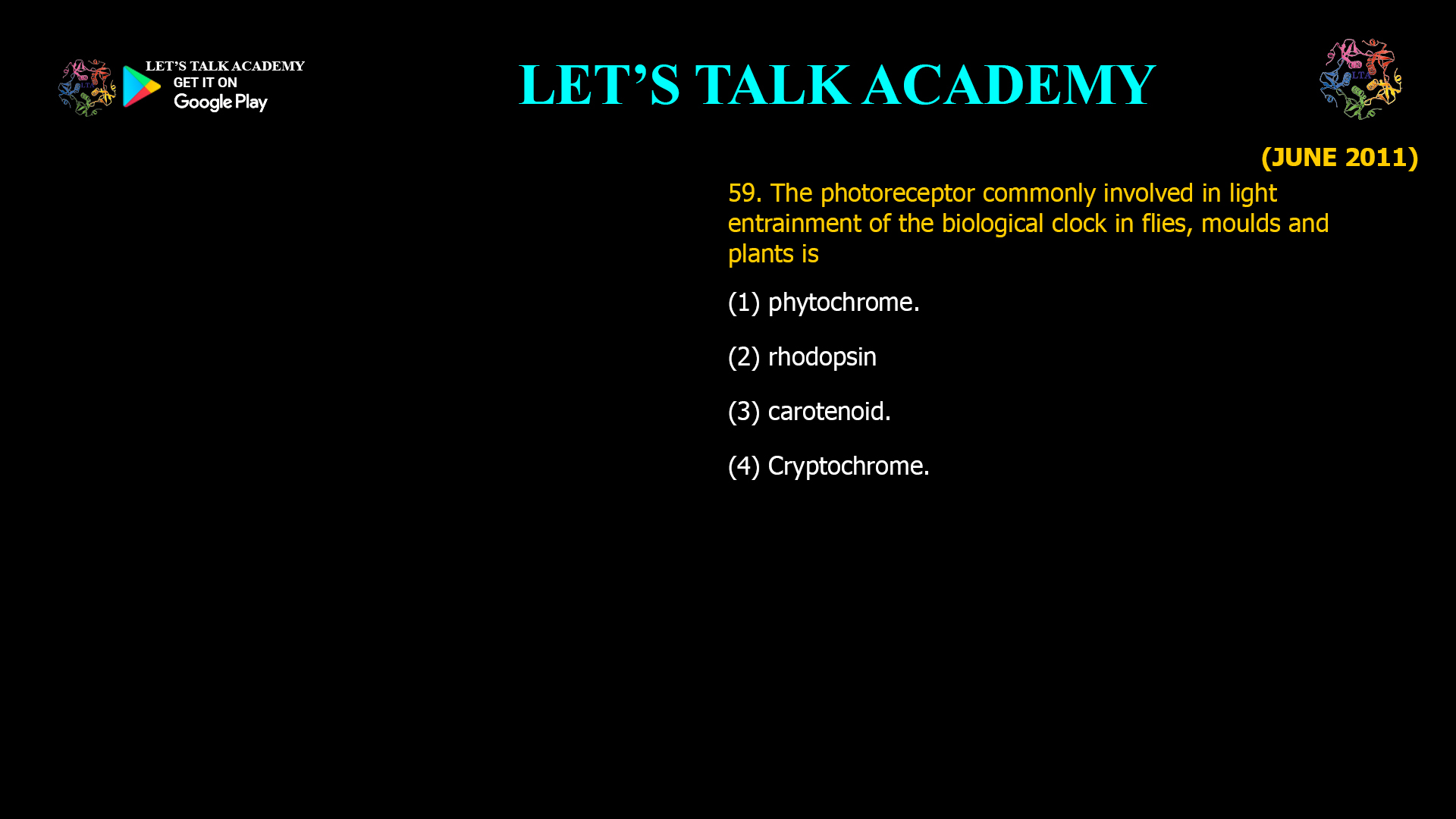
- The photoreceptor commonly involved in light entrainment of the biological clock in flies, moulds and plants is
(1) phytochrome. (2) rhodopsin
(3) carotenoid. (4) Cryptochrome.What Is Cryptochrome?
Cryptochrome is a highly conserved blue-light photoreceptor protein found in plants, fungi (moulds), and animals, including insects like Drosophila (fruit flies). It plays a central role in regulating circadian rhythms by responding to changes in light and transmitting this information to the molecular clock machinery.
How Does Cryptochrome Work?
-
In Drosophila (flies), cryptochrome (CRY) is the main photoreceptor that detects blue light and directly modulates the circadian clock, helping synchronize behavioral and physiological rhythms to the environment.
-
In plants, cryptochromes are crucial for light entrainment of circadian rhythms, working alongside other photoreceptors to ensure the plant’s internal clock matches the external day-night cycle.
-
In moulds and other fungi, cryptochrome serves a similar function, acting as the primary sensor for environmental light that resets the circadian oscillator.
Why Not Other Photoreceptors?
-
Phytochrome is mainly involved in red/far-red light responses in plants, not the primary blue-light entrainment of the circadian clock.
-
Rhodopsin is a photoreceptor found in the eyes of animals, primarily for vision, and only plays a secondary role in circadian light input in some insects.
-
Carotenoids are pigments, not photoreceptors, and do not play a direct role in circadian light entrainment.
Scientific Consensus
Extensive research confirms that cryptochrome is the common photoreceptor responsible for light entrainment of biological clocks in flies, moulds, and plants, making it essential for maintaining synchronized circadian rhythms in these organisms.
Correct answer: (4) Cryptochrome
-


1 Comment
Kajal
October 15, 2025Cryptochromes