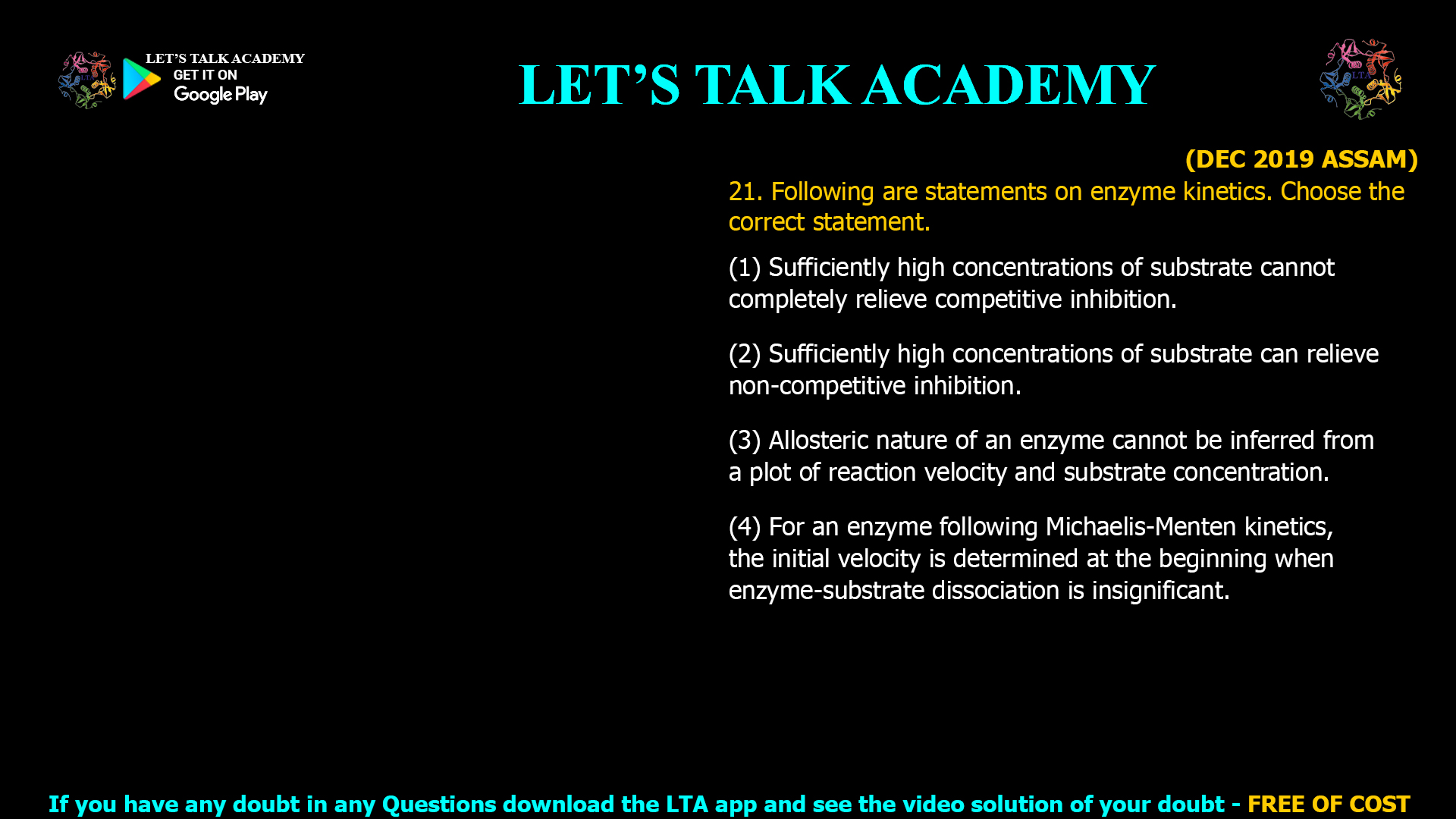
(DEC 2019 ASSAM)
21. Following are statements on enzyme kinetics. Choose the correct statement.
(1) Sufficiently high concentrations of substrate cannot completely relieve competitive inhibition.
(2) Sufficiently high concentrations of substrate can relieve non-competitive inhibition.
(3) Allosteric nature of an enzyme cannot be inferred from a plot of reaction velocity and substrate concentration.
(4) For an enzyme following Michaelis-Menten kinetics, the initial velocity is determined at the
beginning when enzyme-substrate dissociation is insignificant.
The correct answer is (4) For an enzyme following Michaelis-Menten kinetics, the initial velocity is determined at the beginning when enzyme-substrate dissociation is insignificant.
Title
Meta Description
Slug
Introduction
Enzyme kinetics involves understanding how enzymes interact with substrates and inhibitors to regulate reaction rates. Several statements regarding enzyme behavior, inhibition types, and kinetics can help clarify these mechanisms. This article analyzes key statements from enzyme kinetics, focusing on substrate concentration effects, types of inhibition, and determination of initial velocity in Michaelis-Menten enzymes.
Statement Analysis
(1) Sufficiently high substrate concentrations cannot completely relieve competitive inhibition.
-
Incorrect: Competitive inhibition occurs when an inhibitor competes with substrate for the enzyme active site.
-
Increasing substrate concentration increases the likelihood of substrate outcompeting the inhibitor.
-
Therefore, sufficiently high substrate concentration can completely overcome competitive inhibition.
(2) Sufficiently high substrate concentrations can relieve non-competitive inhibition.
-
Incorrect: Non-competitive inhibitors bind to allosteric sites, not active sites.
-
Substrate concentration does not affect inhibitor binding.
-
Increasing substrate concentration cannot overcome non-competitive inhibition.
(3) Allosteric nature of an enzyme cannot be inferred from a plot of reaction velocity and substrate concentration.
-
Incorrect: Allosteric enzymes often demonstrate sigmoidal (S-shaped) kinetics instead of the hyperbolic curve typical of Michaelis-Menten kinetics.
-
This characteristic curve can be used to infer allosteric behavior.
(4) For an enzyme following Michaelis-Menten kinetics, the initial velocity is determined at the beginning when enzyme-substrate dissociation is insignificant.
-
Correct: Michaelis-Menten kinetics assumes measurements are done at initial reaction velocity, where substrate conversion is minimal.
-
At this stage, breakdown of ES complex to product dominates, and substrate or enzyme depletion is negligible.
-
Enzyme-substrate dissociation does not significantly affect the initial reaction velocity, making this the optimal measure.
Why (4) is Correct
-
Initial velocity avoids complexities from product accumulation.
-
Ensures the system adheres to steady-state assumptions.
-
Enables reproducibility and accuracy in enzyme kinetic measurements.
Summary Table
| Statement | Correctness | Explanation |
|---|---|---|
| (1) High substrate can’t relieve competitive inhibition | Incorrect | High substrate outcompetes competitive inhibitor |
| (2) High substrate can relieve non-competitive inhibition | Incorrect | Non-competitive inhibition unaffected by substrate concentration |
| (3) Allosteric nature cannot be inferred from V vs. S plot | Incorrect | Sigmoidal curve reveals allosteric properties |
| (4) Initial velocity measured when ES dissociation is insignificant | Correct | Matches Michaelis-Menten assumptions |
Conclusion
Among the statements, only (4) is correct, reflecting the principle that initial velocity measurements in Michaelis-Menten enzyme kinetics are taken before significant enzyme-substrate complex dissociation or product formation occurs. Other statements incorrectly describe substrate effects on different inhibition types and allosteric properties. Understanding these nuances is vital for accurate biochemical experimentation and interpretation of enzyme behavior.
This explanation supports robust enzyme kinetics knowledge, empowering students and professionals to analyze inhibition types and enzyme behavior during biochemical reactions.


44 Comments
Aakansha sharma Sharma
September 12, 2025(4) is correct, that initial velocity measurements in Michaelis-Menten enzyme kinetics are taken before significant enzyme-substrate complex dissociation or product formation occurs.
Varsha Tatla
September 12, 2025Here option 4 is ri5
Varsha Tatla
September 12, 2025Option 4 is right 👍🏿
Mohd juber Ali
September 13, 2025Option 4 is right bcz in beginning when enzyme bind with substrate form E-S complex E-S complex dissociation is insignificant (michealis menten)
According option a for competative inhibition inhibitor compete with substrate to bind active site of enzyme
Mansukh Kapoor
September 13, 2025The correct answer is option 4th
The initial velocity measurements in Michaelis-Menten enzyme kinetics are taken before significant enzyme-substrate complex dissociation
Kanica Sunwalka
September 13, 2025option 4 is correct – the initial velocity measurements in Michaelis – Menten enzyme kinetics are taken before significant enzyme -substrate complex dissociation occurs
Bhawna Choudhary
September 13, 2025Option 4 is correct answer
Santosh Saini
September 13, 2025The initial velocity measured when ES complex dissociation is insignificant
Nilofar Khan
September 14, 2025Correct answer is 4
Soniya Shekhawat
September 14, 2025At the beginning, we measure the reaction speed before products accumulate and before enzyme–substrate dissociation or reverse reactions complicate the kinetics.
Aafreen Khan
September 14, 2025Option 4 is correct
Initial velocity measured when ES dissociation is insignificant
Pooja
September 14, 2025Option d is correct
For an enzyme following Michaelis-Menten kinetics, the initial velocity is determined at the beginning when enzyme-substrate dissociation is insignificant.
Dharmpal Swami
September 14, 2025Initial velocity measured when ES complex dissociation is insignificant
Ayush Dubey
September 14, 2025For an enzyme following Michaelis-Menten kinetics, the initial velocity is determined at the beginning when enzyme-substrate dissociation is insignificant.
Tanvi Panwar
September 14, 2025AT the beginning the conversion of ES into product is more and its dissociation is less that’s why the measurements are taken at the initial velocity.
Anjali
September 14, 20254 is correct
Kajal
September 14, 2025Option 4is correct
Anurag Giri
September 14, 2025The correct answer is (4) For an enzyme following Michaelis-Menten kinetics, the initial velocity is determined at the beginning when enzyme-substrate dissociation is insignificant.
Mitali saini
September 14, 2025The correct answer is (4) For an enzyme following Michaelis-Menten kinetics, the initial velocity is determined at the beginning when enzyme-substrate dissociation is insignificant.
Rishita
September 14, 2025For an enzyme following Michaelis-Menten kinetics, the initial velocity is determined at the beginning when enzyme-substrate dissociation is insignificant.
Anju
September 14, 2025Ans:4
According to michealis Menten equation
Avni
September 14, 2025initial velocity measurements in Michaelis-Menten enzyme kinetics are taken before significant enzyme-substrate complex dissociation or product formation occurs.
Vanshika Sharma
September 14, 2025For an enzyme following mechails and menten equation. The initial velocity is determined at the beginning when enzyme substrate dissociation is insignificant
Ajay Sharma
September 14, 2025Option 4 is correct, if an enzyme follows michaelis menten the initial velocity is determined at the beginning when enzyme substrate dissociation is insignificant, at this stage es complex to e and p dominates sufficient enzyme and substrate are available so this stage is best to measure initial velocity
Heena Mahlawat
September 14, 2025For an enzyme following michalis-menten kinetics, initial velocity is determined at beginning when ES dissociation is insignificant.
Pallavi Ghangas
September 14, 2025Initial velocity measured when ES dissociation is insignifican
anjani sharma
September 14, 2025Answer 4
The initial velocity measured when ES complex dissociation is insignificant
Deepika sheoran
September 15, 2025Option 4th is correct
Michaelis menten kinetics for initial velocity is determined at the beginning when enzyme substrate dissociation is insignificant.
Priyanshi sharma
September 15, 2025The correct answer is option is 4
Khushi Agarwal
September 15, 2025Option (4) is correct answer
For an enzyme following Michaelis-Menten kinetics, the initial velocity is determined at the beginning when enzyme-substrate dissociation is insignificant.
Michaelis-Menten kinetics ke liye sabse important assumption hai
Initial velocity ko early stage mein measure karte hain,Jaha product formation itna kam hota hai ki reverse reaction (product substrate) aur ES complex dissociation negligible hote hain
Asha Gurzzar
September 15, 2025Option 4is correct initial velocity measured when es complex dissociation is insignificant
Ankita Pareek
September 15, 2025Option 4th is correct enzymes following michaelis menten reaction, initial velocity is determined at the beginning when enzyme substrate dissociation is significant
Simran Saini
September 15, 2025For an enzyme following Michaelis-Menten kinetics, the initial velocity is determined at the beginning when enzyme-substrate dissociation is insignificant.
Khushi Vaishnav
September 15, 2025For an enzyme following Michaelis-Menten kinetics, the initial velocity is determined at the beginning when enzyme-substrate dissociation is insignificant
Muskan singodiya
September 15, 2025Correct option 4
Arushi Saini
September 15, 2025Option 4 is correct
Initial velocity measured when ES dissociation is insignificant
Anjana sharma
September 16, 2025For an enzyme following Michaelis-Menten kinetics, the initial velocity is determined at the beginning when enzyme-substrate dissociation is insignificant.
Sonal nagar
September 16, 2025Option 4
For an enzyme following Michaelis-Menten kinetics, the initial velocity is determined at the beginning when enzyme-substrate dissociation is insignificant..
Minal Sethi
September 16, 2025option 4 is correct
Muskan Yadav
September 17, 2025For an enzyme following Michaelis-Menten kinetics, the initial velocity is determined at the beginning when enzyme-substrate dissociation is insignificant.
so option 4 is correct
Yogita
September 17, 2025For an enzyme following Michaelis Manten enzyme kinetics are taken before significant enzyme substrate complex dissociation
Savita Garwa
September 21, 2025The correct answer is option 4th
The initial velocity measurements in Michaelis-Menten enzyme kinetics are taken before significant enzyme-substrate complex dissociation
Khushi Singh
September 25, 20254 is coy
Khushi Singh
September 25, 20254 is correct