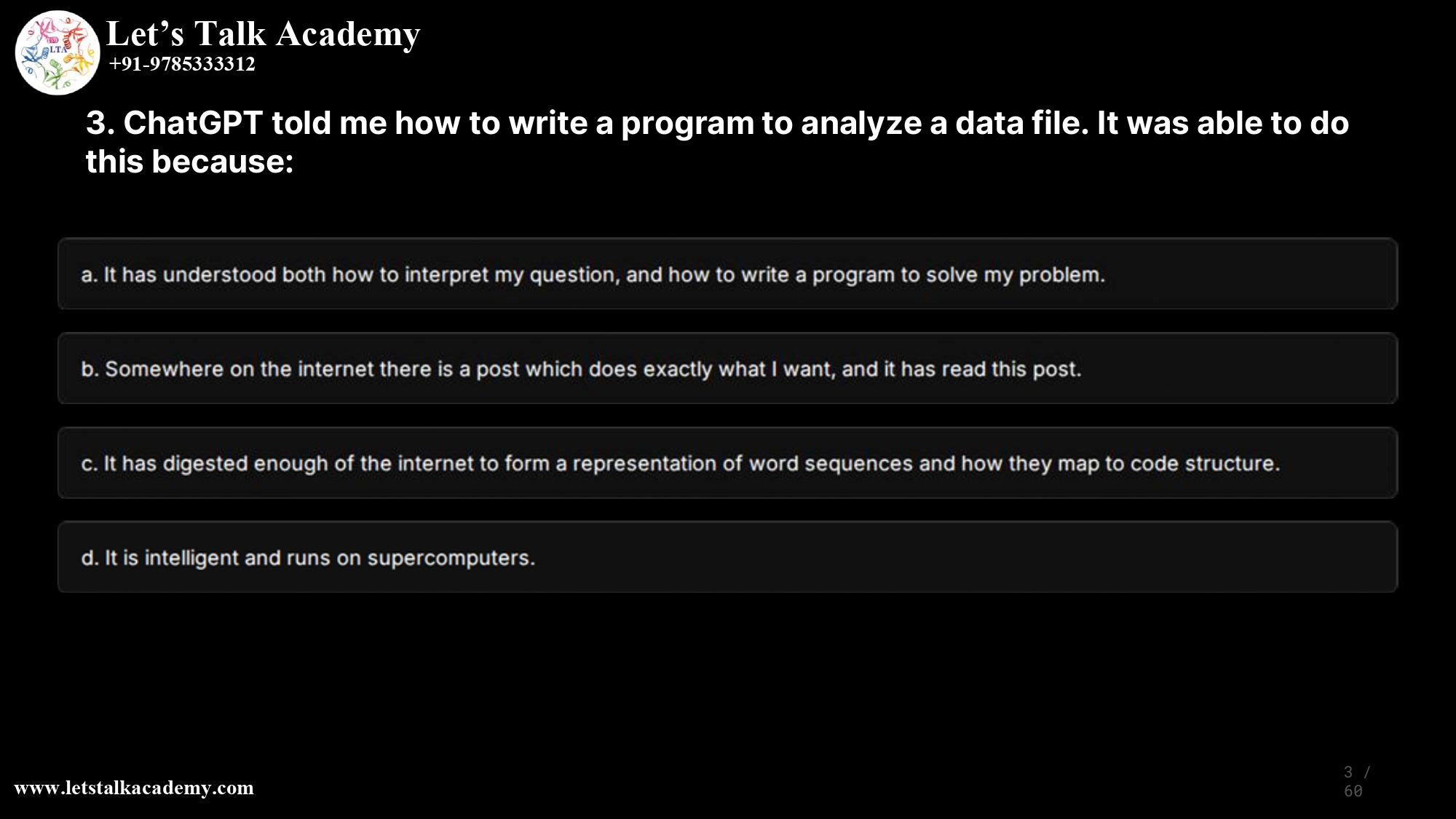
3. ChatGPT told me how to write a program to analyze a data file. It was able
to do this because:
a. It has understood both how to interpret my question, and how to write
a program to solve my problem.
b. Somewhere on the internet there is a post which does exactly what I want,
and it has read this post.
c. It has digested enough of the internet to form a representation of word
sequences and how they map to code structure.
d. It is intelligent and runs on supercomputers.
ChatGPT generates code to analyze data files through statistical pattern recognition learned from vast training data, not true understanding or direct internet access. The correct answer is c. It has digested enough of the internet to form a representation of word sequences and how they map to code structure.
Option Analysis
a. It has understood both how to interpret my question, and how to write a program to solve my problem.
This option implies human-like comprehension and problem-solving intent. ChatGPT processes inputs via transformer architecture, predicting tokens based on patterns without genuine understanding or intent. It mimics interpretation through statistical correlations, not cognitive grasp.
b. Somewhere on the internet there is a post which does exactly what I want, and it has read this post.
ChatGPT trains on massive datasets before deployment without real-time web access during inference. It generalizes from patterns across code examples, not verbatim recall of specific posts. Exact matches rarely exist; novel combinations emerge from learned structures.
c. It has digested enough of the internet to form a representation of word sequences and how they map to code structure. (Correct)
Large language models like ChatGPT train on internet-scale text, encoding relationships between natural language queries and code via transformer layers. For data file analysis, it maps phrases like “analyze CSV” to Python patterns (pandas reads, dataframes), enabling coherent code generation.
d. It is intelligent and runs on supercomputers.
Supercomputers provide compute for training/inference, but capability stems from statistical modeling, not intelligence. ChatGPT excels at pattern matching for code tasks like data analysis via next-token prediction, lacking consciousness or reasoning.
Core Mechanism
Transformer models convert queries to embeddings, apply self-attention to capture context, and generate code autoregressively. Training on code-datafile examples creates internal mappings for tasks like pandas-based analysis.
This MCQ tests AI fundamentals: LLMs simulate expertise through probabilistic representations, ideal for exam prep on machine learning concepts.


