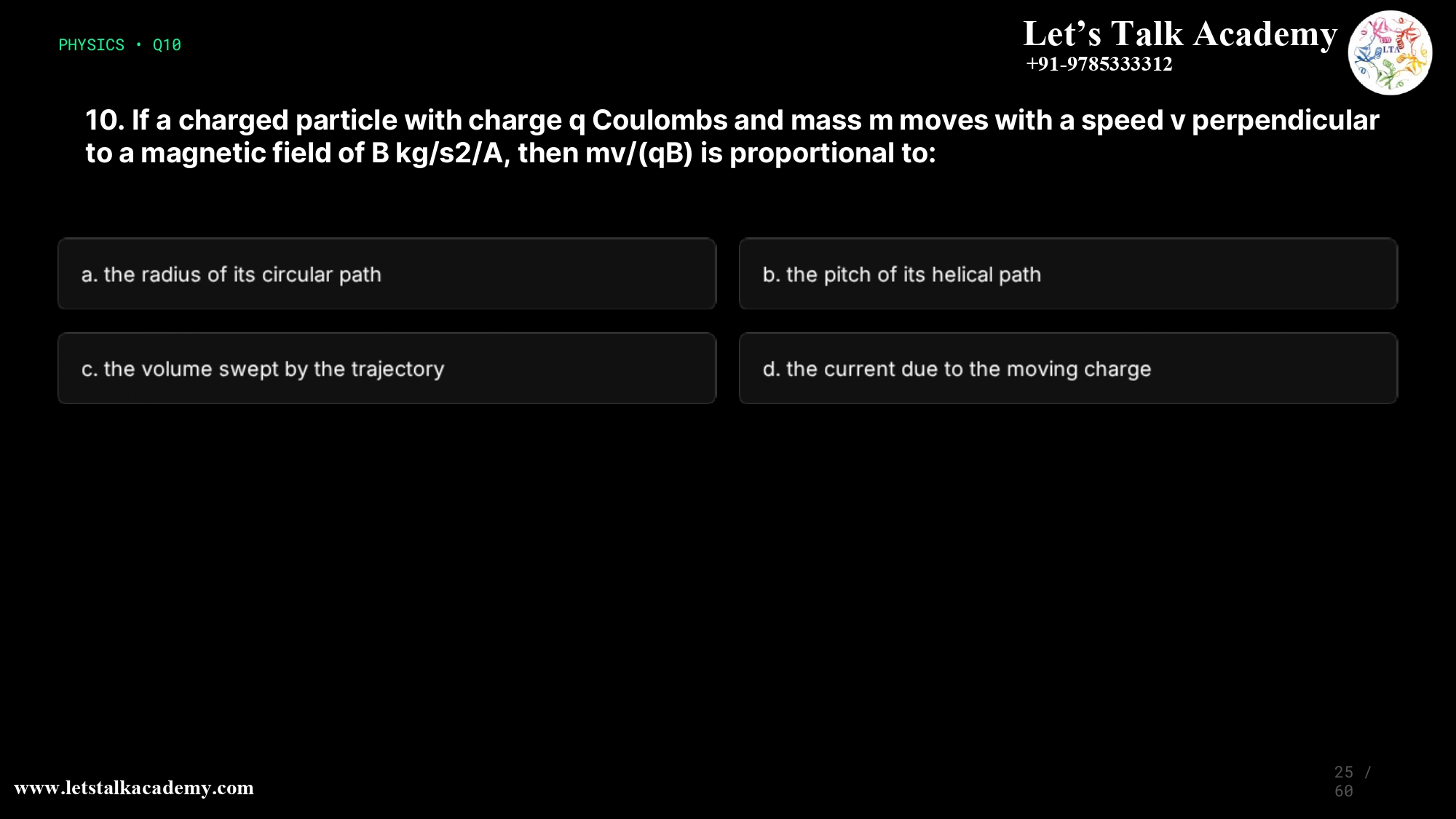
10. If a charged particle with charge q Coulombs and mass m moves with a speed v perpendicular to
a magnetic field of B kg/s2/A, then mv/(qB) is proportional to:
a. the radius of its circular path
b. the pitch of its helical path
c. the volume swept by the trajectory
d. the current due to the moving charge
Solution Explanation
A charged particle with charge q, mass m, moving at speed v perpendicular to magnetic field B follows a circular path. The magnetic force qvB provides centripetal force mv²/r, yielding radius r = mv/(qB).[web:21][web:24][web:28]
Thus, mv/qB equals the radius r directly, making it proportional to the radius of the circular path.[web:23][web:29][web:36] Since motion is perpendicular, no helical component exists.[web:24]
Option Analysis
- a. the radius of its circular path: Correct. r = mv/qB shows direct proportionality.[web:21][web:28][web:36]
- b. the pitch of its helical path: Incorrect. Pitch p = v∥T = 2πm v∥/(qB) applies only when velocity has parallel component; here v is perpendicular so v∥ = 0, pitch = 0.[web:26][web:30][web:38]
- c. the volume swept by the trajectory: Incorrect. Volume relates to 4/3πr³ or path length times area, not directly mv/qB.[web:27]
- d. the current due to the moving charge: Incorrect. Equivalent current I = q/T = q²B/(2πm); inversely proportional to m/q, unrelated to mv/qB.[web:32]
Key Formula: r = \frac{mv}{qB} → \frac{mv}{qB} = r


