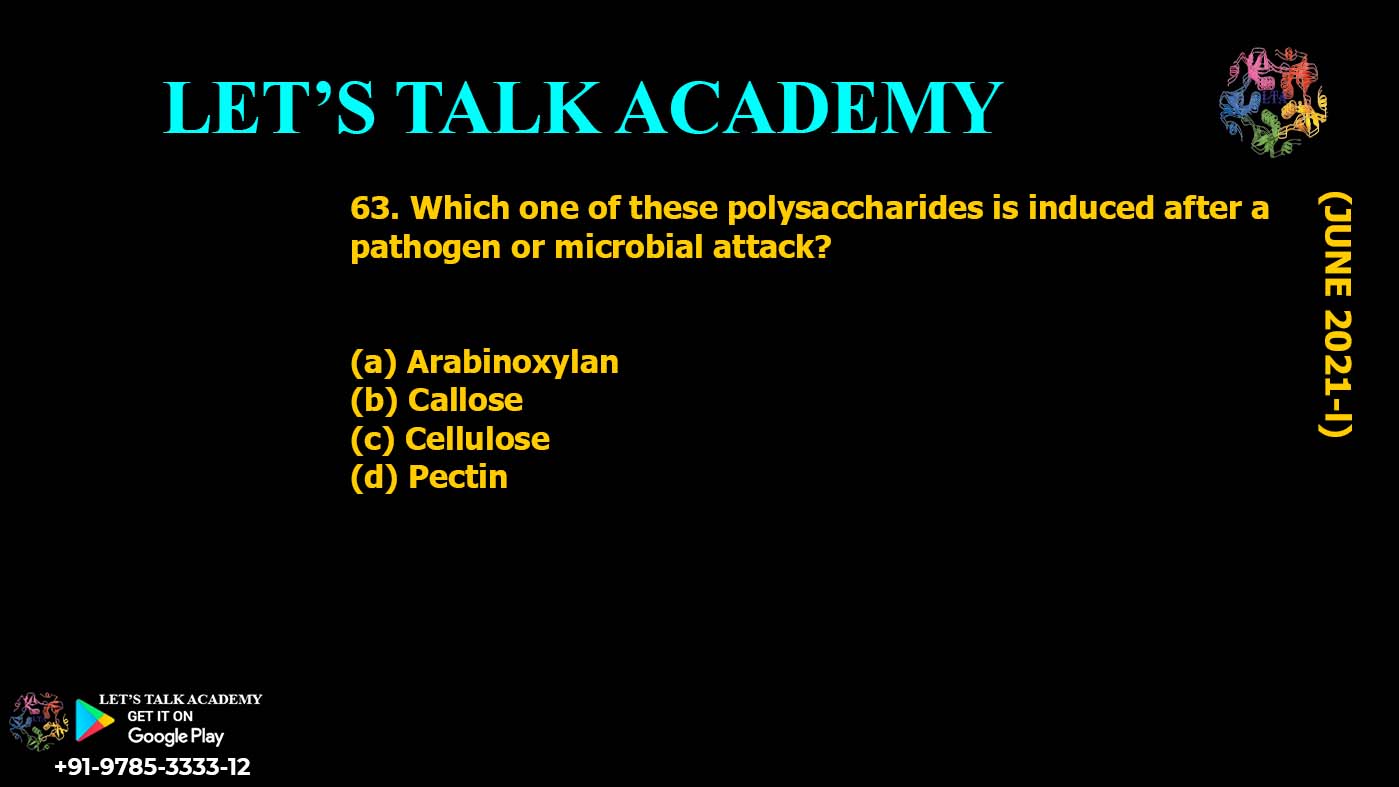
63. Which one of these polysaccharides is induced after a pathogen or microbial attack?
(a) Arabinoxylan
(b) Callose
(c) Cellulose
(d) Pectin
Callose: A Key Defense Polysaccharide in Plants
When plants encounter a pathogen or microbial attack, their immune systems respond rapidly to prevent further infection and damage. One of the most important biochemical responses in this scenario is the synthesis of callose, a polysaccharide that strengthens cell walls and blocks pathogen progression.
Correct Answer:
(b) Callose
What is Callose?
Callose is a β-1,3-glucan polysaccharide that is rapidly synthesized and deposited at specific sites in the plant cell wall, especially around plasmodesmata and in response to stress or pathogen invasion. Its accumulation is part of a first-line defense strategy, forming physical barriers that restrict pathogen movement between cells.
Role of Callose in Plant Immunity
-
Plugs plasmodesmata to limit pathogen spread.
-
Reinforces cell walls at infection sites, often forming structures called papillae.
-
Works in conjunction with other defense responses, including reactive oxygen species (ROS) generation and pathogenesis-related proteins.
Why Not the Other Options?
-
Arabinoxylan: Found in cell walls but not primarily involved in pathogen response.
-
Cellulose: Structural component of all plant cell walls; not specifically induced by pathogens.
-
Pectin: Part of the primary cell wall and middle lamella but not an inducible defense response.
Conclusion
Callose plays a crucial role in the early immune response of plants. Its inducible nature makes it a valuable marker in plant pathology studies and an important target in agricultural biotechnology to improve disease resistance.


3 Comments
Vikram
April 19, 2025⛄👏🏻
Akshay mahawar
April 23, 2025Done 👍
yogesh sharma
May 7, 2025Done sir ji 👍😄