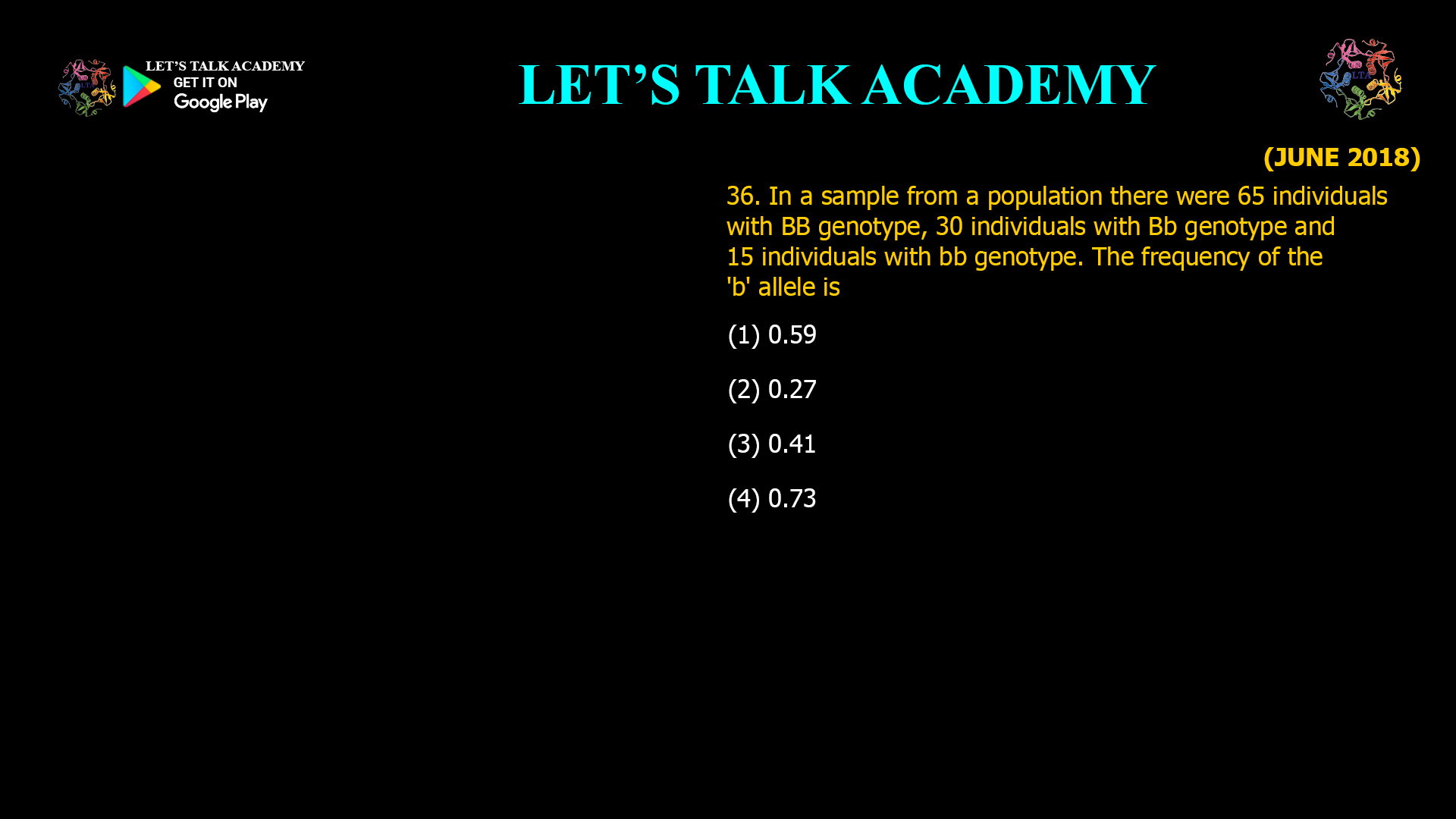
- In a sample from a population there were 65 individuals with BB genotype, 30 individuals with Bb genotype and 15 individuals with bb genotype. The frequency of the ‘b’ allele is
(1) 0.59 (2) 0.27
(3) 0.41 (4) 0.73How to Calculate the Frequency of the ‘b’ Allele from Genotype Data in a Population
Calculating allele frequencies from genotype data is a fundamental skill in population genetics. The Hardy-Weinberg principle provides a simple framework to determine the frequency of any allele using the observed numbers of each genotype in a sample.
Step 1: Gather Genotype Data
Given:
-
BB: 65 individuals
-
Bb: 30 individuals
-
bb: 15 individuals
Total individuals = 65 + 30 + 15 = 110
Step 2: Use the Allele Counting Method
Each individual has two alleles. To find the frequency of the ‘b’ allele:
-
Each bb individual contributes 2 b alleles.
-
Each Bb individual contributes 1 b allele.
-
Each BB individual contributes 0 b alleles.
Total number of b alleles:
-
From bb: 15 × 2 = 30
-
From Bb: 30 × 1 = 30
-
From BB: 65 × 0 = 0
Total b alleles = 30 + 30 = 60
Total number of alleles in the population:
110 individuals × 2 = 220 allelesStep 3: Calculate the Frequency of the ‘b’ Allele
Frequency of b=Number of b allelesTotal number of alleles=60220=0.273
Rounded to two decimal places, the frequency is 0.27.
Step 4: Match with the Provided Options
-
(1) 0.59
-
(2) 0.27
-
(3) 0.41
-
(4) 0.73
The correct answer is (2) 0.27.
Why This Calculation Matters
-
Population genetics: Understanding allele frequencies helps track genetic diversity and evolutionary trends.
-
Medical genetics: Knowing allele frequencies can predict carrier rates for genetic diseases.
-
Conservation biology: Allele frequency data informs management of endangered populations.
Conclusion
The frequency of the ‘b’ allele in this population is 0.27. This calculation uses straightforward allele counting and is essential for any genetic analysis of populations
-