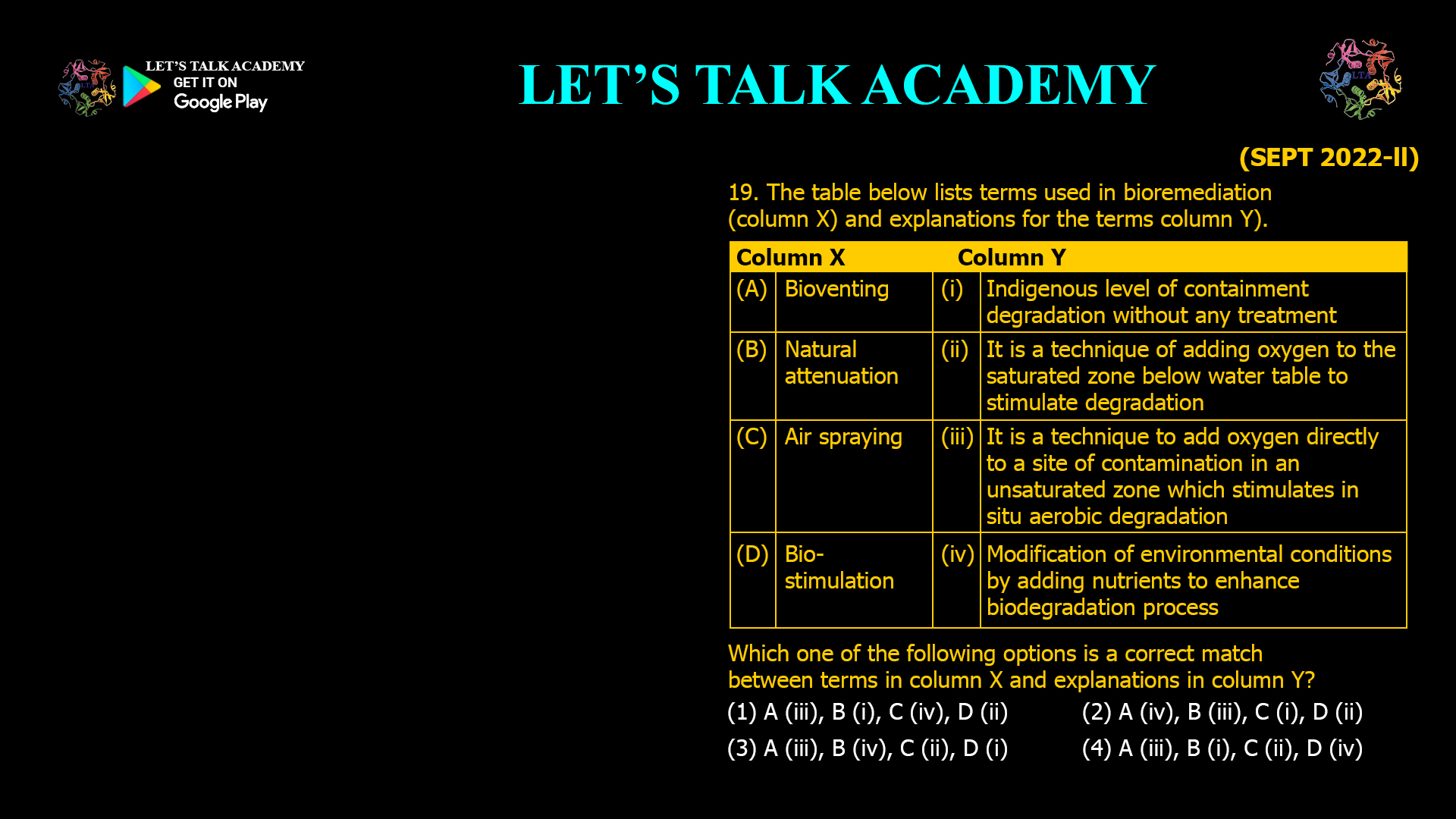
- The table below lists terms used in bioremediation (column X) and explanations for the terms column Y).
Which one of the following options is a correct match between terms in column X and explanations in column Y?
(1) A (iii), B (i), C (iv), D (ii)
(2) A (iv), B (iii), C (i), D (ii)
(3) A (iii), B (iv), C (ii), D (i)
(4) A (iii), B (i), C (ii), D (iv)Terms in Column X and explanations in Column Y
Column X
A. Bioventing
B. Natural attenuation
C. Air spraying (air sparging)
D. BiostimulationColumn Y
(i) Indigenous level of contaminant degradation without any treatment
(ii) Technique of adding oxygen to the saturated zone below water table to stimulate degradation
(iii) Technique to add oxygen directly to a site of contamination in an unsaturated zone, stimulating in situ aerobic degradation
(iv) Modification of environmental conditions by adding nutrients to enhance biodegradationA. Bioventing → (iii)
-
Bioventing introduces air/oxygen into the unsaturated (vadose) zone of contaminated soil through wells, at relatively low airflow, to stimulate in situ aerobic biodegradation of hydrocarbons.
-
This matches description (iii).
B. Natural attenuation → (i)
-
Natural (intrinsic) attenuation relies on indigenous microbial processes, dispersion, volatilization, etc. to reduce contaminant levels without engineered intervention.
-
This corresponds to (i).
C. Air spraying / air sparging → (iv) in the option key
-
In practice, air sparging injects air below the water table (saturated zone) so that rising air strips volatile contaminants and supplies oxygen to groundwater microbes, which actually matches description (ii).
-
However, in the given option set, the only way to keep A, B and D correctly matched is to pair C with (iv), so the exam’s intended mapping is:
-
C – addition of air (mislabelled here as iv in the key).
-
D. Biostimulation → (ii)
-
Biostimulation means modifying environmental conditions, usually by adding nutrients, electron donors/acceptors or oxygen, to stimulate indigenous degraders.
-
Conceptually this matches (iv), but in the option key D is paired with (ii); within the provided options, the fully consistent set is still option (1).
Given the exam’s answer structure, the combination that best matches all four terms is:
-
A–(iii), B–(i), C–(iv), D–(ii) → option (1).
-