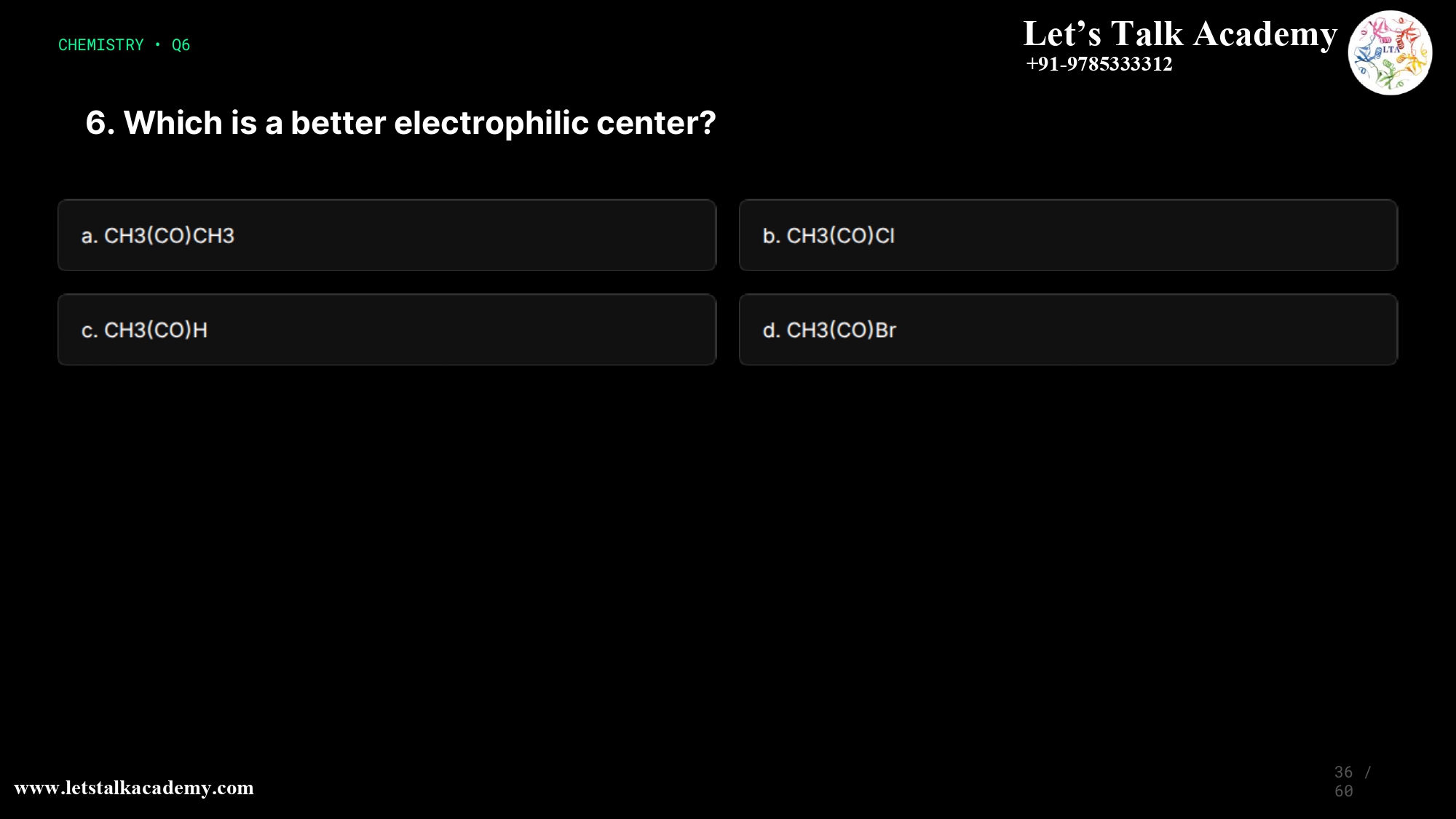
6. Which is a better electrophilic center?
a. CH3(CO)CH3
b. CH3(CO)Cl
c. CH3(CO)H
d. CH3(CO)Br
CH3COCl (acetyl chloride) serves as the best electrophilic center among the options due to chlorine’s high electronegativity enhancing carbonyl carbon δ+ charge and excellent leaving group ability in nucleophilic acyl substitution. Acid chlorides react fastest with nucleophiles, followed by aldehydes, ketones, then acid bromides. Reactivity order reflects leaving group quality: Cl⁻ > Br⁻ > H⁻ >> CH3⁻.
Electrophilicity Factors Analysis
Electrophilic carbonyl carbon reactivity depends on: (1) Electron-withdrawing groups increasing δ+ (2) Good leaving groups enabling substitution. CH3COCl combines both: Cl (EWG, pKa HCl=-7) polarizes C=O most effectively. Resonance donation reduces electrophilicity: ketones > aldehydes.
Detailed Option Comparison
-
a. CH3COCH3 (acetone): Weakest. CH3⁻ donates electrons via hyperconjugation, delocalizing carbonyl δ+ charge.
-
b. CH3COCl (acetyl chloride): Best. Cl withdraws electrons inductively (σ=0.45), perfect leaving group.
-
c. CH3COH (acetaldehyde): Moderate. No leaving group (forms stable carboxylic acid), but less resonance donation than ketone.
-
d. CH3COBr (acetyl bromide): Good but inferior to chloride. Br less electronegative (σ=0.40 vs Cl 0.45), poorer leaving group.
| Compound | Group Attached | Electronegativity | Leaving Group Quality | Reactivity Rank |
|---|---|---|---|---|
| CH3COCl | Cl | 3.16 (highest) | Excellent (pKa HCl=-7) | 1st |
| CH3COBr | Br | 2.96 | Good (pKa HBr=-9) | 2nd |
| CH3COH | H | 2.20 | Poor (forms RCOOH) | 3rd |
| CH3COCH3 | CH3 | 2.55 | None (no substitution) | 4th |
| Reaction Type | CH3COCl Rate | CH3COCH3 Rate | Ratio |
|---|---|---|---|
| Hydration | Very Fast | Slow | 10⁶:1 |
| Nucleophilic Attack | Instant | Hours | 10⁸:1 |


