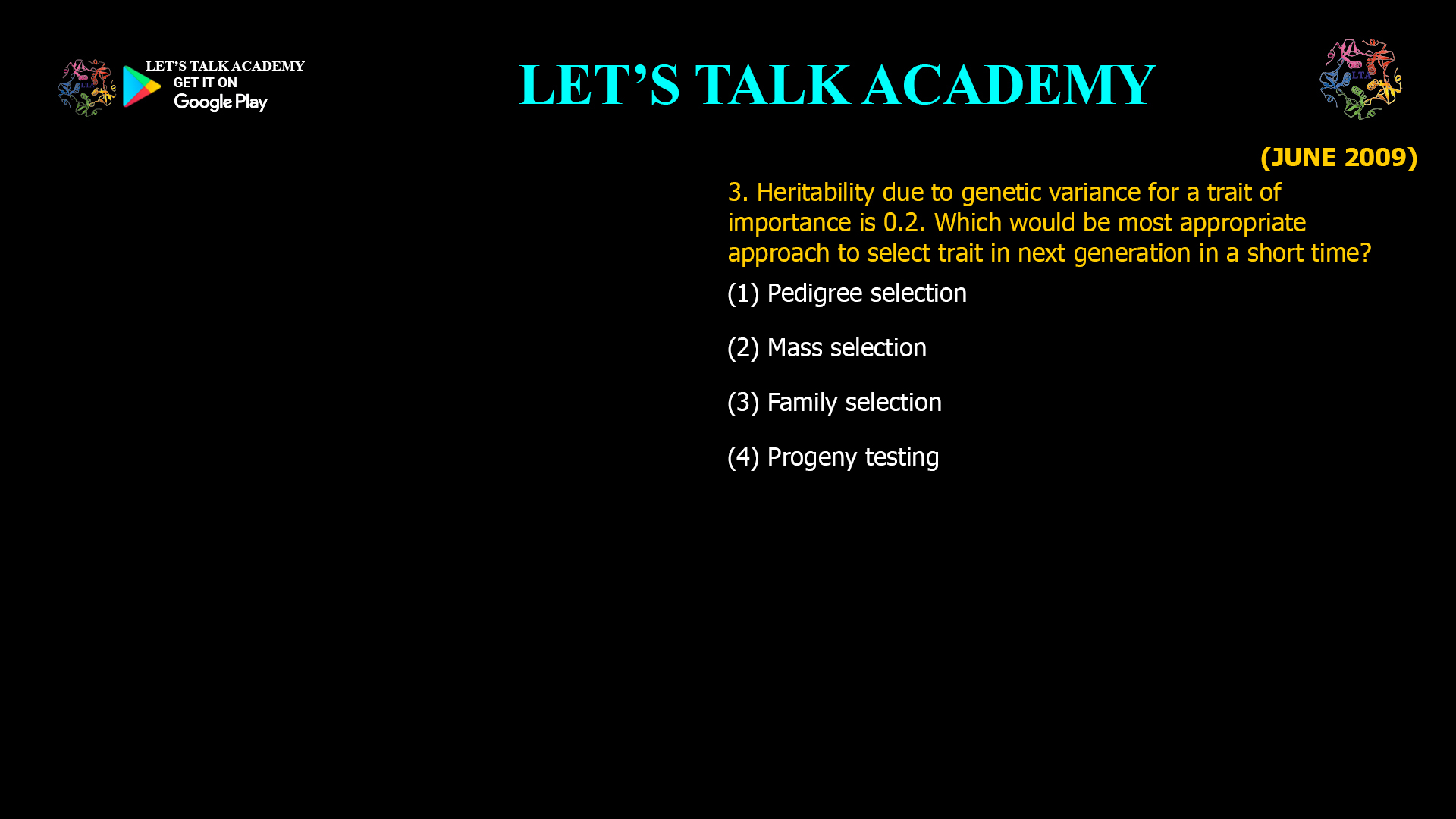
- Heritability due to genetic variance for a trait of importance is 0.2. Which would be most appropriate approach to select trait in next generation in a short time?
(1) Pedigree selection (2) Mass selection
(3) Family selection (4) Progeny testingConcept: Heritability 0.2 and its implication
-
Heritability h2=0.2 means only 20% of phenotypic variation is genetic; 80% is environmental.
-
Individual plant phenotype is therefore a poor predictor of breeding value, so methods that average over progenies or families give more accurate selection.
Option-wise explanation
-
Pedigree selection
-
Relies heavily on individual plant phenotype plus recorded ancestry.
-
With low heritability, single-plant phenotype is unreliable, so pedigree selection is slow and less effective for quick gain.
-
-
Mass selection
-
Selects individual plants on phenotype and bulks their seed.
-
Works best when heritability is high; with h2=0.2, environmental noise makes it inefficient for rapid improvement.
-
-
Family selection
-
Uses performance of families (e.g., half-sib or full-sib) rather than individuals, which improves accuracy.
-
However, the classic, more rigorous version of this idea is progeny testing.
-
-
Progeny testing – correct
-
Plants are selected, their progenies grown and evaluated, and selection is based on progeny mean performance, which averages out environmental effects.
-
This is especially recommended for low-heritability traits, giving higher accuracy and better genetic gain in a relatively short number of generations.
-
Because the trait has low heritability (0.2) and rapid, reliable improvement is desired, progeny testing (option 4) is the most appropriate approach.
-


1 Comment
Muskan Yadav
December 8, 2025Progeny testing – correct