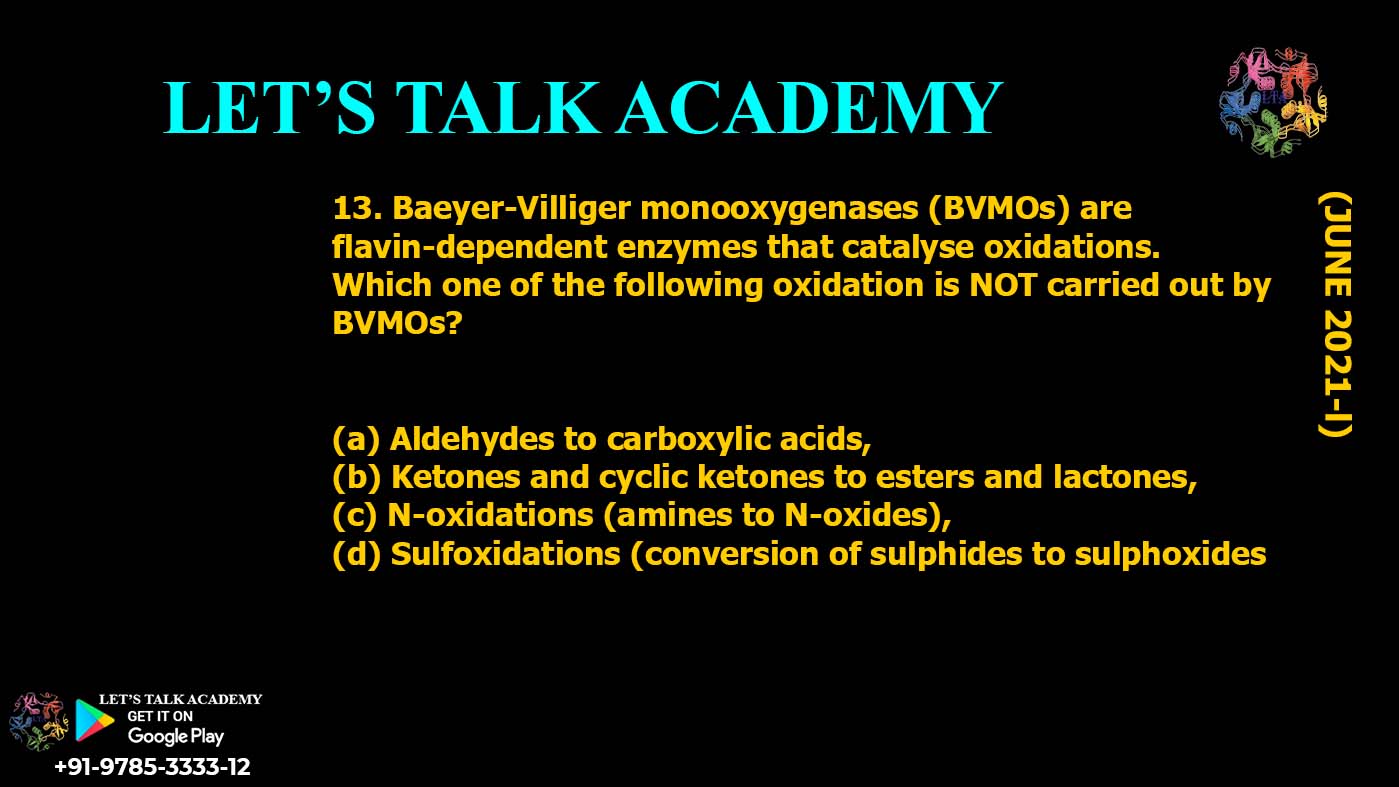
13. Baeyer-Villiger monooxygenases (BVMOs) are flavin-dependent enzymes that catalyse oxidations.
Which one of the following oxidation is NOT carried out by BVMOs?
(a) Aldehydes to carboxylic acids,
(b) Ketones and cyclic ketones to esters and lactones,
(c) N-oxidations (amines to N-oxides),
(d) Sulfoxidations (conversion of sulphides to sulphoxides
Article:
Introduction to Baeyer-Villiger Monooxygenases (BVMOs)
Baeyer-Villiger monooxygenases (BVMOs) are a fascinating class of flavin-dependent enzymes that catalyze oxidation reactions in various organic substrates. They play an essential role in biotransformations, particularly in the conversion of aldehydes, ketones, and cyclic ketones into esters, lactones, and other important compounds.
The Baeyer-Villiger oxidation, a key reaction facilitated by these enzymes, involves the incorporation of an oxygen atom into a substrate, leading to the formation of an ester or lactone, depending on the structure of the substrate. These enzymes are widely used in biocatalysis due to their ability to selectively carry out oxidations under mild conditions, making them valuable tools in industrial chemistry, pharmaceutical synthesis, and biotechnology.
In this article, we will dive deeper into the functions of BVMOs, identify the types of oxidation reactions they catalyze, and clarify which oxidation reaction is NOT typically carried out by BVMOs.
What Oxidation Reactions Are Catalyzed by BVMOs?
BVMOs are primarily involved in the following types of oxidation reactions:
-
Aldehydes to Carboxylic Acids: One of the key reactions catalyzed by Baeyer-Villiger monooxygenases is the oxidation of aldehydes to carboxylic acids. In this reaction, the enzyme facilitates the addition of an oxygen atom to the aldehyde group, converting it into a carboxyl group. This is a typical oxidative transformation carried out by BVMOs.
-
Ketones and Cyclic Ketones to Esters and Lactones: Another important reaction carried out by BVMOs is the oxidation of ketones (including cyclic ketones) to esters and lactones. This is the hallmark of the Baeyer-Villiger oxidation, which involves the insertion of an oxygen atom into a carbonyl group, forming either an ester or lactone, depending on the substrate’s structure. This is one of the most well-known reactions in organic chemistry.
-
N-oxidations (Amines to N-oxides): In addition to carbonyl-containing compounds, some Baeyer-Villiger monooxygenases are capable of catalyzing N-oxidations, where an amine is converted to an N-oxide. This type of reaction involves the oxidation of the nitrogen atom in an amine group to form an N-oxide, which is often found in pharmaceutical intermediates and natural products.
What Reaction is NOT Catalyzed by BVMOs?
While Baeyer-Villiger monooxygenases are versatile enzymes, they do not catalyze sulfoxidation reactions. Sulfoxidation involves the oxidation of sulphides to sulphoxides, a process typically catalyzed by other types of enzymes, such as cytochrome P450 enzymes. Sulfoxidation reactions involve the insertion of an oxygen atom into a sulfur atom, which is not a characteristic reaction for BVMOs.
Thus, the incorrect oxidation reaction for Baeyer-Villiger monooxygenases is:
(d) Sulfoxidations (conversion of sulphides to sulphoxides)
Conclusion:
Baeyer-Villiger monooxygenases are powerful enzymes involved in various oxidative reactions, especially in the oxidation of aldehydes, ketones, and amines. These reactions are highly valuable in biocatalysis and industrial applications. However, it is important to note that BVMOs do not catalyze sulfoxidations, which are carried out by other enzymes like cytochrome P450.
Key Takeaways:
-
BVMOs catalyze oxidations of aldehydes to carboxylic acids, ketones to esters and lactones, and amines to N-oxides.
-
They do not catalyze sulfoxidations, which are typically carried out by other types of enzymes.
-
Baeyer-Villiger monooxygenases are valuable in biotechnology and pharmaceutical synthesis due to their specificity and mild reaction conditions.
Understanding the diverse roles of BVMOs in biochemical transformations opens up opportunities for green chemistry, sustainable manufacturing, and innovative drug development.


2 Comments
Vikram
April 22, 2025👏🏻
yogesh sharma
May 8, 2025Done sir ✅