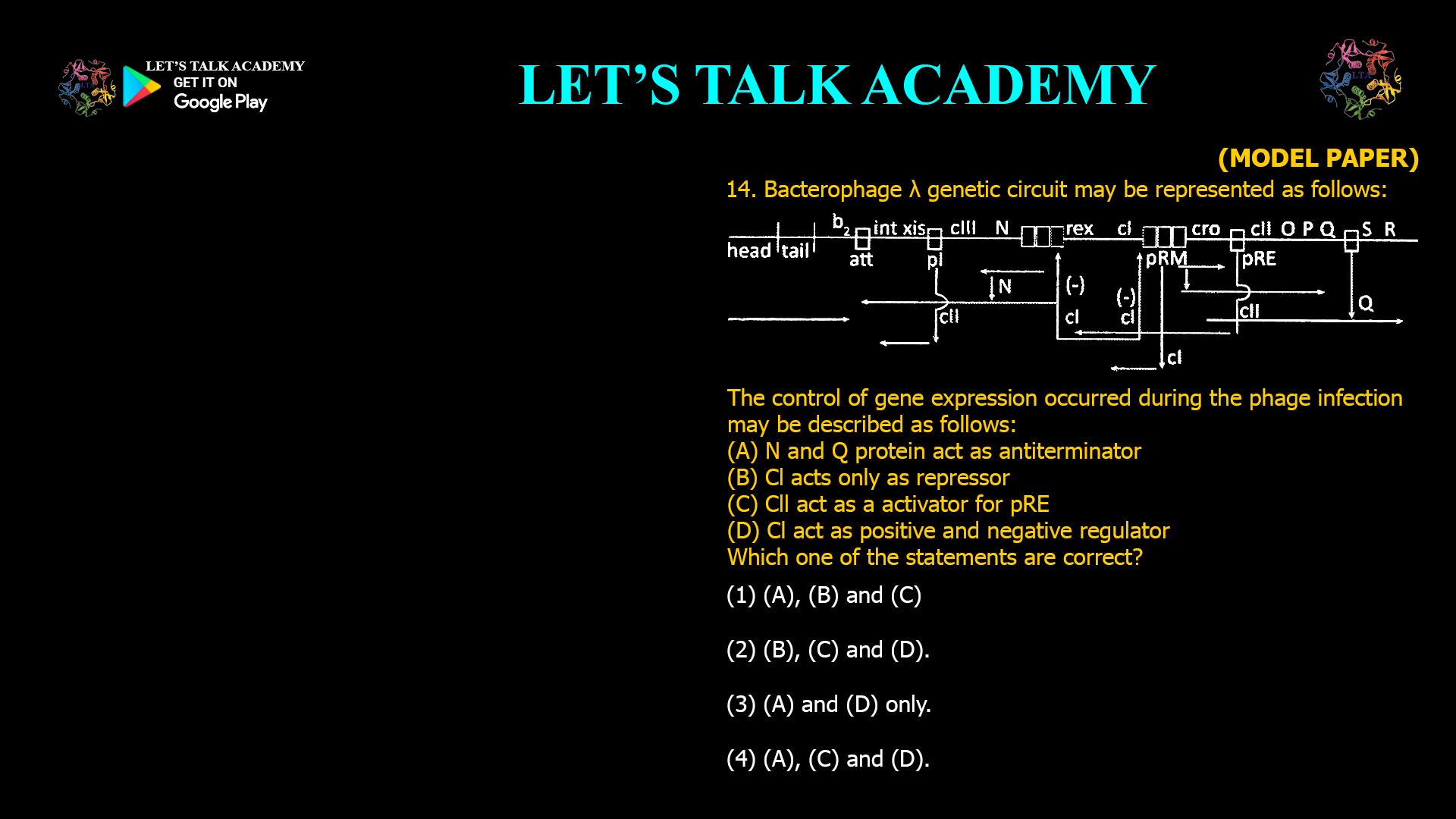
14. Bacterophageλgenetic circuit may be represented as follows:
The control of gene expression occurred during the phage infection may be described as follows:
(A) N and Q protein act as antiterminator
(B) Cl acts only as repressor
(C)Cli act as a activator for pRE
(D) Cl act as positive and negative regulator
Which one of the statements are correct?
(1) (A), (B) and (C).
(2) (B), (C) and (D).
(3) (A) and (D) only.
(4) (A), (C) and (D)
 Bacteriophage lambda (λ phage) is a temperate virus that infects Escherichia coli and exhibits two distinct life cycles: the lytic cycle, where new phage particles are produced leading to host cell lysis, and the lysogenic cycle, where the phage genome integrates into the host chromosome and remains dormant. The control of gene expression during these processes is orchestrated by several phage-encoded regulatory proteins, which ensure the timely expression of genes necessary for each stage.
Key Regulatory Proteins in Lambda Phage Gene Expression
-
N protein: Acts as an antiterminator during early transcription. It modifies RNA polymerase to bypass transcriptional terminators, allowing expression of delayed early genes.
-
Q protein: Functions as an antiterminator for late gene transcription, enabling RNA polymerase to transcribe genes required for phage assembly and lysis.
-
CI protein: Also known as the lambda repressor, it plays a central role in maintaining lysogeny by repressing lytic promoters and activating its own expression.
-
CII protein: Activates transcription of the cI gene from the P_RE promoter, promoting lysogeny.
Analysis of Statements About Lambda Phage Regulatory Proteins
Let’s evaluate the given statements:
(A) N and Q proteins act as antiterminators:
This is correct. The N protein allows RNA polymerase to read through early terminators, enabling delayed early gene expression. The Q protein similarly modifies RNA polymerase to transcribe late genes. Both are essential antiterminator proteins in lambda phage gene regulation.
(B) CI acts only as a repressor:
This is incorrect. While CI represses lytic promoters (P_R and P_L), it also acts as a positive regulator by activating its own transcription from the P_RM promoter. Therefore, CI functions both as a repressor and activator.
(C) CI acts as an activator for P_RE promoter:
This is incorrect. The P_RE promoter is activated by the CII protein, not CI. CII activates P_RE to initiate transcription of the cI gene, which produces the CI repressor.
(D) CI acts as both positive and negative regulator:
This is correct. CI represses lytic promoters to maintain lysogeny and activates its own promoter to sustain its expression, exemplifying dual regulatory roles.
Correct Combination of Statements
Given the above analysis, the correct statements are:
-
(A) N and Q proteins act as antiterminators.
-
(D) CI acts as both positive and negative regulator.
Thus, the correct answer is:
(3) (A) and (D) only.
How These Regulatory Proteins Work Together
-
After infection, immediate early genes including N and cro are transcribed.
-
The N protein modifies RNA polymeras
-
e to bypass terminators, allowing expression of delayed early genes such as cII, cIII, int, and xis.
-
The CII protein activates the P_RE promoter to express cI, which produces the CI repressor.
-
CI represses lytic promoters and activates its own promoter, maintaining lysogeny.
-
If lysogeny is not established, Cro protein represses cI expression, favoring the lytic cycle.
-
The Q protein enables transcription of late lytic genes necessary for phage assembly and host lysis.
Biological Significance
This regulatory network enables lambda phage to:
-
Decide between lysogenic and lytic pathways based on host conditions.
-
Maintain stable lysogeny through CI-mediated repression and activation.
-
Efficiently produce progeny during the lytic cyc
-
le via N and Q antitermination mechanisms.
Conclusion
The control of gene expression during bacteriophage lambda infection is a finely tuned process involving multiple regulatory proteins. The N and Q proteins act as antiterminators, facilitating transcription of early and late genes, respectively. The CI protein functions as both a repressor and activator, maintaining lysogeny by repressing lytic genes and activating its own expression. The CII protein, not CI, activates the P_RE promoter to initiate cI transcription.
Therefore, the correct understanding aligns with statements (A) and (D), making option (3) (A) and (D) only the accurate choice.


