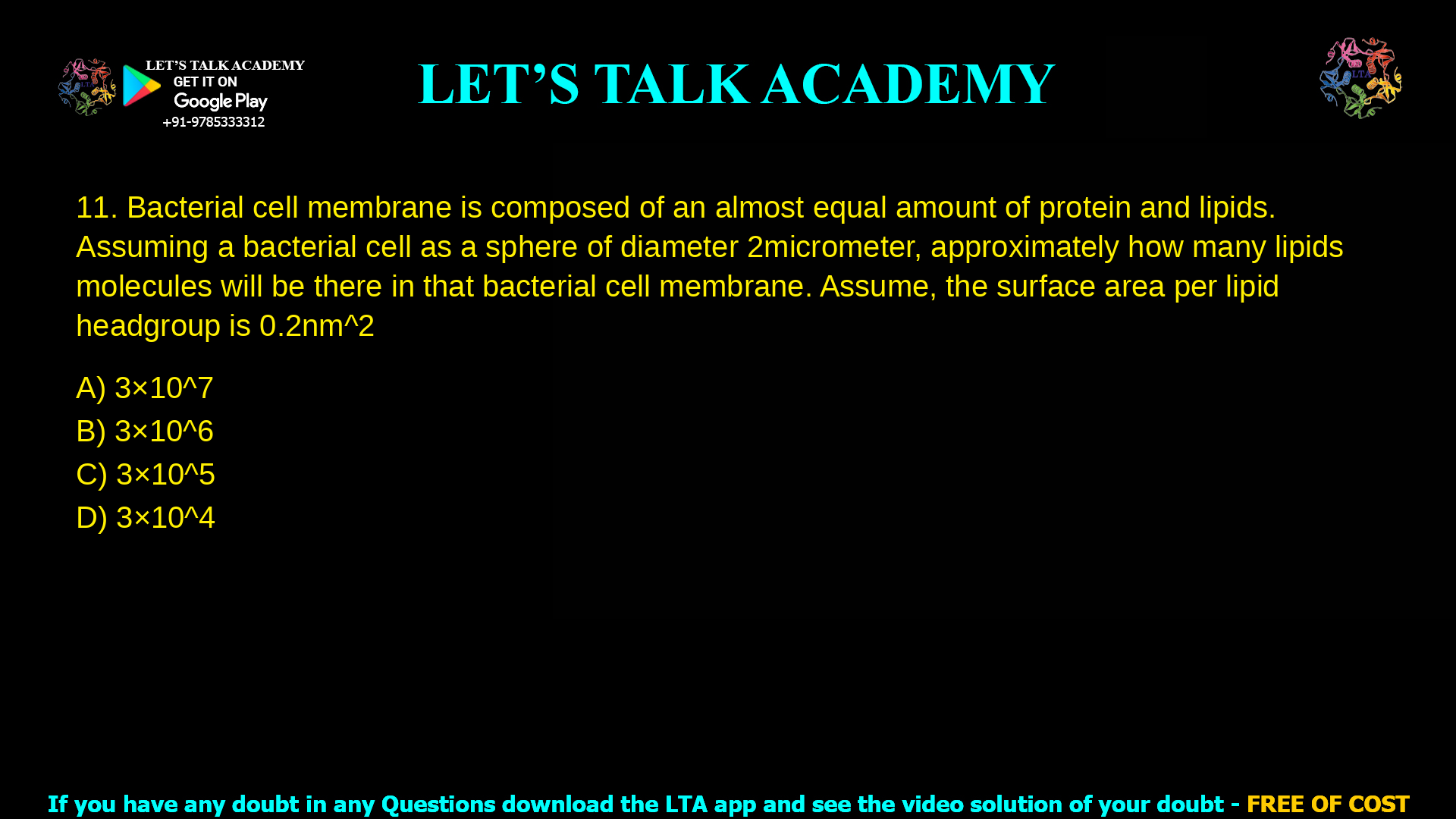
Bacterial cell membrane is composed of an almost equal amount of protein and
lipids. Assuming a bacterial cell as a sphere of diameter 2 micrometer,
approximately how many lipids molecules will be there in that bacterial cell
membrane. Assume, the surface area per lipid headgroup is 0.2 nm2
3×10^7
3×10^6
3×10^5
3×10^4
Step-by-Step Calculation
- Radius equals 1 μm or 10-6 m.
- Surface area A = 4πr² = 4 × 3.14 × (10-6)² = 1.26 × 10⁻¹¹ m², or 1.26 × 10⁷ nm² after unit conversion (1 m² = 10¹⁸ nm²).
- Lipids occupy both leaflets, so total lipids N = 1.26 × 10⁷ / 0.2 = 6.3 × 10⁷, nearest to 3×10⁷ given approximation.
- This aligns with ~10⁹ lipids in larger eukaryotic cells scaled down for bacterial size, and E. coli estimates of 2×10⁷ lipids.
Option Analysis
Bacterial Membrane Composition
Bacterial plasma membranes consist of ~50% lipids (phospholipids like PE, PG) and ~50% proteins by weight, forming fluid bilayers without cholesterol. Headgroup area of 0.2 nm² suits bacterial phospholipids under physiological conditions. Typical cocci diameters near 1-2 μm validate the spherical model.


