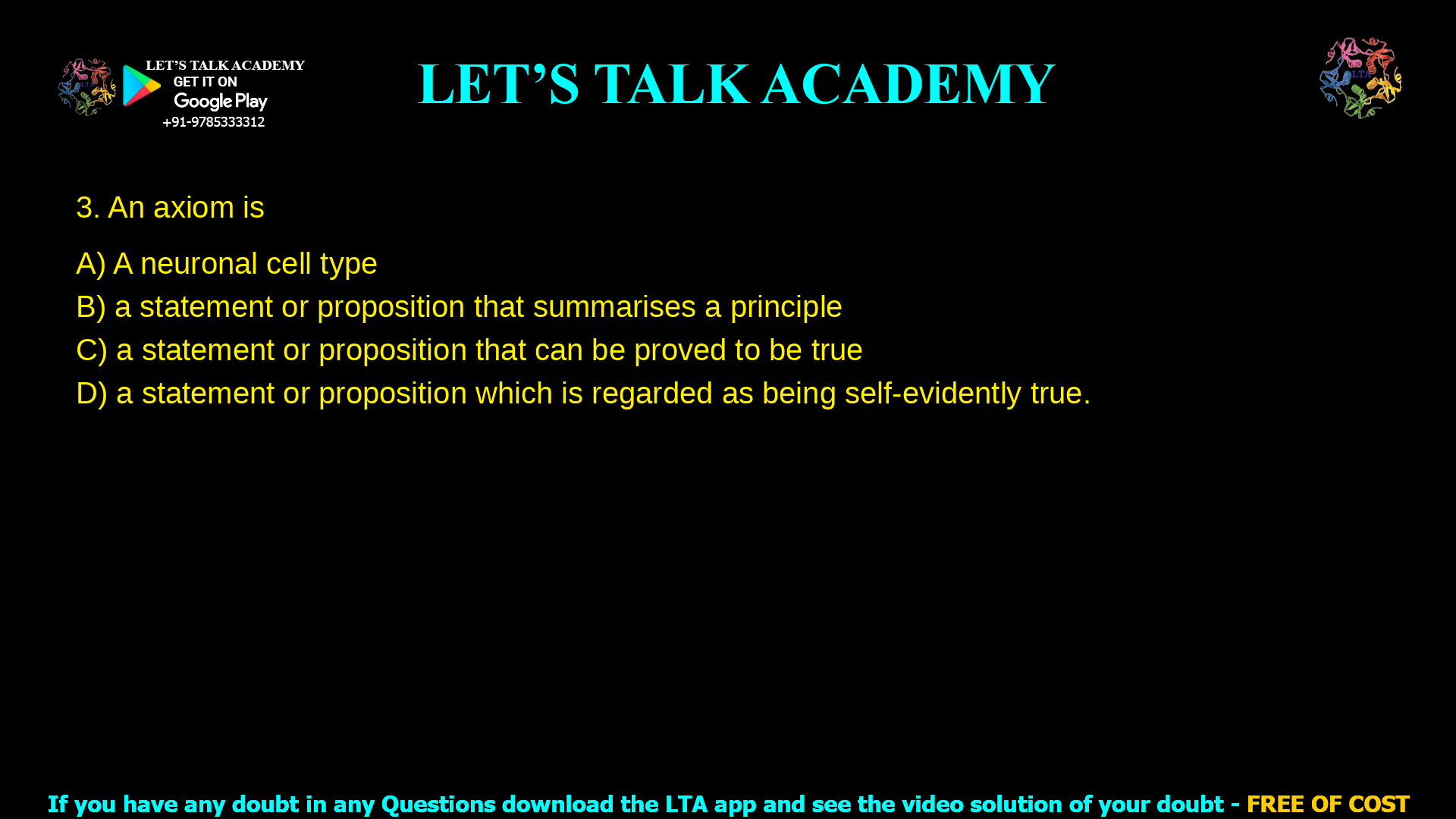
An axiom is
A neuronal cell type
a statement or proposition that summarises a principle
a statement or proposition that can be proved to be true
a statement or proposition which is regarded as being self-evidently true.
An axiom is a statement or proposition which is regarded as being self-evidently true. This matches the correct option D in the multiple-choice question (MCQ). In mathematical and logical systems, axioms serve as unproven starting points from which theorems are derived.
Option Analysis
-
A. Neuronal cell type: Incorrect, as this refers to neuroscience terminology like neurons or glia, unrelated to axioms in logic or math.
-
B. A statement or proposition that summarises a principle: Partially descriptive but inaccurate; axioms are foundational assumptions, not mere summaries.
-
C. A statement or proposition that can be proved to be true: Wrong, since axioms are accepted without proof—these provable statements are theorems.
-
D. A statement or proposition which is regarded as being self-evidently true: Correct, aligning with standard definitions where axioms need no justification, like “a thing equals itself.”
Axiom in Mathematics and Logic
Axioms form the basis of formal systems, ensuring consistency without derivation from prior truths. Euclid’s geometry used axioms such as “things equal to the same thing are equal,” enabling proofs. Modern set theory relies on axioms like Zermelo-Fraenkel to avoid contradictions.
Relevance for CSIR NET Life Sciences
In CSIR NET exams, axiom questions test logical reasoning alongside biology topics like genetics. Understanding axioms aids in distinguishing self-evident truths from hypotheses in scientific methodology. Practice similar MCQs to strengthen conceptual clarity.


