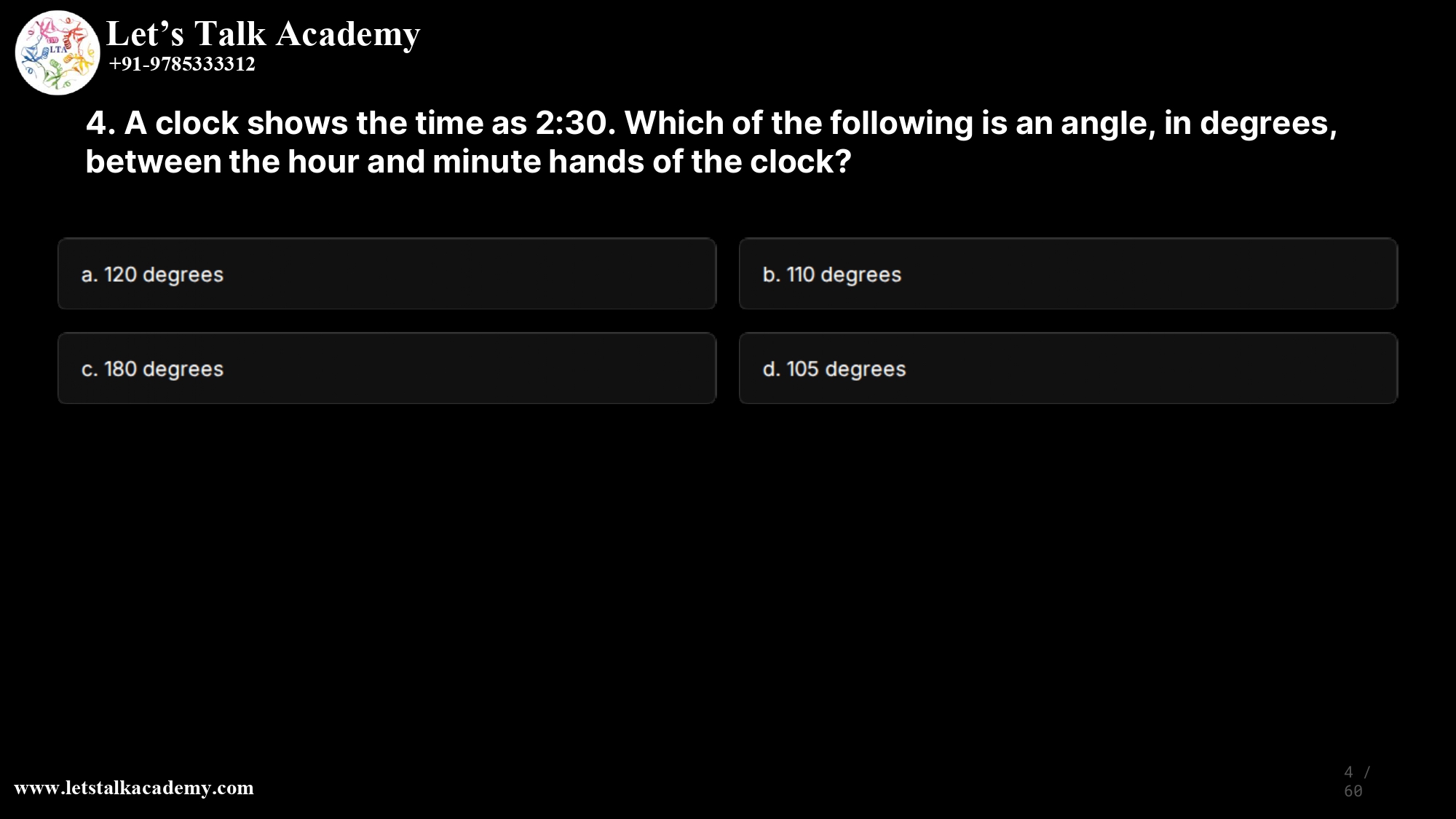
4. A clock shows the time as 2:30. Which of the following is an angle, in degrees, between the hour
and minute hands of the clock?
a. 120 degrees
b. 110 degrees
c. 180 degrees
d. 105 degrees
Introduction
When working with clock problems, one of the most fundamental concepts in competitive exams is calculating the angle between the hour hand and minute hand at a given time. This article provides a comprehensive, step-by-step solution to the question: “A clock shows the time as 2:30. Which of the following is an angle, in degrees, between the hour and minute hands of the clock?” We will solve this problem using the standard clock angle formula, explain why 105 degrees is the correct answer, and analyze each multiple-choice option in detail.
Understanding the Clock Angle Formula
An analog clock face is divided into 12 equal sections, with each section representing one hour. Since a complete circle contains 360 degrees, each hour division equals:
Each hour division = 360° ÷ 12 = 30°
Key Formulas:
- Minute hand angle from 12 o’clock: Angleminutes = 6° × number of minutes
- Hour hand angle from 12 o’clock: Anglehours = 30° × number of hours + 0.5° × number of minutes
The minute hand moves 360° in 60 minutes, which equals 6° per minute. The hour hand moves 30° per hour but also moves continuously, advancing 0.5° per minute.
Clock Angle Calculation at 2:30: Step-by-Step Breakdown
Step 1: Calculate the Minute Hand Position
At 2:30, the minute hand points to the 6 on the clock face (since 30 minutes = half an hour).
Using the formula: Angleminutes = 6° × 30 = 180°
The minute hand is positioned at 180 degrees from the 12 o’clock position.
Step 2: Calculate the Hour Hand Position
At 2:30, the hour hand is not exactly at the 2; it has moved halfway toward the 3 because 30 minutes have passed.
Using the formula: Anglehours = (30° × 2) + (0.5° × 30) = 60° + 15° = 75°
The hour hand is positioned at 75 degrees from the 12 o’clock position.
Step 3: Calculate the Angle Between the Hands
The angle between the two hands is the absolute difference between their positions:
Angle = |180° − 75°| = 105°
Therefore, the correct answer is 105 degrees (Option D).
Detailed Analysis of All Options
Option A: 120 Degrees ❌ (Incorrect)
An angle of 120° would result from neglecting the 15° movement of the hour hand during the half-hour. Without accounting for this, you might wrongly calculate 120° instead of 105°.
Option B: 110 Degrees ❌ (Incorrect)
An angle of 110° is a common close distractor. This mistake can occur if a student rounds the hour-hand movement incorrectly or misapplies the formula.
Option C: 180 Degrees ❌ (Incorrect)
This angle occurs at 6:00, when the hands are opposite each other — not at 2:30. Hence, this answer confuses the specific time or the continuous motion concept.
Option D: 105 Degrees ✅ (Correct)
Minute hand = 180°, hour hand = 75°, difference = 105°. This forms an acute angle slightly larger than a right angle, which is visibly accurate when observing a real clock showing 2:30.
Important Clock Angle Concepts
Two Possible Angles Between Hands
At any given time, two possible angles exist between the hour and minute hands:
- Smaller angle = 105°
- Reflex angle = 360° − 105° = 255°
Unless specified otherwise, we always refer to the smaller angle.
When Do the Hands Overlap?
The hands overlap (0° angle) 11 times in 12 hours around:
12:00, 1:05, 2:11, 3:16, 4:22, 5:27, 6:33, 7:38, 8:44, 9:49, and 10:55.
Common Clock Angles at Specific Times
- 3:00 or 9:00 — 90° (Right angle)
- 6:00 — 180° (Straight line)
- 2:30 — 105° (Our problem)
- 5:00 — 150° (Obtuse angle)
Practice Tips for Clock Angle Problems
- Master the Formula: Use Anglehours = 30H + 0.5M and Angleminutes = 6M consistently.
- Account for Hour Hand Movement: The hour hand moves continuously; don’t assume it “jumps” between numbers.
- Convert 24-Hour Time: Use the 12-hour format before calculations (H mod 12).
- Visual Verification: Cross-check using a real or mental clock representation.
- Beware of Distractors: MCQs often include angles from common calculation errors.
Conclusion
The angle between the hour and minute hands at 2:30 is 105 degrees, making Option D correct. This demonstrates the importance of recognizing continuous hour-hand motion. By applying the clock angle formulas correctly—minute hand at 180° and hour hand at 75°—we find their difference of 105°.
To excel in exams, stay consistent with formulas, understand the underlying clock mechanics, and practice various time configurations.


