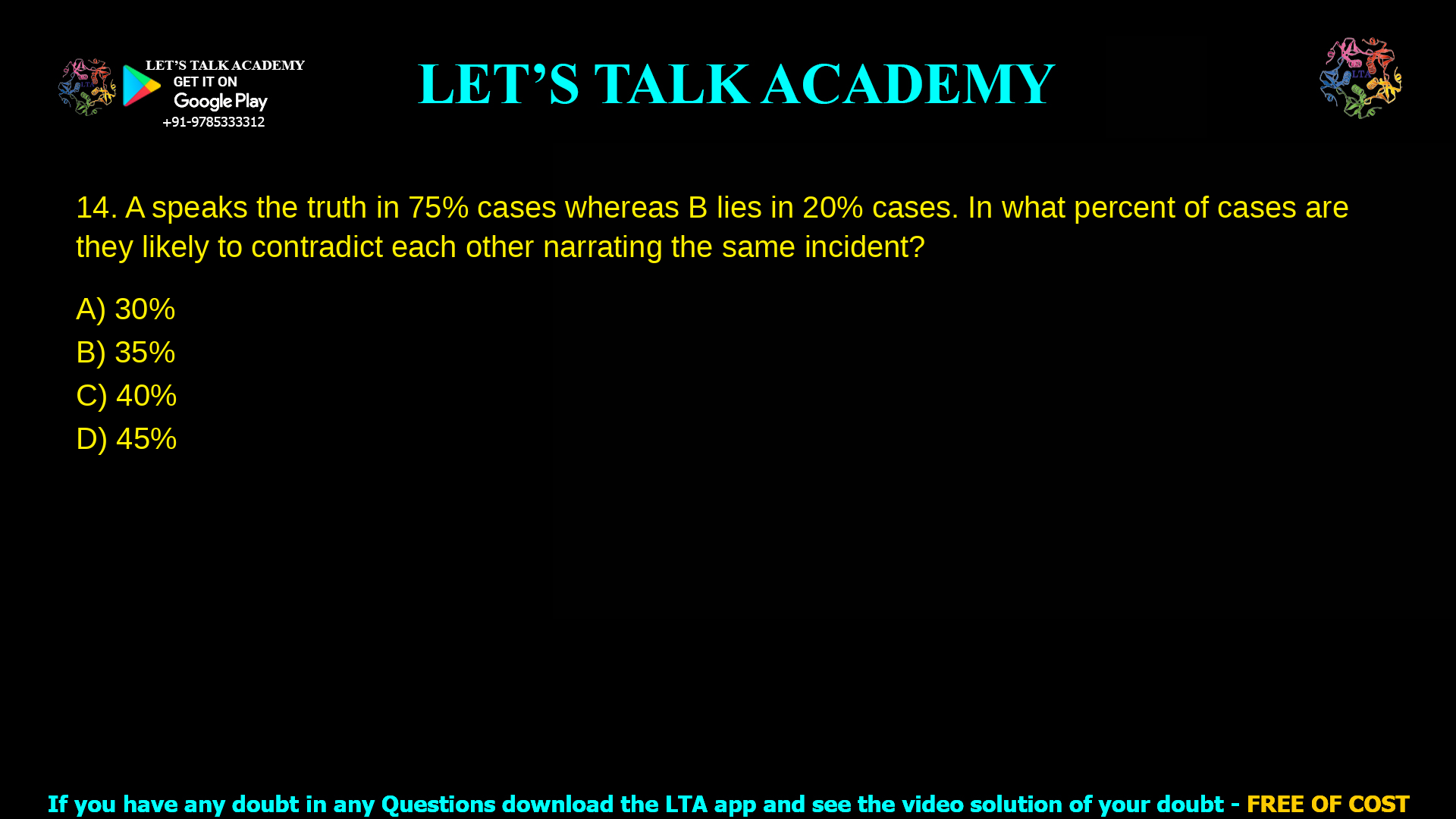
14. A speaks the truth in 75% cases whereas B lies in 20% cases. In what percent of
cases are they likely to contradict each other narrating the same incident?
a. 30%
b. 35%
c. 40%
d. 45%
They are likely to contradict each other in 35% of the cases, so the correct option is (b) 35%.
Introduction
Probability questions like “A speaks truth in 75% cases and B lies in 20% cases” are very important for competitive exams, especially when they ask for the percentage of cases in which two witnesses contradict each other.
Understanding how to convert percentages into probabilities and combine different cases helps in quickly solving such objective type questions with options.
Step-by-step solution
Given:
A speaks the truth in 75% cases
⇒ \(P(A \text{ speaks truth}) = 75\% = \frac{75}{100} = \frac{3}{4}\).
So,
\(P(A \text{ lies}) = 1 – \frac{3}{4} = \frac{1}{4}\).
B lies in 20% cases
⇒ \(P(B \text{ lies}) = 20\% = \frac{20}{100} = \frac{1}{5}\).
So,
\(P(B \text{ speaks truth}) = 1 – \frac{1}{5} = \frac{4}{5}\).
They contradict each other when:
- A speaks truth and B lies, or
- A lies and B speaks truth.
Assuming independence:
Case 1: A speaks truth, B lies
\(P_1 = P(A \text{ truth}) \times P(B \text{ lies}) = \frac{3}{4} \times \frac{1}{5} = \frac{3}{20} = 0.15.\)
Case 2: A lies, B speaks truth
\(P_2 = P(A \text{ lies}) \times P(B \text{ truth}) = \frac{1}{4} \times \frac{4}{5} = \frac{4}{20} = 0.20.\)
Total probability of contradiction
\(P(\text{contradiction}) = P_1 + P_2 = \frac{3}{20} + \frac{4}{20} = \frac{7}{20} = 0.35.\)
Convert to percentage:
\(0.35 \times 100\% = 35\%\).
So, they contradict each other in 35% of the cases.
Explanation of each option
The options are:
- a. 30%
This would arise if someone incorrectly adds only one case or makes an arithmetic error (for example, taking 0.15 + 0.15 = 0.30), but this ignores that the two probabilities \(P_1\) and \(P_2\) are not equal here. - b. 35%
This is correct because it equals \(\frac{7}{20} \times 100\%\), obtained by adding both independent contradiction cases, A truth & B lies plus A lies & B truth. - c. 40%
This could come from wrongly adding 0.20 + 0.20 or misreading one of the given percentages; it does not match the correct combined probability. - d. 45%
This is higher than any of the individual contradiction components and typically results from mixing up truth and lie percentages or incorrectly assuming more overlapping cases than actually exist.
Therefore, the correct answer is 35% (option b).


