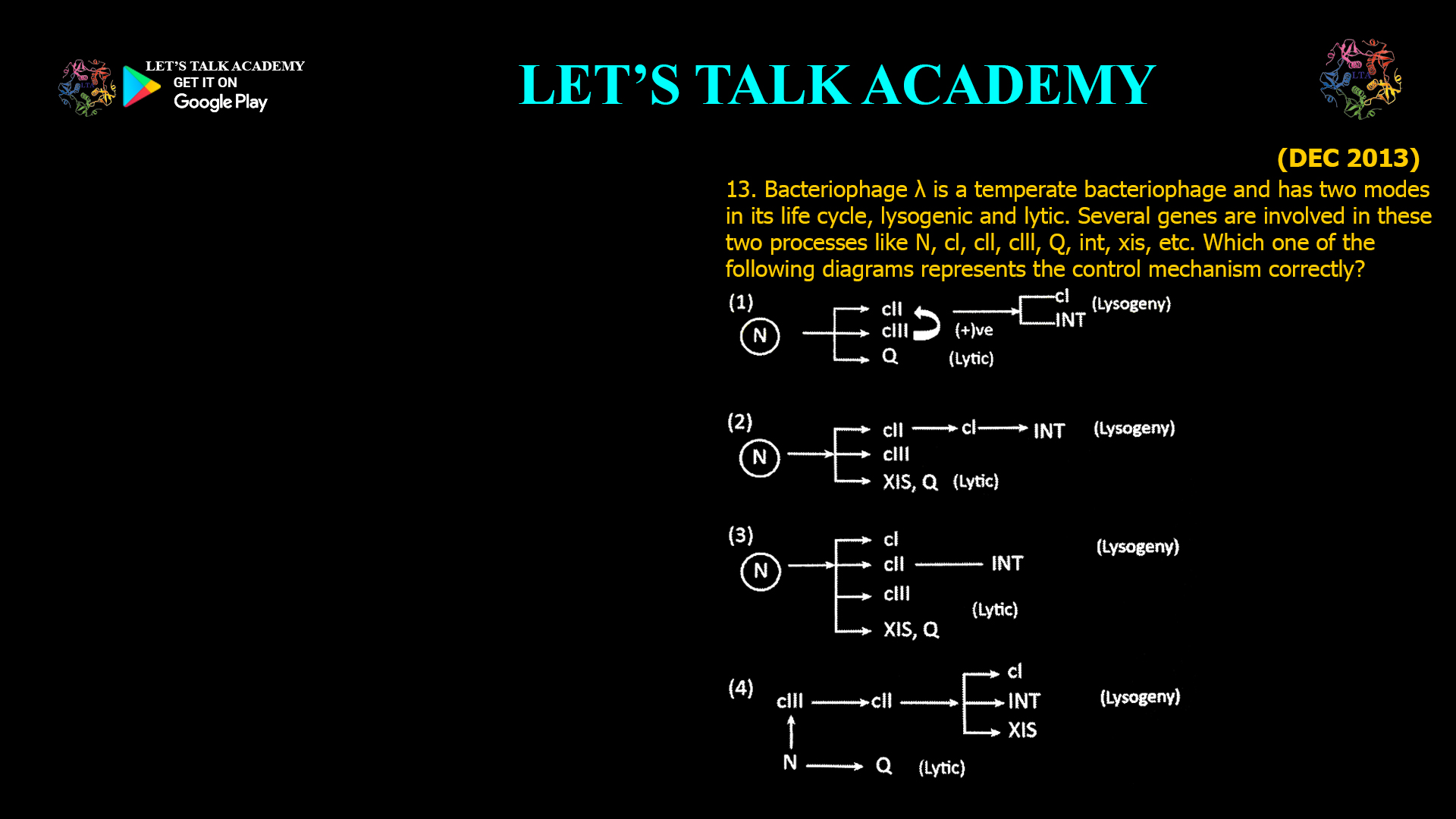
13. Bacteriophage λ is a temperate bacteriophage and has two modes in its life cycle, lysogenic and lytic. Several genes are involved in these two processes like N, cl, cll, clll, Q,int, xis, etc. Which one of the following diagrams represents the control mechanism correctly?
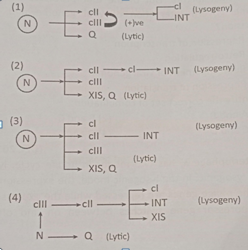
Bacteriophage lambda (λ phage) is a temperate virus that infects Escherichia coli and exhibits two distinct life cycles: the lytic cycle, where the virus replicates and lyses the host cell, and the lysogenic cycle, where the viral genome integrates into the host chromosome and remains dormant as a prophage. The decision between these two pathways is tightly regulated by a complex network of phage-encoded genes and host factors.
Overview of Lambda Phage Life Cycles
-
Lytic cycle: The phage hijacks the host machinery to replicate its DNA, produce viral proteins, assemble new virions, and ultimately lyse the host cell to release progeny.
-
Lysogenic cycle: The phage genome integrates into the host chromosome and replicates passively with the host DNA. The virus remains dormant until induced to enter the lytic cycle.
Key Regulatory Genes in Lambda Phage
Several genes coordinate the switch between lysogeny and lysis:
-
N gene: Encodes an antiterminator protein that allows RNA polymerase to read through transcriptional terminators, enabling the expression of delayed early genes.
-
cI gene: Encodes the lambda repressor (CI protein), which maintains lysogeny by repressing lytic promoters.
-
cII and cIII genes: Encode regulatory proteins that promote lysogeny by activating cI expression.
-
Q gene: Encodes an antiterminator protein that enables transcription of late lytic genes.
-
int gene: Encodes integrase, an enzyme required for integration of phage DNA into the host chromosome.
-
xis gene: Encodes excisionase, which helps excise the prophage from the host genome during induction of the lytic cycle.
The Genetic Control Mechanism
-
Immediate Early Transcription:
After infection, transcription initiates from promoters P_L and P_R, producing immediate early genes including N and cro. The N protein modifies RNA polymerase to bypass terminators, allowing transcription of delayed early genes. -
Decision Point – Lysogeny vs. Lysis:
The levels of cII and cIII proteins determine the pathway:-
High cII and cIII stabilize cII, which activates the P_RE promoter, leading to expression of cI (lambda repressor).
-
CI protein represses lytic promoters P_L and P_R, maintaining lysogeny.
-
If cII is degraded (e.g., due to host proteases), cro dominates, repressing cI expression and favoring the lytic cycle.
-
-
Lysogenic Maintenance:
CI binds to operator sites, repressing lytic promoters and activating its own transcription from P_RM, ensuring stable lysogeny. -
Lytic Gene Expression:
If lysis is favored, the Q protein acts as an antiterminator at the P_R’ promoter, allowing transcription of late genes responsible for phage assembly and host lysis. -
Integration and Excision:
-
Integrase (Int) mediates integration of phage DNA into the host genome during lysogeny.
-
Excisionase (Xis) assists in prophage excision during induction of the lytic cycle.
-
Diagrammatic Representation of Control Mechanism
A correct diagram would show:
-
Early promoters P_L and P_R driving immediate early genes including N and cro.
-
N protein enabling read-through of terminators to express delayed early genes such as cII, cIII, int, and xis.
-
cII activating P_RE promoter to express cI, which represses lytic promoters and activates its own expression.
-
Cro repressing P_RM to inhibit cI expression during lytic growth.
-
Q protein enabling late gene expression from P_R’ during lytic cycle.
-
Integration and excision functions mediated by Int and Xis proteins.
Biological Significance of This Regulation
This intricate control system allows lambda phage to:
-
Sense host cell conditions.
-
Choose between dormancy (lysogeny) and active replication (lysis).
-
Maintain stable lysogeny with minimal harm to the host.
-
Rapidly switch to lytic growth when conditions deteriorate, ensuring phage propagation.
Conclusion
The control mechanism of bacteriophage lambda’s life cycle is a sophisticated genetic switch regulated by multiple phage genes and their protein products. The interplay between N, cI, cII, cIII, Q, int, and xis orchestrates the precise timing and choice between lysogenic and lytic pathways, enabling the phage to adapt and survive in varying environmental conditions.


