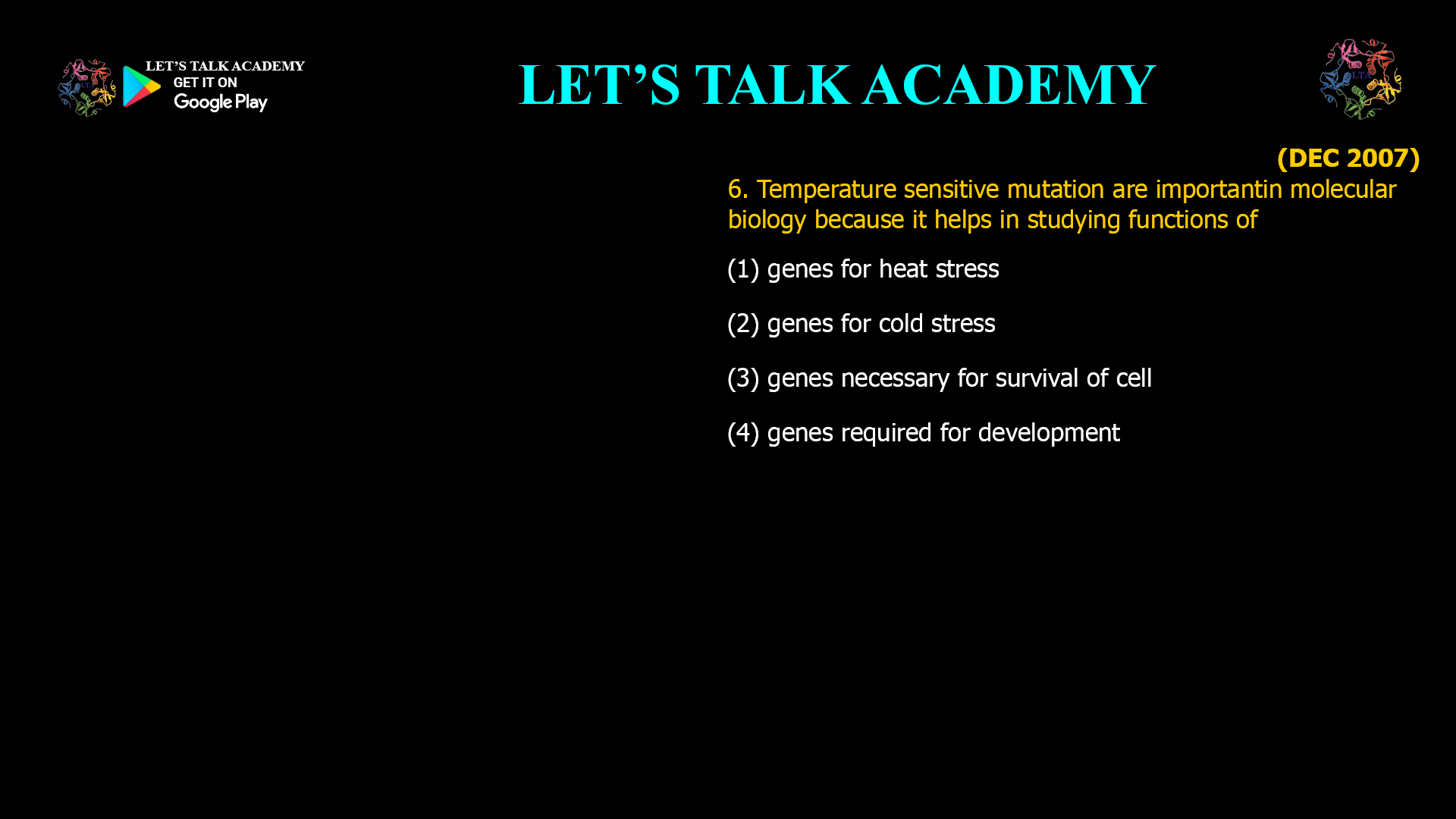
6. Temperature sensitive mutation are importantin molecular biology because it helps in studying functions of
(1) genes for heat stress
(2) genes for cold stress
(3) genes necessary for survival of cell
(4) genes required for development
Introduction
Temperature-sensitive (TS) mutations are invaluable tools in molecular biology that allow scientists to study essential genes—those necessary for cell survival—without causing immediate lethality. By enabling conditional inactivation of gene function at non-permissive temperatures, TS mutations facilitate detailed analysis of gene roles in vital cellular processes. This article explains why TS mutations are particularly important for studying genes necessary for survival of the cell.
What Are Temperature-Sensitive Mutations?
-
TS mutations produce proteins that function normally at a permissive (lower) temperature but become nonfunctional or unstable at a restrictive (higher) temperature.
-
This temperature-dependent behavior allows researchers to toggle gene function on or off by simply changing the incubation temperature.
-
TS mutations often affect protein folding or stability, causing loss of function only under stress conditions (e.g., heat).
Why Are TS Mutations Important for Studying Essential Genes?
1. Avoiding Lethality
-
Many essential genes cannot be studied by traditional loss-of-function mutations because their inactivation kills the cell.
-
TS mutations circumvent this by allowing normal gene function at permissive temperatures, enabling cell growth and viability.
-
Researchers can then shift cells to restrictive temperatures to temporarily inactivate the gene, observing immediate effects on cellular processes.
2. Temporal Control
-
TS mutants provide precise temporal control over gene activity.
-
This is critical for studying dynamic processes like DNA replication, cell division, and protein synthesis, where timing is crucial.
3. Functional Dissection
-
By observing phenotypes at restrictive temperatures, scientists can dissect the specific roles of essential proteins in various pathways.
-
TS mutations help differentiate between structural and regulatory functions of proteins.
4. Reversibility
-
Shifting back to permissive temperature can restore protein function, allowing reversible studies of gene activity and recovery.
Applications of TS Mutations
-
Studying DNA replication machinery components in yeast and bacteria.
-
Dissecting cell cycle regulators and checkpoints.
-
Investigating protein folding and stability mechanisms.
-
Modeling disease-related mutations in essential genes.
Why Other Mutation Types Are Less Suitable
| Mutation Type | Limitations for Studying Essential Genes |
|---|---|
| Gain of Function | May cause non-physiological effects, lacks conditionality |
| Loss of Function | Often lethal if gene is essential, no temporal control |
| Suppressor Mutation | Indirect, depends on secondary mutations |
| Conditional Mutation (TS) | Allows controlled, reversible inactivation of essential genes |
Summary Table
| Feature | Temperature-Sensitive Mutation |
|---|---|
| Gene Function at Permissive | Normal |
| Gene Function at Restrictive | Impaired or lost |
| Study of Essential Genes | Enabled via conditional inactivation |
| Temporal Control | Yes |
| Reversibility | Yes |
Conclusion
Temperature-sensitive mutations are uniquely suited for studying genes necessary for the survival of the cell because they allow controlled, reversible inactivation of essential gene functions. This conditional approach enables detailed functional analysis without causing immediate lethality, making TS mutations indispensable in molecular biology research.
Answer:
Temperature-sensitive mutations are important because they help in studying (3) genes necessary for survival of cell.


31 Comments
Manisha choudhary
July 25, 2025🔥🔥🔥🔥gazab kaa explanation
Diksha chhipa
July 29, 2025Temp sense mutation are suitable for study of gene necessary for the survival of the cell because they allow controlled manner.and reversible inactivation of important gene functions
Mansukh Kapoor
July 29, 2025Yes answer is 3(The genes which are important to survival of cells)
Ravindra Pindel
July 29, 2025Sir very good explanation
Anurag giri
July 29, 2025Ans 3 Temperature-sensitive mutations are valuable tools in molecular biology because they allow conditional inactivation of essential genes, enabling the study of genes necessary for cell survival
Vijay Marmat
August 2, 2025Done ✔️ 3
Vanshika Sharma
July 29, 2025Correct answer is 3 , Temperature sensitive mutation are important bcz they help in study of of genes important for survival ofcells
Surbhi Rajawat
July 29, 2025TS mutations helps to study the role of genes necessary for survival because they can’t be effectively studies by any other method or mutation
Priti Khandal
July 29, 2025Nice explanation sir 🙏🙏🙏
Priya Khandal
July 29, 2025Answer is 3 right best explanation sir
Monika jangid
July 29, 2025Temp. Sensitive mutation is imp in mol bio genes are necessary for survival of cell bcoz without gene cell cannot survive
Sneha Kumawat
July 30, 2025Gene necessary for survival of cell
Aafreen
July 30, 2025Ans:- 3 Temperature sensitive mutation are important because they allow researchers to study the functions of genes that are essential for cell survival
Niti tanwar
July 30, 2025Option c is right answer
Aman Choudhary
July 30, 2025Option 3 gene necessary for survival of cell
Anisha jakhar
July 31, 2025Option 3 is the right answer as Temperature-sensitive mutations are important because they help in studying genes necessary for survival.
Khushi Mehra
July 31, 2025Answer is 3 …. temperature sensitive mutation is important because it help to study the functions of genes necessary for survival of cell by providing restrictive temperature (high temperature) the enzymes are non functional but at permissive temperature (low or room temperature) the enzymes are functional
Shivani
July 31, 2025Genes necessary for survival of cell 👍
Dipti Sharma
July 31, 2025correct answer 3
Temperature sensitive mutation allows us to study the genes necessary for survival.
Mahima Sharma
August 2, 2025Option 3
Vijay Marmat
August 2, 2025Done ✔️
Soniya Shekhawat
August 3, 2025TS allow to study gene necessary survival of cell.
Varsha tatla
August 3, 2025Tamp. Sensitive mutation responsible for survival it is crucial role play in replication
Anita Choudhary
August 28, 2025Answer 3 is correct answer as temperature sensitive mutation because it help to study the function of genes necessary for survival of cell.
Alec
August 30, 2025They help in studying genes necessary for survival of cell.
Swati Choudhary
October 3, 2025Genes necessary for survival of the cell is the correct answer.
Komal Sharma
October 23, 2025Temperature-sensitive mutations are uniquely suited for studying genes necessary for the survival of the cell because they allow controlled, reversible inactivation of essential gene functions. This conditional approach enables detailed functional analysis without causing immediate lethality, making TS mutations indispensable in molecular biology research.
Deepika Sheoran
November 6, 2025Temperature sensitive mutations are valuable tools in molecular biology.because they allow conditional.
Inactivation of essential genes enabling the study of genes necessary for cell survival.
Meenakshi Choudhary
November 10, 2025Genes necessary for survival of cell.
Swati Choudhary
December 13, 2025Genes necessary for survival of cells.
Kirti Agarwal
February 18, 2026Genes necessary for survival of cell