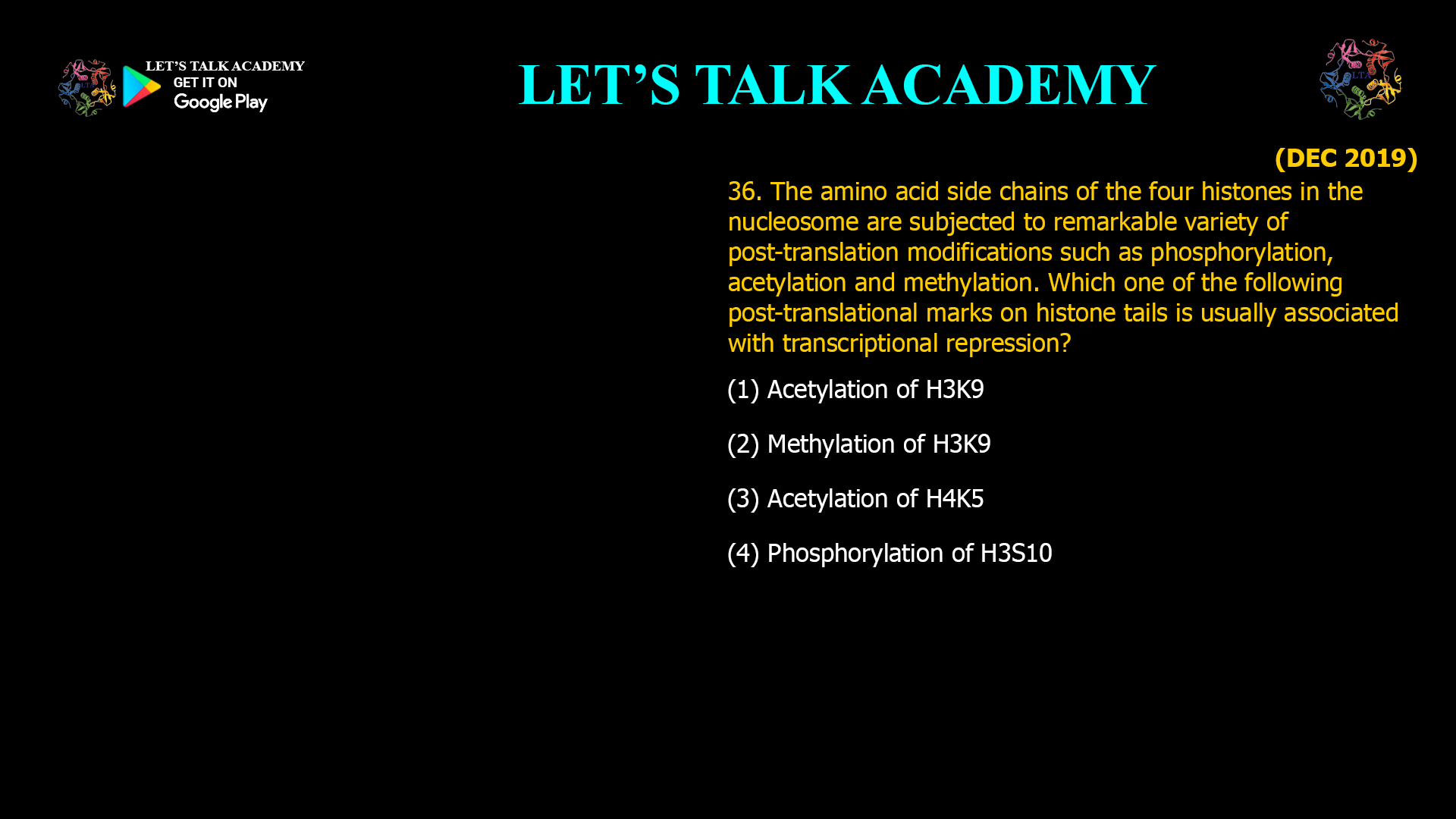
36. The amino acid side chains of the four histones in the nucleosome are subjected to remarkable variety of post-translation modifications such as phosphorylation, acetylation and methylation. Which one of the following post-translational marks on histone tails is usually associated with transcriptional repression?
(1) Acetylation of H3K9
(2) Methylation of H3K9
(3) Acetylation of H4K5
(4) Phosphorylation of H3S10
Introduction
Post-translational modifications (PTMs) of histone proteins play vital roles in regulating chromatin structure and gene expression. Among these modifications, methylation and acetylation of specific lysine residues on histone tails are critical determinants of whether a gene is actively transcribed or silenced. This article focuses on the methylation of histone H3 at lysine 9 (H3K9), a hallmark of transcriptionally repressive chromatin, and contrasts it with other histone marks associated with gene activation.
Histone Modifications and Their Functional Consequences
Histone tails protruding from nucleosomes are subject to diverse PTMs, including acetylation, methylation, phosphorylation, and ubiquitination. These modifications influence chromatin accessibility by altering histone-DNA interactions or by recruiting regulatory proteins that modulate transcription.
-
Acetylation generally neutralizes the positive charge on lysine residues, loosening chromatin and facilitating transcription.
-
Methylation can signal either activation or repression depending on the residue and methylation state (mono-, di-, or tri-methylation).
Methylation of H3K9 and Transcriptional Repression
Methylation of lysine 9 on histone H3 (H3K9me) is widely recognized as a repressive epigenetic mark. This modification is catalyzed by histone methyltransferases such as SUV39H1 and G9a and is enriched in heterochromatin regions.
Mechanisms of Repression by H3K9 Methylation
-
Recruitment of HP1: H3K9me serves as a binding site for heterochromatin protein 1 (HP1), which promotes chromatin compaction and gene silencing.
-
Chromatin Condensation: The presence of H3K9 methylation leads to a more condensed chromatin state, restricting access of transcription factors and RNA polymerase II.
-
Stable Gene Silencing: H3K9 methylation contributes to the maintenance of long-term transcriptional repression, crucial for processes like X-chromosome inactivation and genomic imprinting.
Comparison with Other Histone Marks
-
Acetylation of H3K9 and H4K5: These marks are generally associated with transcriptional activation by opening chromatin structure.
-
Phosphorylation of H3S10: Typically linked to chromatin relaxation and gene activation, especially during mitosis and immediate early gene expression.
Thus, among the options:
-
Acetylation of H3K9 (Option 1) and acetylation of H4K5 (Option 3) are associated with active transcription.
-
Phosphorylation of H3S10 (Option 4) is also linked to activation rather than repression.
-
Methylation of H3K9 (Option 2) is the mark most consistently associated with transcriptional repression.
Biological Significance of H3K9 Methylation
-
Gene Silencing: H3K9 methylation is crucial for silencing repetitive elements and maintaining genome stability.
-
Developmental Regulation: It plays a role in lineage commitment by repressing genes inappropriate for a given cell type.
-
Disease Implications: Aberrant H3K9 methylation patterns are implicated in cancer and other diseases involving epigenetic dysregulation.
Conclusion
Among common histone tail modifications, methylation of histone H3 at lysine 9 (H3K9me) stands out as a key epigenetic mark associated with transcriptional repression. It facilitates heterochromatin formation and stable gene silencing by recruiting chromatin-binding proteins and promoting chromatin compaction. Understanding this modification provides insight into the complex regulation of gene expression and the epigenetic mechanisms underlying cellular identity and disease.
Answer:
The post-translational modification usually associated with transcriptional repression is (2) Methylation of H3K9.


