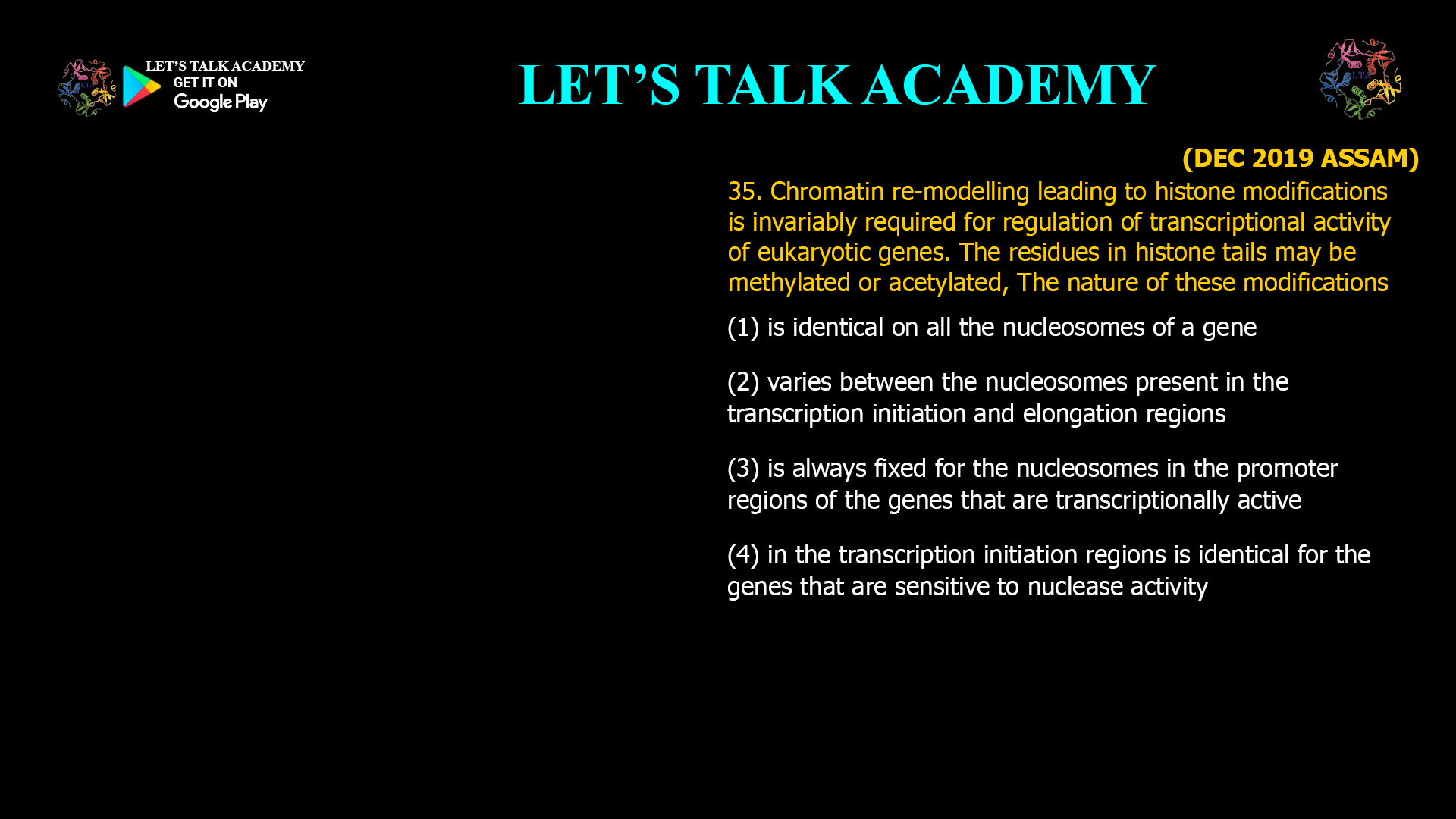
35. Chromatin re-modelling leading to histone modifications is invariably required for regulation of transcriptional activity of eukaryotic genes. The residues in histone tails may be methylated or acetylated, The nature of these modifications
(1) is identical on all the nucleosomes of a gene
(2) varies between the nucleosomes present in the transcription initiation and elongation regions
(3) is always fixed for the nucleosomes in the promoter regions of the genes that are transcriptionally active
(4) in the transcription initiation regions is identical for the genes that are sensitive to nuclease activity
Introduction
Chromatin remodeling and histone modifications are central to the regulation of gene expression in eukaryotic cells. Histone tails undergo various post-translational modifications, such as methylation and acetylation, which influence chromatin structure and transcriptional activity. Importantly, these modifications are not uniform across all nucleosomes of a gene but vary dynamically, especially between regions involved in transcription initiation and elongation. This article explores the nature of histone modifications across nucleosomes and their role in fine-tuning transcription.
Histone Modifications and Their Role in Transcription
Histones, particularly their N-terminal tails, are subject to a variety of chemical modifications that serve as signals for the recruitment of transcription factors, chromatin remodelers, and other regulatory proteins. The two most studied modifications are:
-
Acetylation: Typically associated with transcriptional activation, acetylation neutralizes the positive charge on lysine residues, reducing histone-DNA affinity and loosening chromatin structure.
-
Methylation: Can be associated with either activation or repression depending on the specific lysine residue and the degree of methylation (mono-, di-, or tri-methylation).
These modifications collectively form a “histone code” that determines chromatin accessibility and gene expression outcomes.
Variation of Histone Modifications Across Nucleosomes
Differences Between Transcription Initiation and Elongation Regions
Studies have shown that histone modifications are not identical across all nucleosomes within a gene. Instead, distinct patterns emerge:
-
Promoter and Transcription Initiation Regions: These nucleosomes often exhibit high levels of histone acetylation (e.g., H3K9ac, H3K14ac) and specific methylation marks (e.g., H3K4me3) that facilitate the recruitment of the transcriptional machinery and chromatin remodeling complexes.
-
Transcription Elongation Regions: Nucleosomes in these regions tend to have different methylation patterns, such as H3K36me3, which are associated with elongation and suppression of cryptic transcription initiation within gene bodies.
This spatial variation in histone modifications reflects the dynamic nature of chromatin during the transcription cycle.
Implications for Gene Regulation
The differential histone modification patterns allow cells to:
-
Precisely regulate the initiation of transcription.
-
Maintain chromatin integrity during elongation.
-
Prevent inappropriate transcription initiation within coding regions.
Why Other Options Are Incorrect
-
(1) Identical modifications on all nucleosomes:
This is incorrect because histone modifications vary spatially along genes to regulate different transcriptional stages. -
(3) Fixed modifications at promoters of active genes:
Histone modifications are dynamic and can change in response to cellular signals; they are not permanently fixed. -
(4) Identical modifications in initiation regions of nuclease-sensitive genes:
Sensitivity to nucleases reflects chromatin accessibility but does not imply uniform histone modifications across all such genes.
Conclusion
Histone modifications vary between nucleosomes located in transcription initiation and elongation regions, reflecting their distinct roles in regulating gene expression. This dynamic and region-specific pattern of methylation and acetylation is crucial for the proper control of transcriptional activity in eukaryotic cells.
Answer:
The correct statement is (2) varies between the nucleosomes present in the transcription initiation and elongation regions.


